

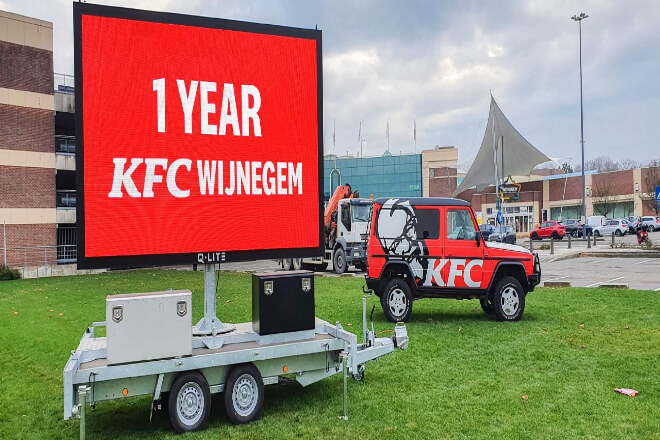
Mobile truck LED displays used in outdoor commercial promotion activities are essentially “mobile players with their own stage.”
Their biggest advantage isn’t just displaying content, but taking the brand “with them.”
Wherever there’s foot traffic, they bring exposure, transforming communication from fixed to mobile.
These devices are particularly impactful during shopping mall parades or brand roadshows.
Moving and playing dynamic visuals, they act like walking advertisements, attracting passersby’s attention more easily than traditional fixed screens.
Especially in information-intensive commercial environments, dynamic large screens are better at breaking visual fatigue, transforming the brand from “background information” into “focus content.”
For new product launches or promotional events, it’s equally effective. Product highlights, event information.
And visual creativity can all be dynamically presented on a large screen, making the content more intuitive and impactful.
Compared to traditional posters or display stands, this format is easier to remember and more likely to attract attention and interaction.
More importantly, it’s flexible. Mobile trucks can be adjusted according to different time periods, pedestrian flow, and regional characteristics.
For example, they can patrol core business districts during the day and move to night markets or event areas at night, essentially covering multiple scenarios with one set of equipment, making promotion more efficient and targeted.
Simultaneously, it can be combined with on-site events, such as music, interactive hosting, or brief stopover displays, turning “mobile display” into “mobile event,” further amplifying the communication effect.
Simply put, a mobile truck LED display is not just “an extra screen,” but an extra, more proactive way of communication.
It can proactively find its target audience, generate attention, and extend exposure, upgrading brand promotion from static display to dynamic reach—more flexible and more memorable.
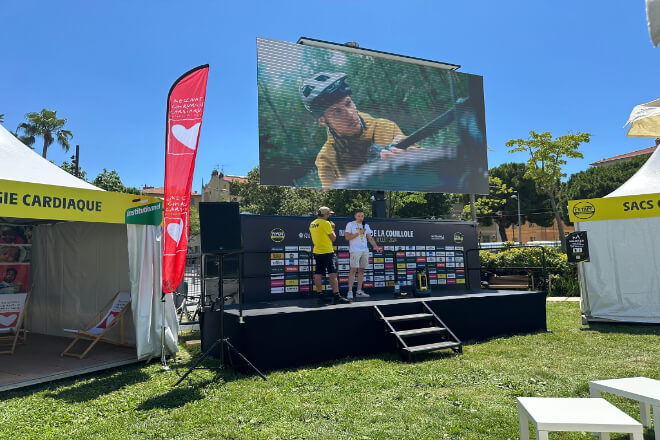
Mobile truck LED displays, used in outdoor sporting events, are essentially “mobile athletes bringing large screens to the venue.”
Their value lies not just in adding another screen, but in allowing event information and viewing experiences to move flexibly with the scene.
At the event, the real-time display of match footage and scores is the most basic and crucial function.
Whether it’s a goal, a key replay, or timers and score updates, everything can be presented synchronously on the large screen, ensuring viewers don’t miss a single exciting detail.
For spectators at a distance, this mobile screen acts as a “temporary viewing center.” Especially in open venues or where spectators are widely dispersed.
It can compensate for limited visibility, allowing viewers standing at a distance or to the side to easily keep up with the pace of the game.
Furthermore, it significantly enhances the event atmosphere. Dynamic visuals, highlight replays.
And interactive content amplify the emotional impact, allowing viewers to not just “watch the game,” but “participate in the atmosphere.”
Most importantly, it offers flexibility. For temporary events, touring competitions, or events held in different cities, mobile truck LED displays don’t require fixed installation.
They can be used immediately upon arrival and then moved away, making them ideal for such highly unpredictable scenarios.
Simply put, a mobile truck LED display acts like a “moving viewing window”—it appears wherever a better viewing experience is needed, making the event clearer, more exciting, and more engaging.
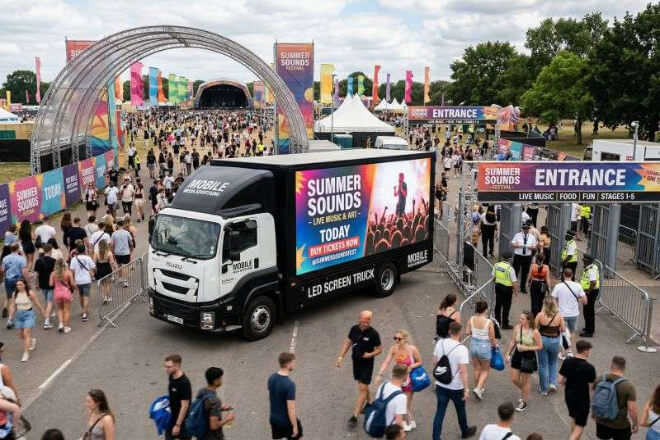
For outdoor performances and music events, a mobile truck LED display can be considered a “mobile add-on that takes the stage visuals with it.”
Its role is not just to supplement the visuals, but to amplify the entire performance experience.
At concerts or music festivals, the core value of a large screen is to complement the stage visuals.
Whether it’s close-ups of singers, details of band performances, or interactive shots, everything can be magnified in real time.
This allows audiences at a distance to clearly see every expression and movement, preventing them from “hearing but not seeing” due to distance.
Live stage playback is especially important. Music festivals typically have open venues and widely distributed audiences.
Without a large screen, those in the back rows may only experience the atmosphere, not the details.
A mobile LED screen acts like a “visual window that fills in wherever needed,” appearing wherever the view is insufficient.
At the same time, its enhancement of the overall visual effect is also very significant.
Dynamic visuals, rhythmic transitions, and lighting effects can all be enhanced through the screen, transforming music from just an auditory experience into a more complete audiovisual fusion.
More importantly, it enhances audience immersion. The screen extends the stage content to a wider area.
Making it easier for the audience to engage with the live rhythm, feeling the same atmosphere and emotions regardless of whether they are in the front or back rows.
Simply put, a mobile truck LED display in outdoor performances acts like a “moving second stage.”
It appears wherever the excitement needs to be amplified, ensuring the music is not only heard but also seen and felt.
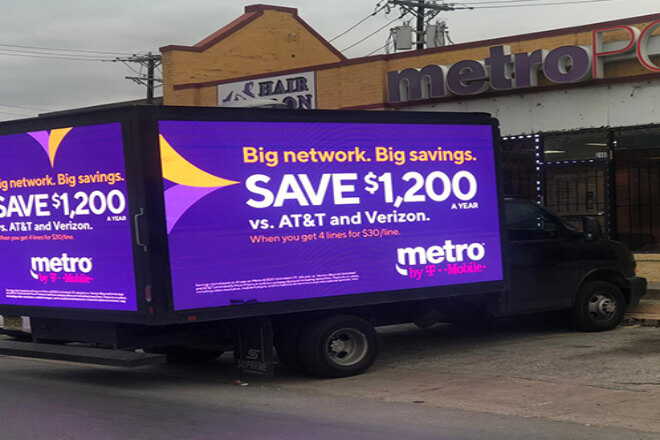
Mobile truck LED displays used for outdoor public awareness campaigns can be considered “patrolling information broadcasters.”
They no longer wait for people to see them but proactively deliver information to the crowd.
This format is particularly advantageous in policy promotion or public welfare activities. Compared to static posters.
Large-screen dynamic content attracts attention more easily, like someone gently reminding you, “This is important, please take a look.”
Information is not only easier to see but also easier to understand and remember.
In community event information dissemination, it acts like a “mobile notification assistant.” Today it circles this community, tomorrow it appears in another block.
Bringing event announcements and service information to different groups of people, no longer limited to fixed bulletin boards where “someone passing by will see it.”
Even more interesting is its ability to “choose its work hours.” For example, it can go to high-traffic commuter areas during the morning rush hour, and then move to communities or squares in the evening.
Allowing the same information to reach different groups of people at different times—essentially, one screen doing multiple jobs.
At the same time, its coverage is more flexible. Compared to fixed locations, this mobile display is more like a “mobile information window.”
Appearing wherever there are crowds and where there is a need, making information dissemination more balanced and impactful.
Simply put, a mobile truck LED display in public communication is like a tireless “information deliveryman”—it doesn’t wait for you to pick it up.
But proactively delivers important content to your eyes, and even makes you take a second look.
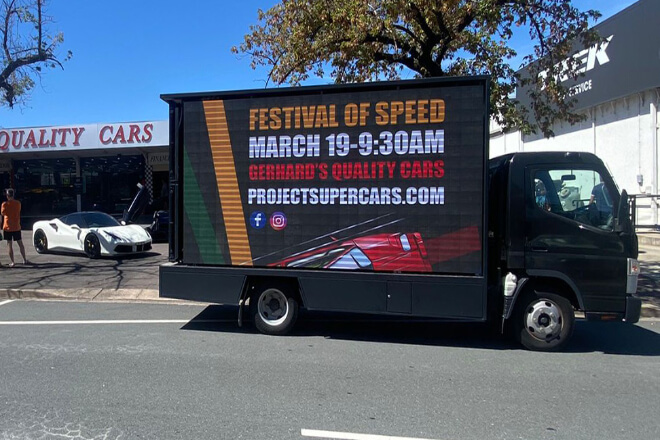
In festivals and city events, mobile LED truck displays are incredibly useful and fun. Here are a few typical examples:
During Spring Festival or New Year celebrations, LED trucks can parade along main city streets, displaying New Year’s greetings, fireworks animations, or city image videos.
As the trucks move, they bring the festive atmosphere to different neighborhoods, acting like a “moving festive vehicle,” allowing even those not at the main venue to experience the holiday spirit.
Another example is during music festivals or city cultural festivals, where the area around the main stage may be crowded, but the experience for those in the surrounding areas is weaker.
In this case, mobile LED trucks can be parked on the periphery or in areas with less foot traffic.
Displaying real-time stage footage, allowing even those on the fringes to see the performance clearly, essentially “splitting” the main stage into more locations.
Furthermore, in city parades, such as float parades or light parades, LED trucks can serve as “themed floats.”
Displaying dynamic visual content, brand images, or interactive animations. Compared to traditional decorations, they are more flexible and easier to become photo spots.
In some nighttime light festivals, LED trucks can even coordinate with light shows, playing rhythmic visuals or themed content, changing as they move, turning the entire route into a “flowing light exhibition.”
Simply put, mobile truck LED displays in festivals are not just “an extra screen,” but become a moving content carrier—adding a highlight wherever they go, and increasing engagement.


 English
  Español
  简体中文
简体中文  Français
  日本語
日本語  한국어
한국어  العربية