

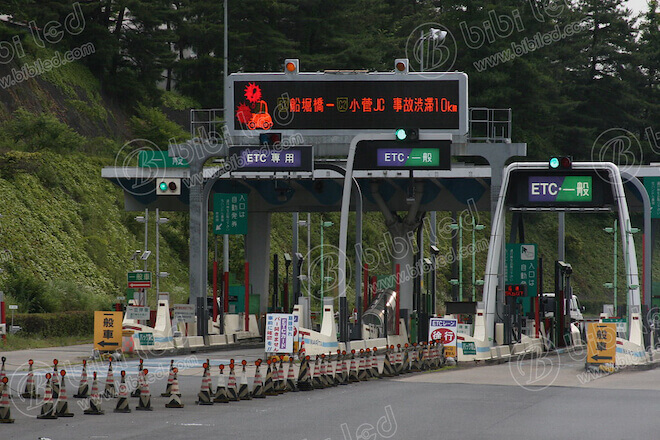
The most important thing in traffic scenarios is that information must be fast and easily understood.
The value of LED displays lies in their ability to directly transform complex and rapidly changing traffic information into real-time visual content.
Firstly, road conditions, congestion, and accident information can be released instantly.
Where there is traffic congestion, which roads are temporarily closed, and whether there are accidents ahead—this information can be displayed immediately, allowing people to make informed decisions.
For example, if a driver is about to enter an elevated highway and the LED screen ahead already indicates “congestion 2 kilometers ahead, detour recommended.”
Many people can change their route in advance, instead of finding themselves stuck in the traffic jam.
Secondly, it allows drivers and pedestrians to quickly obtain key information. Traffic information often doesn’t require extensive reading; a quick glance is sufficient.
LED screens offer high brightness and clear text, making them easily readable even from a distance and in complex environments.
For example, if construction changes occur at an intersection, pedestrians will see “temporary detour direction,” and drivers will see “reduced lanes ahead.”
The information is delivered without needing to stop and ask for directions.
More importantly, it improves overall traffic efficiency. With transparent information, people are more proactive, reducing unnecessary lane changes, sudden braking, or repeated U-turns.
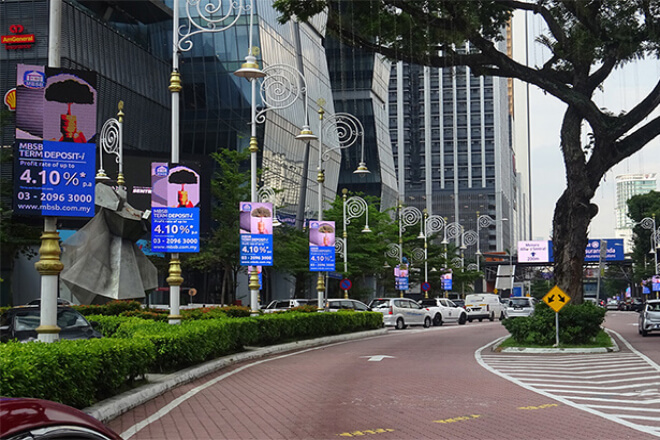
On public transportation, the most important thing is simple: when will the bus arrive?
Unclear information leads to passenger anxiety and potential chaos. LED displays provide this real-time information directly.
Firstly, subway and bus arrival information can be updated in real time. Information such as arrival times, the location of the next bus, and delays can also be displayed simultaneously, eliminating the need for passengers to guess.
For example, during the morning rush hour, many people look up at the LED screen first – “Arriving in 2 minutes” – and immediately feel reassured. If it displays “Train delayed,” people can adjust their routes in advance.
Secondly, it reduces uncertainty during the waiting process. Often, what’s truly frustrating isn’t “waiting 5 minutes,” but “not knowing how much longer the wait will be.”
For example, at bus stops, if there’s no information, people frequently look into the distance to see the bus.
But if the LED screen displays “Next train in 3 stops,” the wait becomes more predictable and less anxious.
More importantly, it optimizes the overall travel experience. Passengers receive information faster, transfers are smoother, and the scene is more orderly.
For example, in large transfer stations, LED screens simultaneously display the arrival status of each line, allowing people to decide in advance whether to transfer or speed up, making the entire flow smoother.
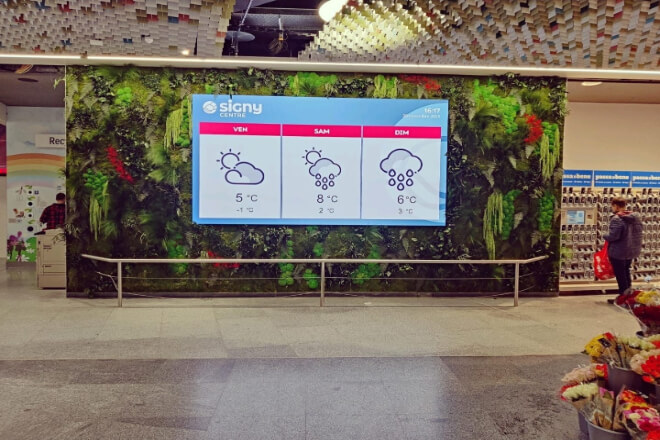
Many traffic accidents aren’t because people “don’t know how to drive,” but because danger comes too suddenly, leaving insufficient reaction time.
A crucial role of LED displays in traffic scenarios is to “inform” people of potential risks in advance.
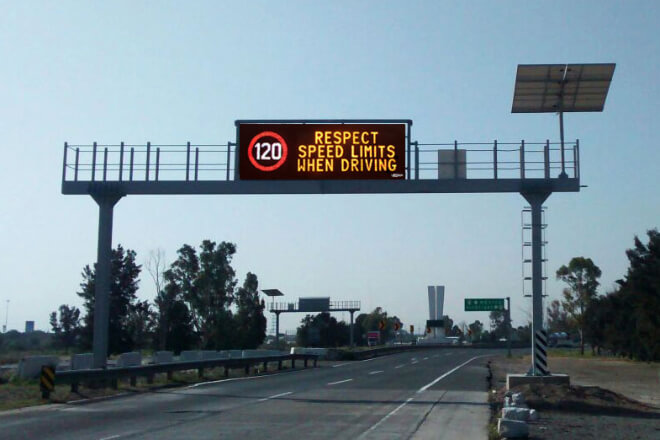
First, it provides real-time alerts on weather, construction, and speed limits. Whether there’s heavy fog ahead, road construction, or the need to slow down can all be displayed on LED screens immediately.
For example, if fog suddenly forms on a highway, the LED screen ahead will immediately display “Low visibility, please slow down.”
Drivers will see this and naturally slow down, rather than realizing they can’t see the road until they’re almost there.
Second, it allows for early intervention to address potential risks. Knowing about many dangers hundreds of meters in advance makes a world of difference in how you handle them.
For instance, if there’s no warning about road construction ahead, drivers might brake suddenly or swerve at the last minute.
However, if the LED screen displays “Right lane closed ahead,” drivers will begin slowing down and changing lanes much earlier, resulting in a much more stable situation.
More importantly, it reduces the probability of traffic accidents. Because often, safety isn’t about “after-the-fact handling,” but about “early warnings.”
For example, slippery bridge surfaces in rainy weather, the risk of rockfalls on mountain roads.
And accident-prone sections at night can all be continuously alerted to drivers through LED screens, keeping everyone constantly vigilant.
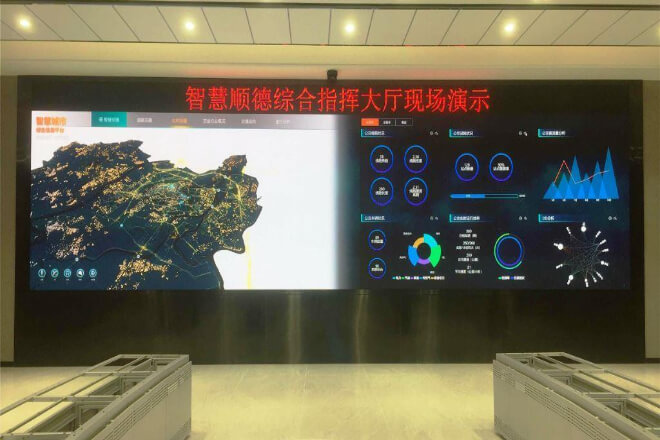
Many cities’ traffic management is no longer simply about “human intervention at intersections,” but increasingly relies on data-driven and intelligent management.
LED displays here act as a “brain window” for urban traffic.
Firstly, data from the command center can be displayed in real-time on the large screen. Road traffic flow, intersection status, accident information.
And subway and bus operation data can all be centrally displayed on the LED screen, allowing managers to see overall changes immediately.
For example, during the morning rush hour, if traffic on a main road suddenly turns red, the command center’s screen will immediately display the congestion situation.
Staff don’t need to wait for on-site reports; they already know where the congestion has started.
Secondly, it supports traffic flow analysis and real-time control. LED screens not only “display information,” but more importantly, they make complex data intuitive.
For example, which intersection has long queues, or which bus routes experience a surge in passenger flow, can be seen at a glance on the screen.
The backend can then quickly adjust traffic light durations, diversion routes, or bus schedules.
Most importantly, it improves the overall efficiency of urban traffic management. Previously, much information was scattered.
Now, through LED display visualization, managers can make faster judgments and coordinate more effectively.
For example, after a large event, when pedestrian and vehicular traffic suddenly concentrates, the command center can observe traffic changes in real time on the large screen and then adjust surrounding road guidance plans accordingly.
One of the worst things for urban traffic is that information is everywhere, but inconsistent. One system says it’s passable, while another shows road closures.
One system updates, but another hasn’t. The important role of LED displays is to “unify” this scattered information.
Firstly, information from multiple road sections and systems can be centrally output. Data from road monitoring, public transportation systems, subway systems, weather warnings.
And construction notices—originally from different platforms—can all be synchronized to LED displays.
For example, if heavy rain causes flooding on some roads, traffic system updates, bus route adjustments.
And detour notices can be simultaneously updated on LED screens across different road sections, instead of each location issuing its own separate notices.
Secondly, it avoids information fragmentation and delays. If information is not synchronized, drivers and passengers will easily become confused, and it can even disrupt on-site orders.
For example, if navigation indicates clear roads, but an LED screen displays a temporary road closure, people might be unsure which information to believe.
With unified information dissemination, road information becomes more consistent, leading to clearer judgments.
More importantly, it can build a complete urban traffic information network. It’s not a single screen working, but rather multiple road segments and traffic nodes working in tandem.
For example, from highway entrances to main urban roads and subway transfer stations.
LED screens continuously synchronize the same set of traffic information, providing drivers and pedestrians with consistent guidance throughout the journey.


 English
  Español
  简体中文
简体中文  Français
  日本語
日本語  한국어
한국어  العربية