
AI has been a hot topic for the past two years, with almost every industry wanting to “touch” it. LED displays are no exception.
But rather than simply labelling products with “AI,” I’m more curious about what new business opportunities LED displays can bring when content can be updated faster, and screens can adapt to different scenarios.
This is perhaps more worthy of discussion than simply saying “screens are smarter.”
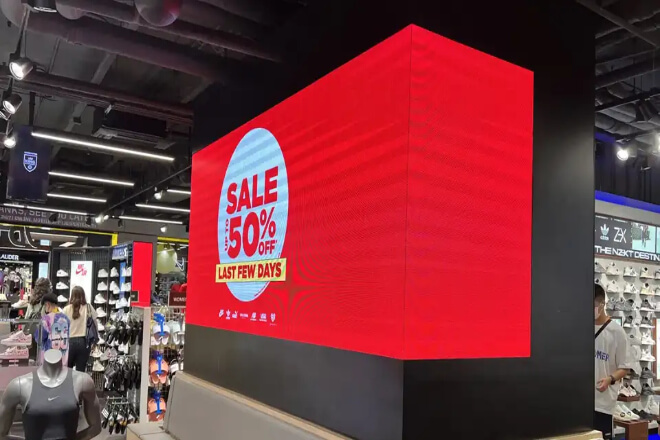
Previously, advertising screens were somewhat “laid-back”—content was placed on the screen and then played on a loop all day. Whether passersby actually bought anything was largely irrelevant.
But smart retail is making LED displays more “informed about the scene.”
For example, at 8 AM, LED screens near office buildings might promote coffee and breakfast; at noon, they might display restaurant (set meals); and in the evening, as foot traffic increases in the mall.
The screens immediately switch to displaying new products, discounts, and limited-time offers. The same LED screen can switch between several “sales identities” throughout the day.
Even more interestingly, combined with AI analysis, businesses can also identify which content is more likely to attract customer attention.
For example, if customers are more likely to stop and look at an advertisement for a new shoe, play it more often.
If people just walk past a promotional video, quickly change the content. Don’t let the LED screen “work hard” in vain.
It’s also convenient for last-minute promotions. Decide on a limited-time discount in the afternoon?
The content is updated in the backend, and the store’s LED display screen can be updated quickly, without waiting for posters to be printed or for staff to stick them up with tape.
Therefore, LED displays in future retail may not just be “playing advertisements.”
They’re more like a digital salesperson who doesn’t say “Welcome,” but knows when to promote coffee and when to promote new products.
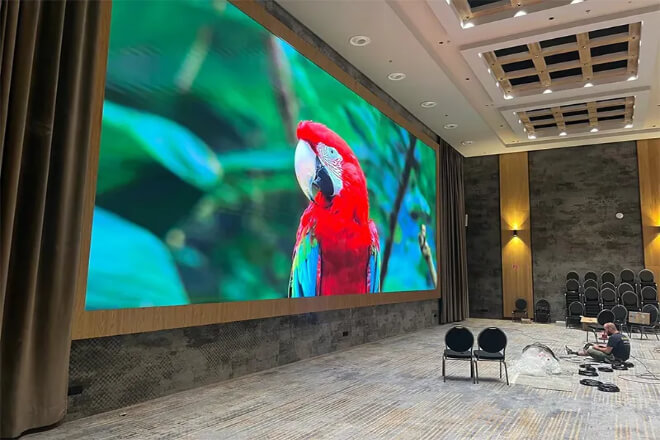
Previously, when entering a bank, hotel, or corporate showroom, the most common question was: “Where is the staff?”
But with the combination of AI digital humans and LED displays, the screen itself can “greet” you first.
For example, in a bank lobby, a digital human on a large LED screen can explain the business process.
If a customer wants to learn about account opening, loan, or credit card services, the digital human will first provide a basic explanation and then guide them to the corresponding window.
Simple questions no longer require waiting in long lines.
Hotels are also well-suited to this model. Arriving at 11 PM, the digital human can display information such as breakfast times, gym location, and nearby transportation on the LED screen.
It won’t be less talkative due to fatigue from a night shift.
It’s even more interesting in corporate showrooms. Previously, promotional videos played on a loop; now, the digital human can stand on a large LED screen and “explain the product.”
As customers move to different display areas, the screen switches to the corresponding product introduction, making the visit feel more like being guided, rather than staring at specifications.
Of course, it’s not meant to completely replace human service. Its more practical value lies in handling repetitive, daily questions, freeing up staff time for more complex inquiries.
Therefore, the new opportunities brought by AI + LED displays may not just be “smarter screens.”
It’s about enabling an LED screen that previously only displayed content to take on the roles of reception, explanation, and basic consultation.
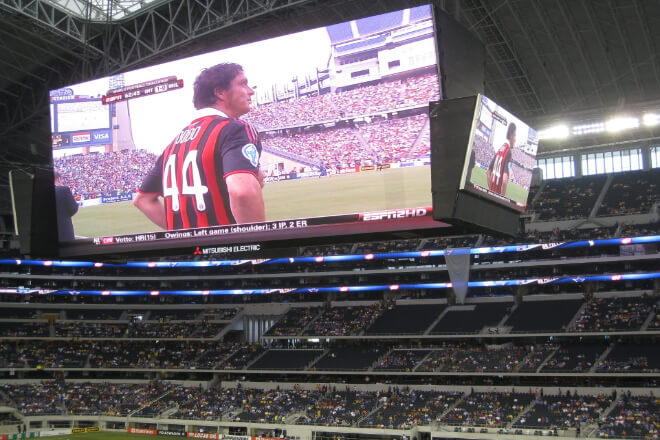
Sports competitions and concerts share an interesting commonality: the more unpredictable the event, the more potential LED screens have.
For example, in a football match, as soon as a goal is scored, AI can quickly gather information such as the goal scorer, number of shots, and movement data.
The LED screen immediately switches to close-ups of the player, goal animations, and statistical displays.
While the audience is still chanting “Goal,” the screen is already “recaping” what just happened.
Basketball games are even more intuitive. If a player suddenly performs a spectacular dunk, the on-site system quickly locates the shot, and the LED screen immediately replays it in slow motion.
If a player casually makes an exaggerated celebration, it might appear in the interactive footage a few minutes later.
The same applies to concerts. For instance, if a singer is singing a chorus and the entire audience suddenly starts singing along.
The on-site team can adjust the LED screen content in real time, combining audience close-ups, lyric animations, and stage visuals.
What was originally just a song performance can become the most memorable and widely shared moment of the night due to the audience’s reaction.
For example, if it suddenly rains at a music festival, the LED screen can quickly adjust its content.
Simultaneously playing a rainy night visual presentation to match the stage while displaying on-site services or safety notices.
The screen doesn’t need to be stuck on the program schedule.
Therefore, the truly interesting aspect of AI+LED displays is that, previously, large screens displayed pre-prepared content.
Future large screens may instantly generate the next display based on what’s happening on-site.
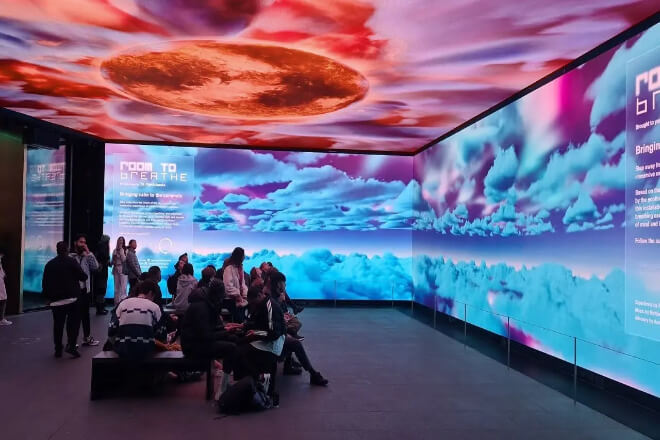
Previously, when visiting scenic spots, people were mostly willing to pay extra for performances, cable cars, or boat rides.
Now, some digital experience projects are also starting to enter tourists’ spending lists.
For example, creating an immersive LED display forest. As tourists enter, the images on the walls and floor change with their movements.
Walking to the “lake,” schools of fish slowly approach; waving a hand, fireflies move with them. Children might not want to leave, while younger tourists are busy filming.
With the addition of AI, the content on the LED screen doesn’t have to be the same for everyone.
In historical and cultural exhibition halls, visitors can choose different characters from various stories, and the large screen will transport them to different scenes.
Some will see a bustling ancient market, while others will be transported to a local festival.
A ten-minute visit might turn into an extra half hour as visitors try a different storyline.
Nighttime exhibits also offer considerable flexibility. After completing interactive tasks, visitors receive a personalised visual experience from the LED display installations.
Sometimes even incorporating their names into the visual content. Taking photos and posting short videos becomes effortless.
More practically, these LED digital scenes offer far more flexibility in content changes than building entirely new physical projects.
A New Year theme can be introduced during the Spring Festival, family-friendly activities during summer vacation, and a completely different visual experience for Halloween.
For cultural tourism projects, the real change brought by AI+LED display might be the addition of an activity that visitors are willing to stop and experience, or even purchase a separate ticket for.
The traditional business model of the LED display industry is easy to understand: customers buy screens, manufacturers deliver and install them, and the project is essentially complete.
However, the problem is also obvious—an LED screen might be used for many years, but when will the next screen be sold? Nobody can say for sure.
The emergence of AI has actually created more business opportunities “after the screen is sold.”
For example, a chain store might have installed dozens of LED displays.
Previously, each promotion required a design company to create designs, stores to confirm, and staff to update each screen individually.
During Christmas, Black Friday, or new product launches, just changing the content was enough to keep them busy for a while.
Now, thanks to AI, promotional posters, simple animations, and even different versions of content for different stores can be produced much faster.
LED display companies can continue to help clients with content updates and daily operations, charging service fees monthly or annually.
With more screens, management also becomes a business. For example, a brand with stores in Tokyo, Osaka, and Singapore can have its headquarters remotely manage and adjust the LED screen content.
When a new product is launched in the morning, dozens of stores update simultaneously, eliminating the need to send documents to each store and urging staff to change the display.
In this way, LED display companies are selling much more than just a screen.
The initial purchase of equipment by a customer marks the first collaboration. The subsequent content creation, remote management, system maintenance, and routine updates are what truly constitute a business that lasts for many years.
In the past, it was about “installing the screen and leaving.” Going forward, the more worthwhile endeavour is to operate the screen indefinitely.


 English
  Español
  简体中文
简体中文  Français
  日本語
日本語  한국어
한국어  العربية