

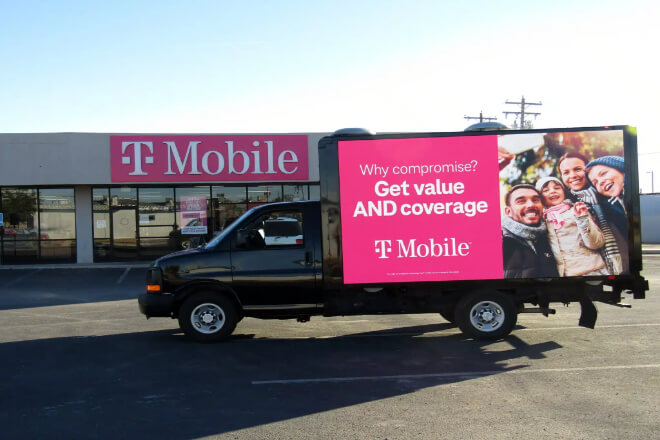
Traditional billboards have a characteristic: they are very “stable,” but also very “lazy”—they always stand in the same place waiting for people to pass by.
Vehicle-mounted or mobile LED displays are different; they are the type that “go out and find audiences on their own.”
First, they can flexibly move between business districts, communities, and event venues.
A vehicle equipped with an LED screen can be at the entrance of a business district today, a community square tomorrow, and an event venue the day after.
It goes wherever there are crowds and excitement, essentially turning a fixed advertising space into a “mobile booth.”
For example, during weekend promotional events at shopping malls, mobile LED trucks screen can drive directly to the entrance and continuously play promotional information.
Later in the evening, they can move to night markets, where the flow of people changes, and the audience exposed changes accordingly—the same advertisement reaches three different groups of viewers.
Secondly, it breaks the limitations of fixed advertising locations. Traditional billboards have fixed locations and limited reach.
Mobile LED screens can flexibly adjust their routes according to time, events, and trending topics, allowing advertisements to proactively “find people” rather than “wait for customers.”
For example, if a community holds a festival event, a mobile screen can arrive at the site in advance to generate buzz.
After the event, it can follow the flow of people to surrounding commercial areas to continue its exposure, essentially allowing the advertisement to “follow the trend.”
More importantly, it enables “advertisements to proactively find people.”
Instead of people passing by the advertisement, the advertisement appears in the most concentrated areas of traffic, even when people are most active, resulting in higher exposure efficiency and greater visibility.
For example, during rush hour, a mobile LED truck parked at a subway entrance playing brand content will be “seen” by people as they emerge from the crowd.
Making it almost impossible to avoid their attention—this is the advantage of mobile communication.
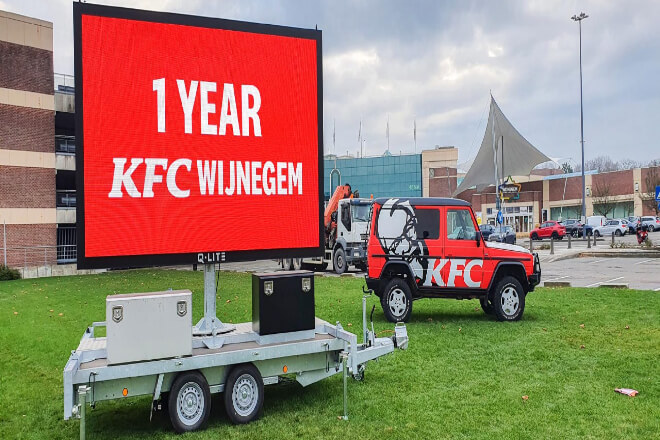
There’s a stark difference in street advertising: static car stickers are easily forgotten, while in-vehicle LED screens are the kind you can’t ignore—even if you want to.
First, dynamic videos are far more eye-catching than traditional car stickers.
Car stickers are “fixed images,” while LED screens can play videos, animations, and rhythmically changing content, making them visually more attention-grabbing.
Especially in information-dense environments like city streets, dynamic content is more likely to “jump out.”
For example, a regular advertising vehicle might only be glanced at.
But an LED screen playing dynamic content might make you subconsciously look for a couple more seconds—and in those two seconds, the information is already “in your brain.”
Second, it continuously attracts pedestrian attention while the vehicle is in motion. Whether in congested traffic, at traffic lights, or in pedestrian areas of commercial streets.
The LED screen is constantly “working” as long as the vehicle is moving or stationary. It’s not a fleeting exposure, but continuous exposure.
For example, at a busy intersection during rush hour, during the few tens of seconds when traffic stops, a car with an LED screen might be parked on the opposite side—the screen lights up.
And the advertising content naturally comes into view. This “passive viewing” effect is very direct.
More importantly, it significantly improves brand recall. Dynamic visuals + repeated exposure + mobile path coverage allow the brand to appear repeatedly in different scenarios, thus increasing impression depth.
Simply put: see it once in a shopping district today, again at a subway entrance tomorrow.
And again at the entrance of your neighborhood the day after—you see it repeatedly, and the brand becomes “familiar.”
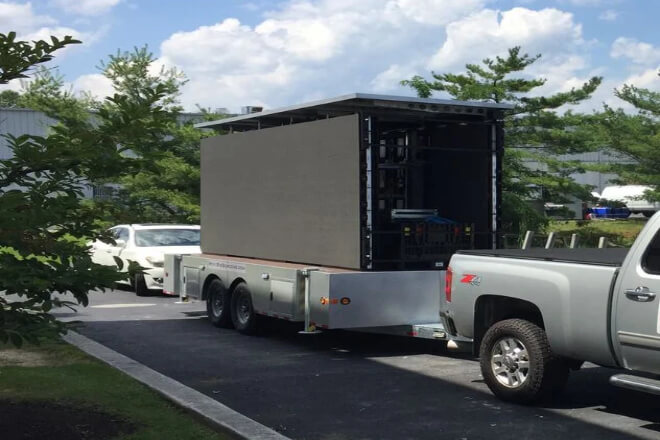
The most “fussy” part of many offline promotional activities isn’t the content, but the setup—stage, backdrop, materials, lighting.
A whole process that consumes half the energy of the “construction site” before the promotion even begins.
The advantage of mobile or vehicle-mounted LED screens is that they can basically start working on-site.
Firstly, they can be quickly put into use upon arrival. Mobile truck LED display equipment are typically integrated designs.
Once on-site, they only require simple positioning, power supply, and signal connection to start playing content directly.
Eliminating the need for extensive structural setups like traditional exhibition booths.
For example, a brand launching a new product might have previously needed to set up the venue, erect backdrops, and adjust lighting a day in advance.
Now, an mobile truck LED display simply drives to the mall entrance, the screen rises, the video starts playing, and the event is “on.” The efficiency difference is striking.
Secondly, it’s particularly suitable for roadshows, product launches, and touring exhibitions.
These events inherently involve “multi-point mobility”—today in a shopping district, tomorrow on a campus, the day after in a community.
Rebuilding the scene at each stop would be extremely costly, while a mobile truck LED display can “travel the entire city with a single device.”
For instance, in a brand touring exhibition, the mobile truck LED display could play promotional content at a university entrance in the morning, continue its display in a commercial street in the afternoon.
And then move to a plaza for interactive activities in the evening—the same content, constantly switching scenes, but without the need for repeated equipment setup.
More importantly, it significantly saves on setup time and labor costs. Traditional events require a complete process of design, setup.
And dismantling, while mobile LED screens reduce these steps, requiring less manpower, lowering time costs, and enabling faster event launches.
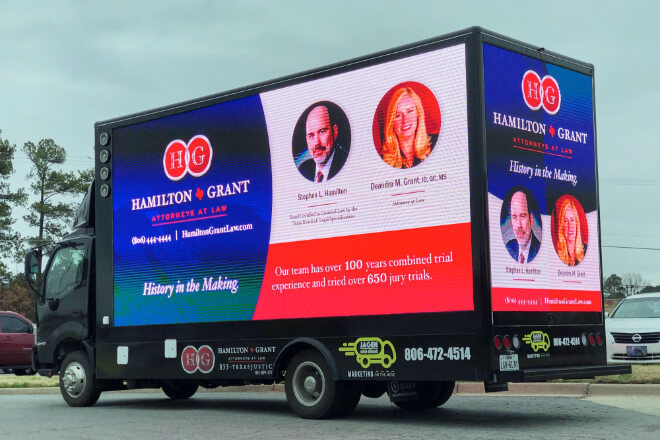
The smartest aspect of mobile truck LED display isn’t just its movement, but its ability to follow its target audience wherever it goes and what content it plays.
Compared to the traditional “one screen for everyone,” it’s more like a “mobile precision targeting system.”
First, it adjusts its driving area based on the target customer. Different brands target different demographics, so the vehicle can go to different “crowd gathering places.”
For example, brands targeting young people go to shopping districts and trendy areas; products targeting families go to communities and areas around supermarkets.
For instance, a maternity and baby brand can drive near large supermarkets and children’s playgrounds on weekends.
While a sports brand can choose gyms, skate parks, or areas around universities—wherever the vehicle goes, the user profile follows.
Second, it plays different advertising content in different areas. The same mobile truck LED display can switch content based on its route or stopping location, achieving “regionally customized targeting.”
For example, you can play coffee and light food ads in office buildings frequented by white-collar workers.
Then switch to promotional activities or entertainment brand content in night markets or shopping districts—the same device “says different things” in different scenarios.
For instance, in the afternoon, play “Limited-time offer on energy-boosting coffee” near office buildings.
In the evening, park in a shopping district and it becomes “Late-night snack recommendations.”
The advertising content follows the state of the audience, making conversions more closely aligned with actual needs.
More importantly, this method significantly improves the accuracy and ROI of promotion. Compared to fixed billboards “passively waiting for passersby.”
Mobile LEDs can proactively select high-traffic, high-relevance areas for exposure, making each play closer to the target audience.
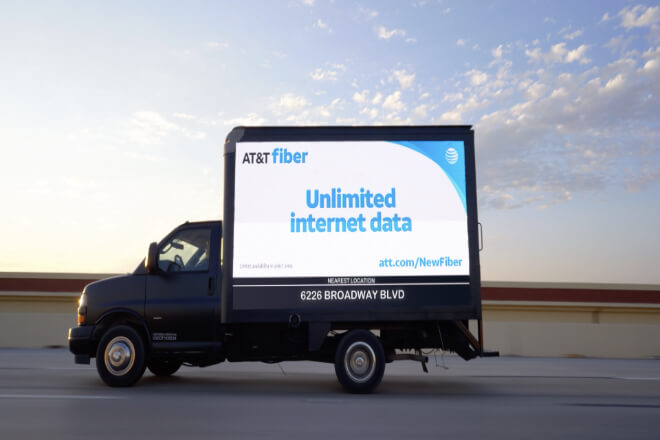
Mobile truck LED display has a very real advantage: it’s not a “one-time use” campaign, but rather like a versatile “advertising all-rounder” that can be used repeatedly.
The same equipment can be switched between different cities and events, spreading costs and maximizing value.
Firstly, one vehicle can serve multiple cities and events. Compared to fixed outdoor screens that can only serve one location.
Mobile truck LED display can travel to shopping districts today, campuses tomorrow, and even other cities for promotional events the day after.
The equipment itself remains the same, but the service scenarios are constantly changing.
For example, a brand conducting a nationwide promotional tour might traditionally need to rent advertising space in each city individually.
However, a mobile truck LED display can “drive” along, repeatedly using the same promotional content in different cities, essentially “carrying” the advertising space “on the road.”
Secondly, repeated use increases the equipment’s value. Mobile truck LED display are not one-time deployment tools but long-term assets.
They are produced once and used long-term, continuously adapting to new event themes and marketing periods, ensuring the equipment consistently generates exposure value.
For example, Black Friday can be used for promotional advertising, Christmas can be changed to holiday-themed content.
And summer can be switched to new product promotions—the same truck, “re-skinned” for different time periods, always maintaining high efficiency.
More importantly, it significantly reduces long-term outdoor advertising costs.
Traditional outdoor advertising requires continuous leasing of fixed locations, while mobile truck LED display, through a “multi-city loop + multi-event reuse” approach.
Break down a single investment into multiple uses, thereby reducing the average cost per exposure.
Simply put, the same budget no longer means “buying a single location,” but rather “buying an advertising space that can move around.”


 English
  Español
  简体中文
简体中文  Français
  日本語
日本語  한국어
한국어  العربية