

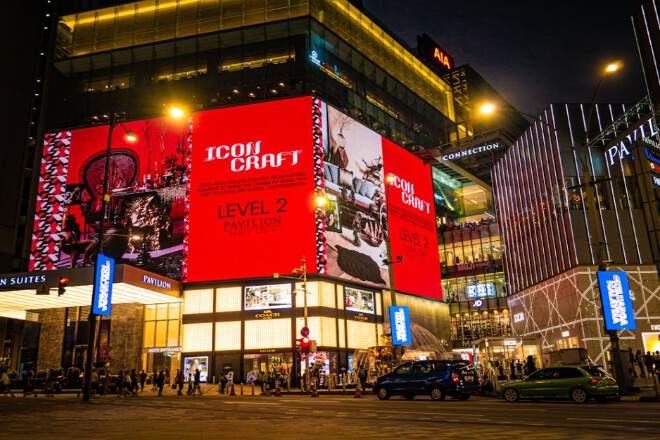
In densely populated but attention-distracted spaces like shopping malls, the most important role of LED screens isn’t “displaying information,” but rather “stopping” people in the moment.
First, they are usually placed in the central atrium or main entrance. These locations are already gathering points for people, and combined with large-scale dynamic images.
They easily become the visual center that people “see immediately upon entering.”
Many people stop in their tracks before they even start browsing.
Second, LED screens create a strong visual impact and attract attention from a distance.
For example, high-saturation dynamic advertisements, naked-eye 3D effects, and close-up product images can be noticed even from dozens of meters away.
A single glance from afar sparks curiosity, prompting the question, “What is this?”
Simultaneously, it quickly grabs the attention of passersby. People in shopping malls typically browse as they walk, but dynamic visuals easily disrupt this “passing by” state.
For example, an animation of a new product “flying off the screen” often makes people unconsciously slow down, or even stop to look for a few more seconds.
More interestingly, these “seconds of stopping” are often crucial. Many consumer behaviors begin with just that “second glance.”
What LED screens do is continuously create these opportunities for “second glances.”
Finally, it can indirectly increase in-store conversion rates. Once someone is attracted and stops, if the screen content happens to be promotional activities, new product recommendations.
Or store traffic information, there’s a higher probability they’ll enter the store, transforming “looking at the screen” into “part of the shopping journey.”
Simply put, the role of LED screens in shopping malls is: first, to make people stop; then, to make them look inside; and finally, to make them walk in.
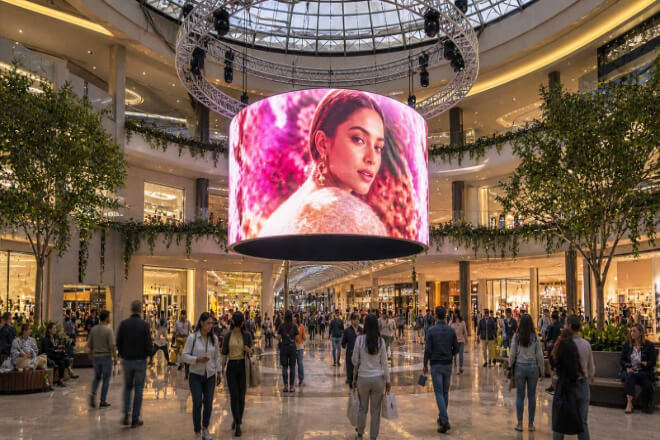
In shopping malls, making people stop is actually more important than making them see the product.
The value of LED screens lies in transforming passersby into people willing to linger for a few more seconds.
First, they can play high-quality visual content and short films, such as brand micro-movies, product story animations, and even fast-paced creative videos.
This type of content is inherently watchable; it’s not just simple advertising but more like a short program, making people unconsciously stop and take a second look.
Second, festive themes and creative interactive content are particularly effective at creating pauses.
Examples include interactive snowflake screens for Christmas, New Year’s countdown animations, or limited-edition naked-eye 3D visual effects for holidays.
This combination of “timeliness + novelty” easily triggers viewers’ curiosity, with some even stopping specifically to take photos and check in.
Simultaneously, LED screens can create an immersive spatial atmosphere. When the entire atrium is surrounded by dynamic visuals, such as ocean scenes, city nightscapes.
Or futuristic technological scenes, people feel as if they are “stepping into the picture,” rather than simply browsing in a shopping mall.
This change in spatial perception is itself a reason to linger.
Even more interestingly, many people stop not because they “want to buy anything,” but because they “just happened to be captivated for a few seconds.”
But those few seconds are often crucial—watching an animation, taking a photo, or waiting for a change in the scene can naturally extend the time people spend looking.
Simply put, the logic behind LED screens creating lingering attention is: not forcibly keeping people there, but making them willingly look a little longer.
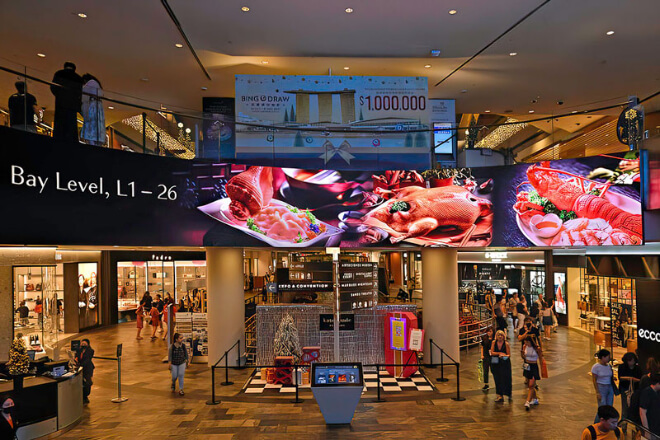
In spaces like shopping malls where people come and go but don’t necessarily stay, one of the most powerful capabilities of LED screens is to gradually “gather” scattered crowds, creating a small, engaging atmosphere.
First, they can display limited-time events and promotional information. For example, “Discounts for the first 30 minutes,” “Today’s limited-time lucky draw,” or “Check-in for a gift.”
Through the high-frequency scrolling of dynamic screens, they are more easily noticed than static posters and create a greater sense of urgency, making people more willing to approach and take a look.
Second, LED screens can operate in conjunction with stage performances and brand roadshows.
When there are performances, interactive games, or new product launches in the mall atrium, the screens not only display the live footage…
It can also simultaneously display activity rules, participation methods, and even real-time lottery results, making the on-site rhythm clearer and the sense of participation stronger.
At the same time, it can attract crowds, creating a “the more you watch, the more people gather” effect.
Initially, only a few people might be drawn in by the screen, but gradually, more people will join in.
As more people take photos and participate in the interaction, a small “hotspot area” naturally forms. With more people, the atmosphere is more easily created.
Even more interestingly, this gathering is often “driven by the atmosphere.”
For example, if a countdown lottery is taking place on the large screen, passersby, even if initially uninterested, will stop and wait for the results because everyone around them is watching.
Simply put, the LED screen here acts as a signal source, constantly creating the message that “something is happening here.”
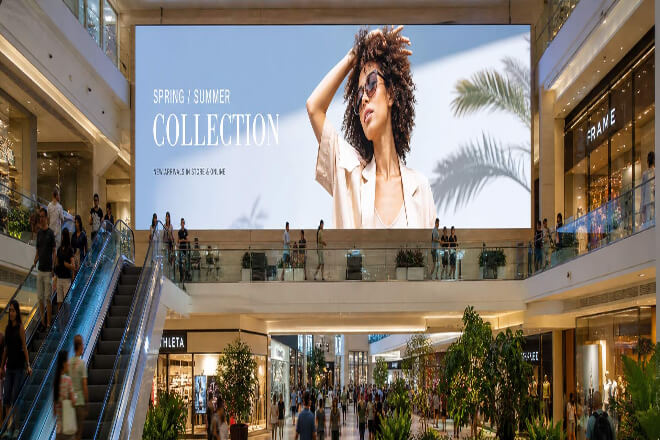
In today’s shopping mall operations, “getting people to come” is no longer enough; more important is “getting people to take photos and share them.”
One of the values of LED screens is that they transform the shopping mall from a shopping space into a content-sharing environment.
Firstly, it can create check-in points and photo opportunities. For example, giant-scale naked-eye 3D animations, immersive cityscapes, and festival-themed visual walls are inherently photogenic.
Standing in front of the screen, a casual snapshot feels like being in a special effects scene, naturally becoming a popular backdrop for photos.
Secondly, it encourages users to take and share photos. When the visuals are stunning and interesting enough, people don’t just “look,” they actively take out their phones to record.
For example, an animation of a whale leaping from the screen, or a limited-time festival countdown, easily prompts people to record a short video and share it.
Simultaneously, this content further boosts social media exposure. A post on WeChat Moments, a short video, or a photo can bring the shopping mall from offline to online dissemination.
What was originally just a few seconds of on-site interaction can become content seen by dozens or even hundreds of people.
Even more interestingly, this dissemination is often “spontaneous,” requiring no deliberate guidance.
When the visuals are appealing enough, crowds naturally gather; as crowds gather, they further attract more people to take photos, creating a slight “amplification effect.”
In short, the role of LED screens here is to transform the shopping mall into a place where “everyone wants to take a picture.”
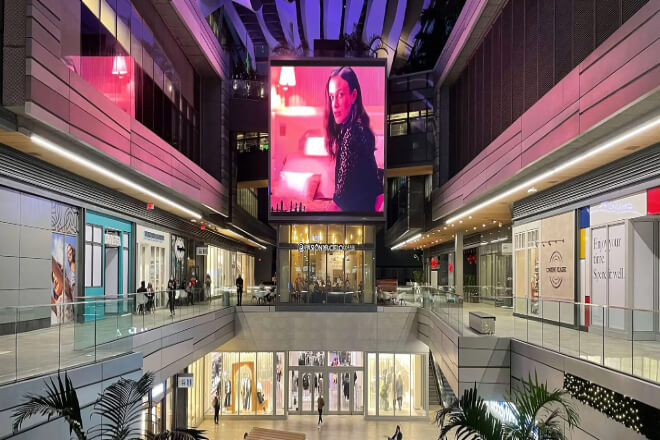
In shopping mall operations, LED screens are no longer just “decoration,” but rather a “traffic and content engine” that continuously generates value.
They influence not only visual effects but also the overall commercial capabilities of the mall.
First, they enhance the value of advertising and brand collaborations. Compared to ordinary static advertising spaces, LED screens offer dynamic displays, multi-content rotation.
And strong exposure advantages, attracting more brands to advertise on them.
For example, holiday main visuals, brand collaborations, or new product launches can all be presented more impactfully on the large screen.
Second, they enhance tenant appeal. For tenants, a shopping mall with a popular LED screen inherently means stronger foot traffic and exposure opportunities.
Many brands also consider the availability of high-quality digital media resources as a plus when choosing a location, as this directly relates to the effectiveness of store communication.
Simultaneously, LED screens can improve overall customer conversion efficiency. By providing dynamic promotional information, reminders of limited-time events.
And brand-driven content, shopping malls can more effectively guide foot traffic from simply passing through to lingering, and then from lingering to making purchases.
Simply put, it makes it easier for shoppers to “buy something on the go.”
More importantly, it strengthens the overall brand image of the mall. When a mall has a high-standard LED visual system, it often feels more modern, upscale, and vibrant.
Especially during festivals or large events, the visual unity brought by large screens directly enhances the overall “aura” of the mall.
Interestingly, many people’s memory of a mall isn’t actually of a particular store, but rather “that impressive large screen.” It becomes a visual landmark, making the mall itself memorable.
In short, the value of LED screens can be summarized as: transforming a mall not just into a shopping space, but also into a content platform that continuously generates traffic and business opportunities.


 English
  Español
  简体中文
简体中文  Français
  日本語
日本語  한국어
한국어  العربية