

In recent years, a noticeable change has emerged in project communication:
When comparing video wall displays and LED displays, more and more customers are no longer simply asking “which is cheaper,” but are directly asking “can the picture be cleaner?”
This may seem like a small issue, but it reflects a shift in usage habits and aesthetic standards.
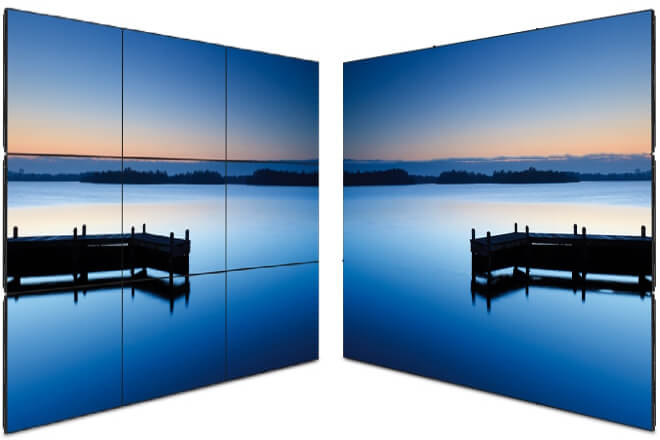
If early large screens were like “many small TVs pieced together,” then today’s LED displays are more like a continuous, luminous visual wall.
First, the biggest drawback of video wall displays is the physical bezel that breaks up the image.
Even with narrow bezels, when displaying a complete image, obvious dividing lines will appear, such as a face being cut off, a map being segmented, or animations flowing discontinuously—the viewer’s attention will be interrupted by these “seams.”
The advantage of LED displays lies in a truly seamless visual experience. Through a dot-matrix light-emitting structure, it can visually achieve a continuous image without obvious boundaries.
Allowing content to “flow naturally across the entire screen surface,” rather than being framed by individual cells.
Even more interestingly, this difference is amplified in immersive scenarios. For example, in esports competitions or brand launches, if the visuals appear spliced, viewers will unconsciously notice the “screen structure.”
However, seamless LED displays allow viewers to easily immerse themselves in the content itself, even forgetting they are looking at a screen.
To give a very intuitive example: Consider the visual content of a “dragon flying out of the screen”—the spliced screen version looks like the dragon “flies intermittently between several screens,” while the LED version looks like the “entire dragon traverses the entire space.”
Simply put, spliced screens emphasize “displaying the image,” while LED displays emphasize “constructing space.”
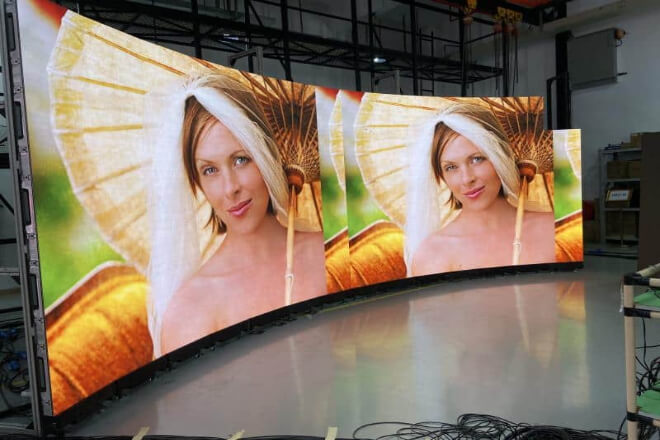
Early large-screen applications were more like “installed in a fixed room for a single purpose,” but today’s LED displays have become visual devices that can be “used everywhere.”
Firstly, LED displays are adaptable to multiple indoor and outdoor environments. Whether in the bright light of a shopping mall atrium, the sun and rain of an outdoor plaza, or the dim atmosphere of an indoor stage, a stable display can be achieved through different configurations, freeing it from being “limited” by the scene.
Secondly, its application range is extremely wide. From shopping mall advertising screens to city landmark screens, from sports event stage backdrops to command center data visualization systems.
And even concert and brand launch events, LEDs can cover almost all spaces requiring “strong visual expression.”
More interestingly, this multi-scene capability brings about a change: the screen is no longer a “fixed device,” but more like a “mobile visual tool.”
The same display technology can play completely different roles in different scenarios—today it’s a commercial advertising carrier, tomorrow it’s a sports event main stage, and the day after it becomes a data monitoring center.
To give a very intuitive example: the same LED screen can play brand advertisements in a shopping mall, display competition footage in an e-sports arena.
And display real-time data in a command center—the content is different, but the “core information presentation” is completely consistent.
Simply put, it can be summarized as: splicing screens are more like “fixed video walls,” while LED displays are more like “adaptable visual platforms.”

If the strength of video wall panels lies in their ability to be pieced together, then the strength of LED displays lies in their ability to deliver clear and impactful visuals regardless of location.
First, LED displays boast higher brightness and contrast. Even in brightly lit environments like shopping mall atriums, outdoor plazas.
And stadiums, they maintain a clear image, ensuring their presence isn’t diluted by the surrounding light.
Second, continued visibility in strong light is a key advantage. For example, during daytime outdoor activities, while ordinary displays might be obscured by sunlight.
LED displays can still consistently output bright content, ensuring that advertisements, sporting events, and stage visuals remain readable and impactful.
More interestingly, this difference is amplified in commercial settings: the same advertisement might only be “visible” on an ordinary screen;
But on a high-brightness LED, it becomes “attractive from afar.” Viewers are already captivated by the image even before they get close.
To illustrate, in an outdoor commercial area, a regular screen looks like a “dimmed phone screen” under sunlight, while an LED screen looks like a “large poster with a built-in glowing filter,” its content visible even from across the street.
Simply put, a video wall is more like an “indoor TV,” while an LED display is more like a “visual signal tower that shines around the clock.”
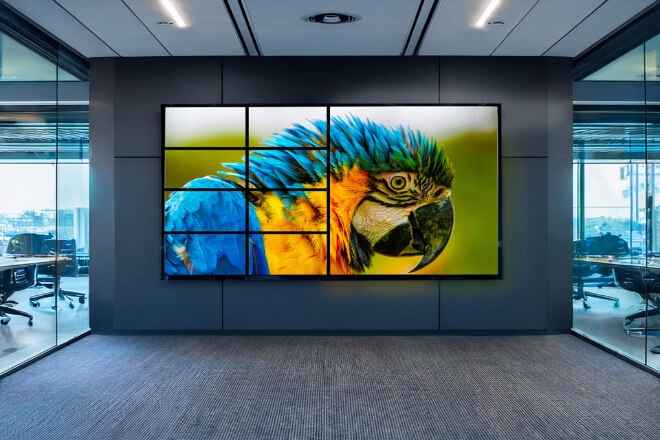
In the long-term use of display systems, what truly differentiates the user experience is often not whether the screen lights up, but rather how troublesome it is to repair when it breaks down.
Firstly, one of the biggest advantages of LED displays is their modular structural design. Even if a small area has a problem, the corresponding module can be directly replaced.
Like “building Lego,” allowing for quick replacement without the need for extensive disassembly of the entire screen.
In contrast, video walls are usually more structurally limited. Once a problem occurs in a section of the screen or the seam area.
It often requires a more meticulous disassembly and assembly process, potentially affecting surrounding units, making repairs more cascading and interconnected.
Secondly, this modular approach significantly reduces long-term operational complexity. For high-frequency usage scenarios such as shopping mall screens, event stages.
Or command centers, rapid recovery is more important than “meticulous repair”—even a minute of screen downtime can affect the audience experience or business operations.
More interestingly, this difference is very intuitive on-site: repairing a video wall is like “repairing a wall, requiring moving half a room.”
While LED repair is more like “replacing a building block, restoring normal operation in minutes.”
To give a vivid example: during a performance or event, if a local module malfunctions, LED technicians can quickly replace it and restore the image.
However, a video wall might require a more complex disassembly, assembly, and calibration process, resulting in a significantly longer recovery time.

The upgrade in display technology is not just about “better screens,” but a change in mindset—from “buying a device that can display” to “building a functional visual system.”
Firstly, LED displays are easier to build into complete screen visual systems. It’s no longer limited to a single screen; instead, it can be used as a unified canvas for content design.
For example, an entire wall can be used for immersive visuals, allowing information, animation, and special effects to flow continuously within the same space.
Secondly, it naturally supports multi-screen interaction and unified content management.
In large venues or commercial spaces, main screens, side screens, floor screens, and even surround screens can work simultaneously and collaboratively.
With content scheduling through a unified control system, achieving “one screen, multi-dimensional presentation,” rather than each displaying its own content.
More interestingly, this systematization capability upgrades visual expression from “playing content” to “designing space.”
For example, in e-sports events, the main screen displays battle scenes, side screens showcase data analysis.
And floor tile screens enhance the rhythm and atmosphere, making the entire space function like a unified “visual engine.”
To give a more intuitive example: at a product launch event, an LED system allows the brand’s main visual to extend from the main screen to both sides and then “flow” to the stage floor.
The audience doesn’t see just one screen, but a complete brand space experience.
In short, it can be summarized as: video walls are “multiple screens working together,” while LED displays are “the entire space expressing itself together.”


 English
  Español
  简体中文
简体中文  Français
  日本語
日本語  한국어
한국어  العربية