
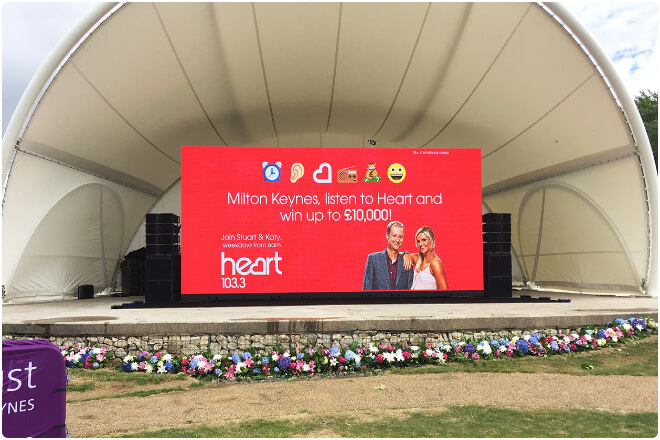
When it comes to event venues, grabbing people’s attention at first glance is crucial. One of the biggest advantages of LED displays is their undeniably striking visual impact.
First, they offer high brightness. Whether it’s a daytime outdoor event or a stage environment with complex lighting, LED screens maintain clear and bright images, unaffected by ambient light.
Even under direct sunlight, the image remains clear, without appearing gray or blurry, which is especially important for large-scale events.
Second, they offer excellent color reproduction. LED displays have high color saturation and rich image detail.
Brand visuals, product videos, and dynamic backgrounds appear more sophisticated and high-quality when displayed on the screen.
Especially in stage settings, the color changes on the screen, combined with lighting and music, directly enhance the atmosphere, making it easier for the audience to immerse themselves.
Another advantage is resolution. High-definition or even ultra-high-definition displays allow audiences sitting in the back rows or even at the edge of the venue to clearly see expressions, movements, and details on stage.
This is crucial for conferences, press conferences, or large-scale performances—every audience member can “participate” in the core visuals, rather than just hearing sound and seeing a blurry outline.
Simply put, an LED display screen is not just a tool for displaying images; it’s more like an amplifier of the atmosphere.
Clear images, vibrant colors, and detailed shots naturally make it easier to capture the audience’s attention.
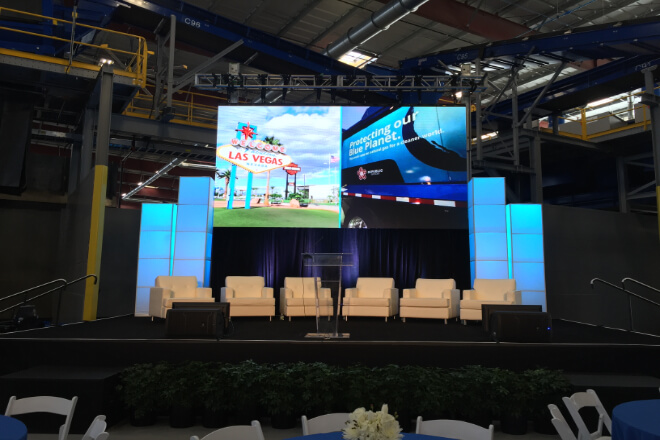
Many people’s first reaction to large screens is: “Such a large screen, isn’t it extremely power-consuming?”
However, current LED displays have achieved considerable maturity in energy consumption control.
Compared to traditional projection equipment or older display systems, LED displays have higher luminous efficiency, achieving brighter and clearer images with less electricity.
Especially in large-scale events or long-term operation scenarios, this high energy efficiency advantage becomes apparent—the same display effect with more controllable power consumption.
Furthermore, many LED screens now feature intelligent brightness adjustment functions, automatically adjusting brightness according to ambient light.
Brighter during the day and dimmer at night or indoors, it not only protects the audience’s vision but also avoids unnecessary power waste.
This energy-saving design aligns perfectly with the current emphasis on environmental protection and sustainability by event organizers.
From a cost perspective, the electricity savings aren’t immediately apparent but accumulate over long-term use.
Especially in high-frequency usage scenarios like shopping malls, exhibition centers, and sports stadiums, the longer the operating time, the more significant the economic benefits of energy saving.
Therefore, LED displays not only deliver stunning visual effects but also quietly save money and electricity behind the scenes.
They offer both prestige and practical benefits, which is one of the key reasons why more and more events and venues are choosing them.
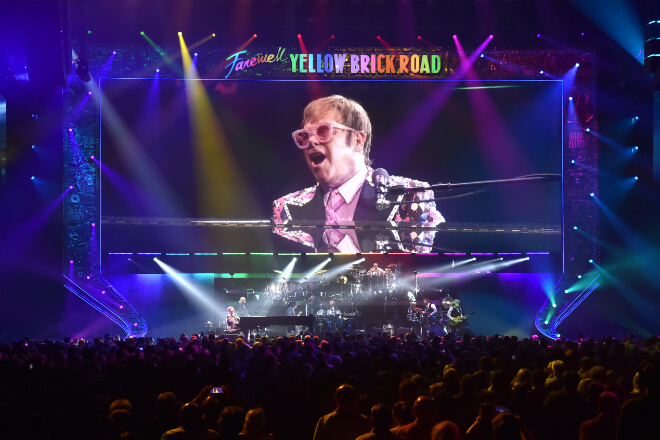
Some venues are conventional, with square stages; but more often, event sites are actually in less ideal conditions—limited space, complex structures, or even temporary setups.
At this point, the flexibility of LED displays becomes particularly important.
First, they can be installed in different ways to meet the needs of the event. Curved screens, cylindrical screens, floor tile screens, hanging screens.
And even entire panels spliced into a super-large background wall can all be achieved through modular splicing.
Need a wraparound stage? Sure. Want to create an attractive curved shape at your booth? No problem.
Compared to traditional fixed-structure display equipment, LED screens are more like “building blocks,” allowing for various combinations.
Second, they are highly adaptable to different venues. Indoor conference halls, outdoor plazas, stadiums, commercial streets… they can basically all be used.
Many outdoor LED screens now feature waterproof, dustproof, and high/low temperature-resistant designs, ensuring stable operation even in hot summers or cold weather, which is crucial for large-scale outdoor events.
Furthermore, there’s customization. Different events have different requirements for screen size, proportions, and shapes.
Some require extra-long horizontal screens to emphasize stage width, some need vertical screens to emphasize visual impact, and others desire irregularly shaped structures to match the theme.
LED displays can be customized in size and shape to meet specific needs, rather than requiring events to “accommodate” the equipment.
Simply put, an LED display is not a fixed “screen,” but a visual tool that can be freely adapted to creativity and venue.
This flexibility allows it to perform optimally in various complex scenarios.
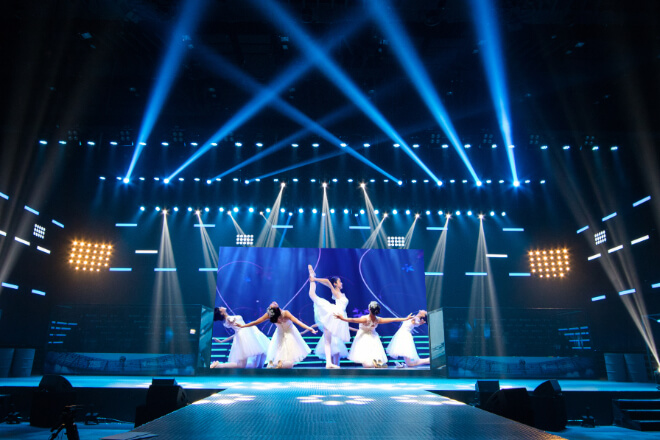
What’s the biggest fear at an event? A slow pace, delayed information, and audiences merely “passively watching.”
A major advantage of LED displays is their real-time and interactive features, which truly bring the event to life.
First, there’s the real-time playback capability. Whether it’s video footage, live camera switching, data updates, or important information inserted temporarily, LED displays can present it instantly.
For example, announcing sales data at a press conference, updating scores in real-time during a sporting event.
Or simultaneously displaying key points of a speech at a meeting—the visuals are virtually lag-free, allowing the audience to receive information immediately, creating a more engaging atmosphere.
Secondly, there’s the interactive functionality. Many LED systems now integrate with interactive projection, motion-sensing devices, and even directly connect to social media platforms.
Audience members can post content tagged with the event on-site, which immediately scrolls across the screen.
Or participate in voting and prize draws by scanning QR codes with their mobile phones, with results announced in real-time on the large screen.
This experience of “I participated, and I see immediate feedback” makes the audience more engaged.
When the screen not only displays content but also responds to the audience, the feeling of the event is completely different.
The audience is no longer just a spectator, but a participant. More interaction, more laughter, more discussion, and the atmosphere naturally becomes more lively.
Therefore, LED displays not only improve the speed of information transmission but also shorten the distance between the event and the audience. This instant interactivity is often the key to making an event truly memorable.
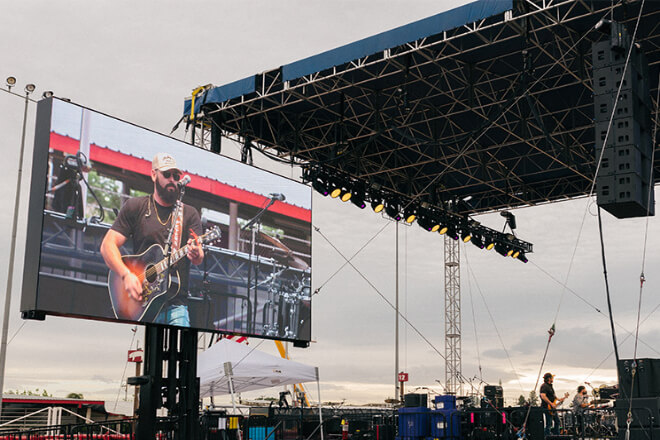
Many large-scale events are not held in “ideal environments.” Outdoor plazas, stadiums, and temporary stages are commonly exposed to wind, sun, and temperature fluctuations.
In these situations, the stability of the equipment is actually more important than imagined.
LED displays perform remarkably reliably in this regard. Outdoor models, in particular, typically feature waterproof and dustproof designs, capable of withstanding the effects of rain, dust, and even humid air.
The LED screen won’t go black in the rain and is less susceptible to damage in sandstorms, which is crucial for music festivals, sporting events, and celebratory activities.
Furthermore, it boasts strong temperature adaptability. Whether in the scorching heat of summer or the frigid temperatures of winter, it operates stably within its specifications.
Compared to some traditional display devices with higher environmental requirements, LED screens are significantly more adaptable.
From a long-term perspective, LED displays have a relatively robust structure and a long lifespan.
Routine maintenance mainly involves module checks and simple upkeep, eliminating the need for frequent replacement of core components.
This not only reduces maintenance costs but also minimizes the risk of unforeseen problems during events.
In short, it’s not just “good-looking,” it’s also “durable.” Its stable operation in complex environments is a vital guarantee for the smooth running of an event.
 English
  Español
  简体中文
简体中文  Français
  日本語
日本語  한국어
한국어  العربية