

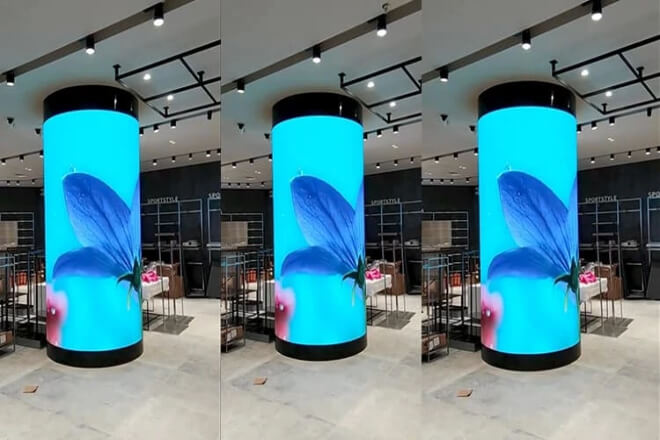
Shopping mall atriums are typically areas with high foot traffic, but customers don’t always come in a queue from the same direction.
Some come down escalators, some from the other side, and others are looking at their phones while shopping.
In this situation, ordinary flat LED screens easily encounter a problem: the image “disappears” from the viewer’s angle.
Cylindrical LED screens, however, can utilize the existing pillars in the shopping mall.
Transforming a somewhat ordinary architectural structure into a digital visual focal point visible from every angle.
No matter which direction customers pass by, they have a chance to see the screen content.
For example, a pillar in a shopping mall atrium can display new product advertisements, holiday events, brand promotions, or dynamic visuals using cylindrical LED screens.
Customers see one side when they come up the escalator and another side when they walk to the other.
The same screen doesn’t need to chase after customers; they encounter it wherever they go.
Moreover, the cylindrical shape itself is more eye-catching than a regular rectangular screen.
Especially in a space like an atrium, it not only displays content but also serves as a visual installation, helping the mall create a more memorable “central point.”
Therefore, the advantage of using cylindrical LED screens in a shopping mall atrium is not just that “the screen can rotate.”
But that it transforms a space-consuming pillar into a digital media entrance that continuously attracts foot traffic.
Previously, people walked around pillars; now, the pillars can also “operate.”
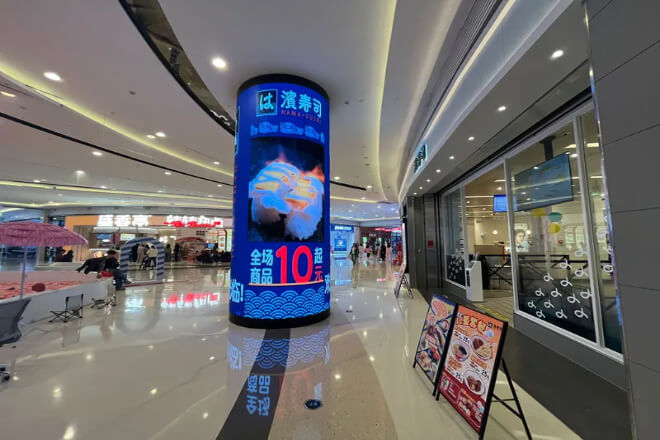
A hotel lobby is inherently a place where “first impressions” are crucial.
However, suddenly placing a plain rectangular LED screen in an elegant lobby would feel somewhat like cramming a screen in after the renovations are complete.
A cylindrical LED screen, on the other hand, can seamlessly integrate with the existing column design of the lobby, allowing the screen to blend naturally with the architectural structure.
For example, a prominent column at the hotel entrance can be directly transformed into a cylindrical LED screen, displaying brand stories, city views, art animations, or holiday themes.
As guests walk from the entrance to the reception desk, the image changes with their viewing angle, ensuring the content is visible from different directions.
For instance, a seaside resort hotel could use a cylindrical screen to display waves, sunsets, and the coastline;
A business hotel could showcase the city skyline, brand philosophy, and important events.
The same column can be used for a business-like atmosphere during the day and a slightly more romantic one at night.
Furthermore, a cylindrical screen doesn’t necessarily need to be constantly “playing at breakneck speed.”
High-end hotels are better suited to using simple, slow-paced dynamic content, allowing the screen to be present without overshadowing the lobby’s décor.
In this way, what was originally just a structural column can become a visual highlight of the space, simultaneously serving as a brand showcase and content dissemination tool.
Previously, hotel guests would ask, “Where’s the front desk?” Now, they might also casually ask, “Why is this pillar moving?”
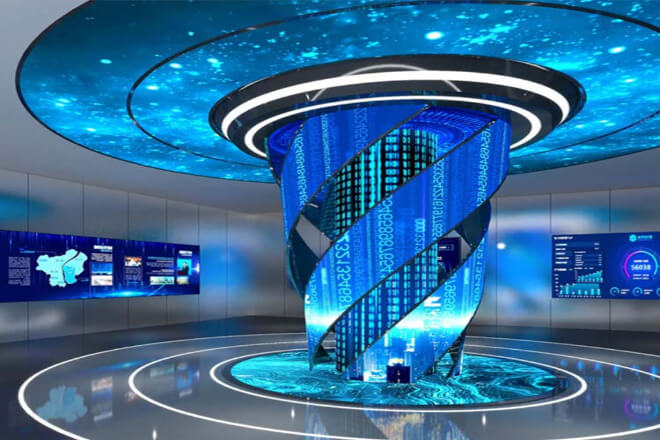
Exhibition halls typically contain a lot of content: products, brand stories, technical introductions, data, case studies…
If all of this is crammed into a regular flat screen, it easily becomes “a screen on the left, a screen on the right, and by the end, the audience doesn’t even remember where they are.”
Cylindrical LED screens offer a different display method. They inherently possess a 360° visual space, allowing for the display of different content from multiple directions, with the content constantly changing as the audience moves around the screen.
For example, science museums can use cylindrical screens to display the Earth, space, or complex mechanical structures, allowing dynamic images to unfold with the screen’s shape.
Automotive brand exhibition halls can integrate car models, brand stories, and racing content, giving a car not just a display stand, but a complete visual backdrop.
Corporate exhibition halls can also use cylindrical screens to showcase the company’s development history, core technologies, global market layout, and other content.
Compared to a regular flat screen, a cylindrical screen is more likely to become the visual center of the exhibition hall and naturally guides the audience to view the screen.
More importantly, it breaks through the traditional method of “standing in front of a screen to view content.” Viewers don’t just see one side; they can walk around the content.
Therefore, cylindrical LED screens are particularly suitable for scenarios where visitors want to create a more spacious and technologically advanced exhibition hall.
Traditional screens are like telling a story; cylindrical screens are more like “standing” the story within the space.
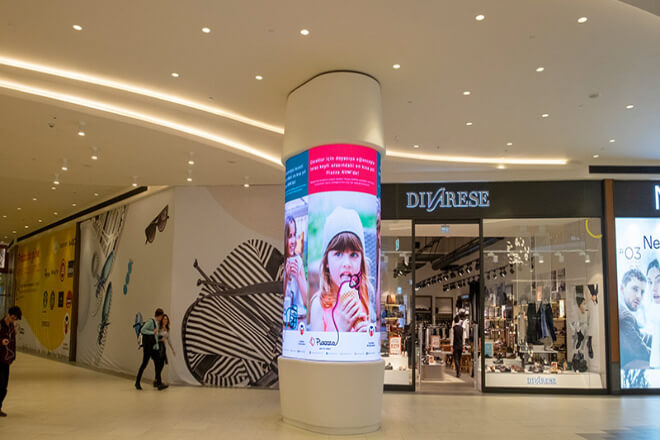
The biggest characteristic of airports, train stations, and transportation hubs is high traffic, and everyone is in a hurry.
Therefore, the screens can’t just be “aesthetically pleasing”; they also need to find ways to ensure that passersby see useful information within seconds.
Cylindrical LED screens can be placed in high-traffic areas such as lobbies, waiting areas, and passageways to display real-time information such as flights, trains, routes, and event reminders.
Because the screen can be seen from multiple directions, customers don’t necessarily have to walk to the front; they can still catch the content as they pass by.
For example, a pillar in the center of an airport hall can be transformed into a cylindrical LED screen.
One side displays flight information, while the other can play airport service announcements or brand content.
When passengers are rushing to catch a flight, it’s an information assistant; when they’re not, it can become an advertising space.
The commercial value is also obvious. Transportation hubs have a large and continuously flowing population.
And cylindrical screens can intersperse brand advertisements, commercial activities, and city promotional content.
Especially during holidays or large events, the content can be quickly changed, ensuring continuous exposure in the same location.
Of course, information display in transportation scenarios cannot only pursue visual effects. If flight numbers are unclear, even the coolest animation won’t save the day.
Therefore, font, brightness, viewing distance, and content update speed all need to be planned in advance.
Ultimately, the role of cylindrical LED screens in transportation spaces can be very flexible:
When information is needed, it “tells you where to go”; when commercial value is needed, it “tells you what’s worth seeing.”
It transforms what would otherwise be a fleeting few seconds of observation into an effective information exposure.
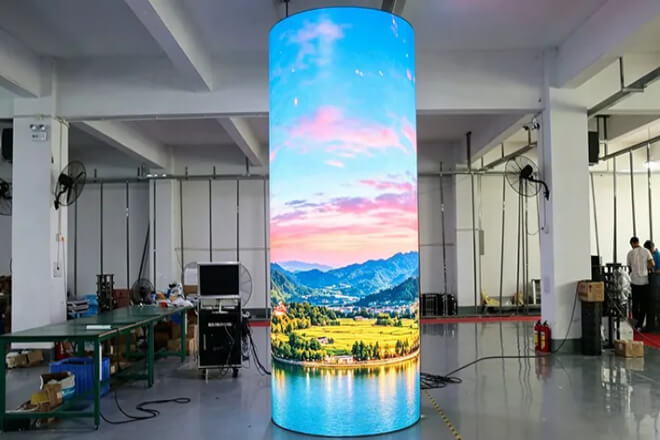
What do entertainment venues fear most? Not the lack of screens, but a screen and atmosphere that are completely out of sync.
Especially in clubs, bars, and esports arenas, where music, lighting, and space are constantly changing, ordinary rectangular screens can sometimes seem too “conventional.”
Cylindrical LED screens are better suited for these atmosphere-driven settings. They can be placed near stages, DJ areas, bars.
Or in the center of a space, playing dynamic content in sync with music and lighting effects, extending the visual impact from one side to multiple directions.
For example, a bar hosting a retro-themed night can use a cylindrical screen to display neon lights and retro animations; for weekend parties, it can switch to a more dynamic visual style.
When esports arenas host competitions, they can display player information, scores, event animations, and brand content.
The screen remains stationary, but the theme can be changed daily.
The cylindrical shape itself easily becomes a photo opportunity.
Especially in well-lit entertainment venues, a “digital pillar” that plays dynamic content often attracts more photos and short videos than a regular backdrop.
Moreover, it doesn’t have to constantly play advertisements. It can create atmosphere during normal times.
Set the theme for events, and display sponsor content for brand collaborations. One screen does three or four jobs.
Therefore, when entertainment venues choose cylindrical LED screens, they consider more than just the display area;
They consider its integration with music, lighting, activities, and social experiences.
After all, in nightclubs, even the pillars are glowing; who wants to see a quiet, square wall?


 English
  Español
  简体中文
简体中文  Français
  日本語
日本語  한국어
한국어  العربية