

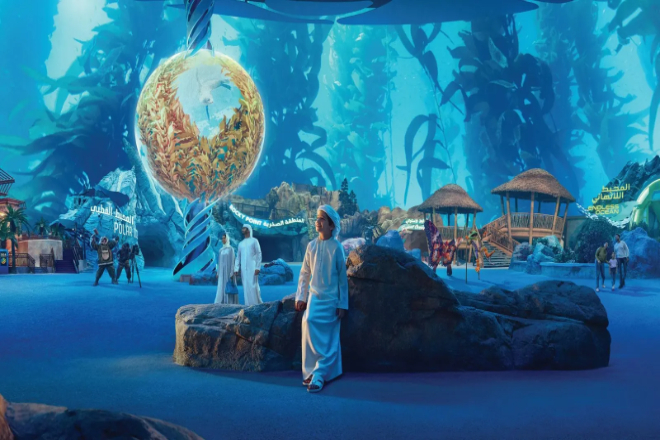
Traditional aquariums primarily rely on aquariums, physical landscaping, and lighting to display marine life.
While these methods provide a realistic viewing experience, they also have limitations in terms of spatial representation.
LED displays can further expand the visual scene, giving visitors a stronger sense of spatial immersion.
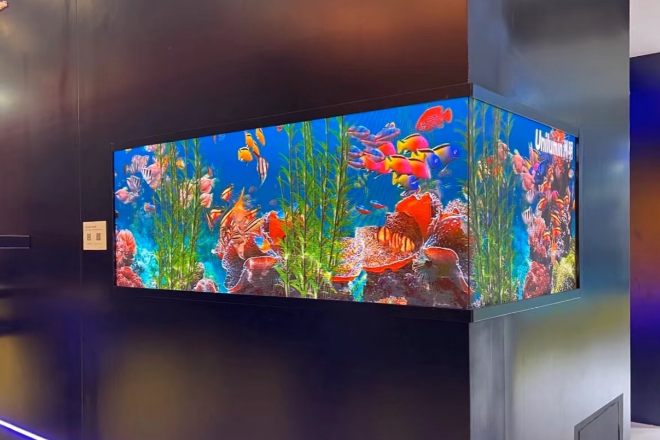
For example, in a marine-themed exhibition hall, a large LED display can showcase the deep-sea environment, coral reefs, underwater caves.
And schools of fish swimming in the distance. Through clever image design, an ordinary wall can become part of the underwater scene.
If space permits, LED displays can be combined with curved walls, circular structures, or ceiling display areas, extending the ocean visuals from a single direction to multiple viewing areas.
Visitors are no longer just standing in front of an aquarium, but feel as if they have entered a constantly changing marine world.
However, immersion doesn’t mean making the screen as big as possible. If the content doesn’t match the exhibition space.
Or if the screen simply plays ocean videos mechanically in a loop, visitors will still feel like they are watching an ordinary display wall.
Therefore, when planning LED displays, aquariums should first determine the theme of the exhibition hall and the visitor flow, and then decide on the size, shape, and installation location of the screen.
For example, a deep-sea theme is suitable for using darker backgrounds and slowly changing images, while a tropical ocean theme can highlight coral reefs, schools of fish, and rich colors.
A truly immersive aquarium LED display is not about showing visitors more images, but about making them feel closer to the ocean.
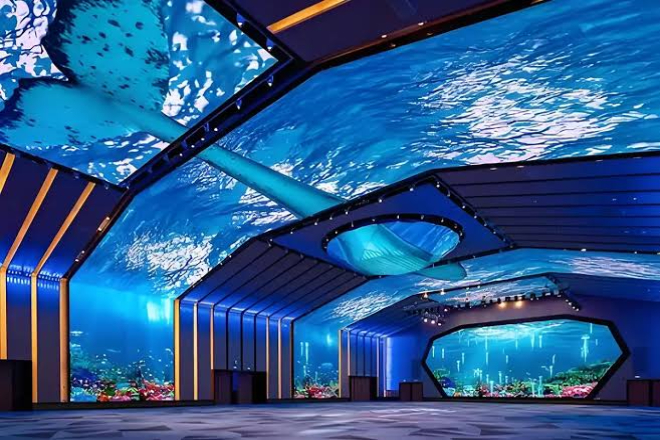
If an aquarium’s LED display is always mounted on a wall, its function may only be to display images.
A truly engaging design integrates the screens with the visitor’s movement, engaging the entire space in telling the ocean story.
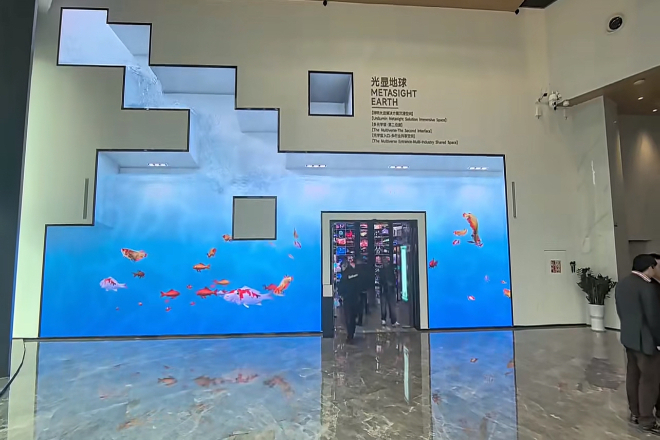
Wall-mounted LED displays are ideal for creating expansive underwater landscapes.
For example, upon entering the exhibition hall. Visitors are greeted by a coral reef stretching into the distance, with schools of fish swimming through the image, creating the illusion of an endless real ocean.
For exhibition halls unable to accommodate large real marine creatures, digital displays can supplement the richer marine scenes.
Floor LED displays offer another unique experience.
As visitors walk across the screen, flowing waves, swimming fish, or gently unfolding seabed textures appear beneath their feet, transforming an ordinary passageway into an interactive experience.
However, ground-mounted screens must fully consider slip resistance, protection, load-bearing capacity, and maintenance requirements; visual appeal cannot come at the expense of safety.
Ceiling-mounted LED displays are suitable for creating an upward-extending ocean space.
By displaying images transitioning from the sea surface to the deep ocean, visitors can look up and see the light gradually dimming and schools of fish swimming gently.
When combined with wall-mounted displays, the sense of immersion in the space is further enhanced.
The Barcelona Aquarium’s digital display project utilizes digital floors, ceiling displays, and other audiovisual devices to create a visitor experience that resonates with the marine environment.
Of course, not every aquarium needs to turn its walls, floors, and ceiling into screens. A more reasonable approach is to select key locations based on the exhibition area, visitor routes, and budget.
Allowing different screens to serve different purposes, rather than surrounding visitors with dynamic images everywhere they go.
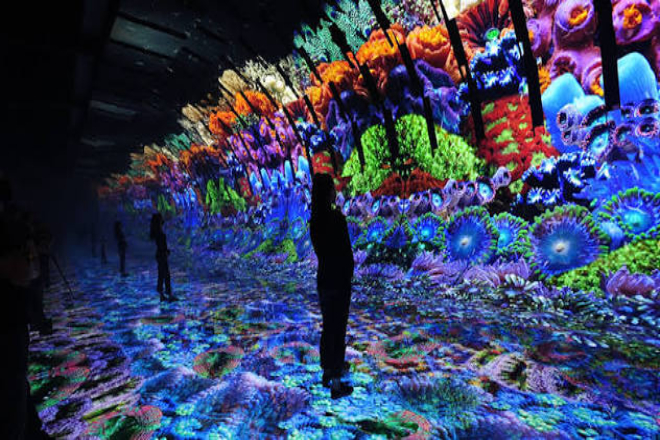
For aquariums, it’s normal for visitors to move on after watching a marine video. However, if the visuals respond to visitors’ actions, they might be willing to stay longer and even actively invite friends to experience it together.
This is precisely the value of interactive LED displays.
For example, interactive marine scenes can be set up in children’s experience areas. When visitors approach the screen, virtual fish swim around; when visitors wave, jellyfish or turtles on the screen react accordingly.
Through cameras, motion recognition, or sensing devices, what was originally a one-way playback can be transformed into a simple and fun interactive experience.
If aquariums wish to enhance their educational content, they can integrate interactive elements with marine knowledge.
After a visitor selects a marine creature, the screen displays its habitat, food sources, and survival characteristics.
This approach is more engaging for children and families than simply reading explanatory plaques.
For large immersive exhibits, phased interactive stories can be designed. For example, visitors can first explore coral reefs, then venture into the deep sea, and finally learn about marine ecological conservation through interactive activities.
LED displays present the visual scenes, sensors capture interactions, and the sound system supplements the ambient sounds.
However, more complex interactive features are not necessarily better. If visitors need to read lengthy instructions or experience long wait times for each interaction, the experience may lose its appeal.
Aquariums should prioritize interactive methods that are simple to operate, provide timely feedback, and are easy to maintain, while considering the usage needs of children, the elderly, and visitors of different heights.
It’s also important that interactive LED displays serve the overall visitor experience, rather than keeping visitors glued to virtual screens and ignoring the real marine life in the aquarium.
The most engaging interactions are not about pressing numerous buttons, but about making visitors feel that their actions are genuinely changing the underwater world before them.
LED displays can showcase ocean scenes, but to truly immerse visitors, the rhythm of the visuals, lighting, and sound must be carefully considered.
First, the content must match the characteristics of different marine environments.
For example, tropical coral reefs can use relatively bright colors and active fish; deep-sea areas are better suited to darker tones, slowly moving creatures, and softer visual changes.
Clear distinctions between different exhibits allow visitors to feel as if they are gradually venturing deeper into the ocean.
Second, visual transitions must be rhythmic.
If the LED display suddenly changes scenes every few seconds, it’s difficult for visitors to become immersed.
For underwater exploration exhibits, continuous, slow visual changes are suitable; for ocean-themed performance areas, dynamic effects can be used to highlight key elements at appropriate moments.
Lighting is equally crucial. If the screen and ambient lighting compete for attention, the visuals may lose depth, and visitors may experience fatigue.
Aquariums should adjust lighting according to the relationship between the actual aquarium, exhibit walls, and the LED display, avoiding highlighting the screen at the expense of other exhibit areas.
Sound can help create a sense of space. The sounds of waves, flowing water, and designed marine ambient sounds can make the visuals more vivid.
However, the sound should not be consistently high, and interference between different exhibit areas must be considered.
For aquariums that also have live aquariums, special care is needed.
The brightness, lighting, and sound of the LED display should be assessed based on the actual environment to avoid affecting animal husbandry and management.
It’s important to note that what works for visitors may not work for all aquatic animals.
Therefore, project planning should involve the display equipment team, content production team, lighting design team, and aquarium operations team.
Determining what each exhibit wants to convey before deciding how the equipment should work is usually more effective than adjusting the effects after installation.
Immersive experiences are appealing, but for aquarium investors, the long-term stability of the equipment and the continuous updating of the content are equally crucial to the project’s worth.
First, the LED display should be selected based on the installation location.
For wall-mounted and interactive screens viewed at close range, the focus should be on image detail and viewing comfort; large background screens require pixel pitch selection based on the overall viewing distance.
Floor screens also require additional evaluation of slip resistance, load-bearing capacity, protection, and maintenance conditions.
Secondly, environmental adaptability is crucial.
Some areas of aquariums have high humidity, and equipment may be affected by moisture, cleaning operations, and temperature changes.
Therefore, during procurement, protection requirements, electrical safety, heat dissipation conditions, and the product’s applicable environment should be confirmed based on the actual installation location.
The fact that a screen is installed indoors does not mean it doesn’t require additional protection.
Third, plan content updates in advance.
If an LED display plays the same marine video for months on end, even if it was initially engaging, visitors may gradually lose interest.
Aquariums can update content based on seasons, holidays, marine science themes, and special events.
For example, adding interactive scenes during marine conservation-themed events and switching marine life images during specific exhibitions.
This maintains freshness and provides new experiences for repeat visitors.
Fourth, calculate the total project cost.
Beyond the LED display itself, costs should also be considered for installation structure, control equipment, content production, energy consumption, maintenance, and spare parts.
For immersive projects, content production and updates can be a significant long-term expense, and hardware purchase prices should not be the sole consideration.
Finally, maintenance and scalability should be a primary concern.
Before purchasing, module replacement methods, after-sales response time, spare parts availability, and warranty coverage should be confirmed.
If future interactive features or expanded display areas are needed, the existing control system’s support for expansion will also impact long-term investment.
For aquarium operators, a worthwhile investment in LED displays should not only be visually stunning upon installation but also easy to operate, continuously updatable, and complementary to the real marine exhibits.


 English
 Español
 简体中文
 Français
 日本語
 한국어
 العربية