
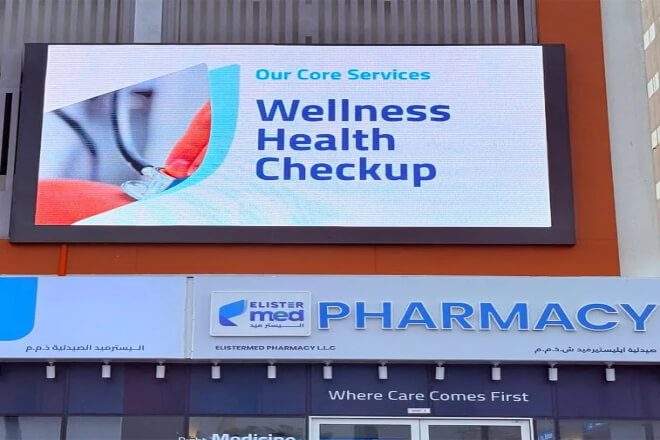
In hospitals, the speed of information updates sometimes outpaces the speed of queuing.
If information is not delivered promptly, patients may repeatedly inquire and run around, creating a chaotic atmosphere.
The emergence of LED displays largely makes this information more “rhythmic.”
For example, in the outpatient area, queueing information can be updated in real time.
Patients don’t need to constantly stare at the window or frequently ask questions; a glance at the screen is enough to keep track of their progress.
Hospital announcements, appointment reminders, and precautions can also be displayed centrally on the screen, making them clear and less likely to be overlooked.
Even more interestingly, information from multiple areas can be published simultaneously.
Whether in the waiting area, triage desk, or lobby, screens in different locations can display consistent content simultaneously.
Avoiding inconsistent information delivery and ensuring more unified and reliable information transmission.
Compared to traditional paper notices or manual notifications, LED displays offer the advantage of flexible updates and rapid response.
Without the need for repeated printing, posting, or content changes, a single update can quickly cover multiple areas, saving time, reducing labor costs, and preventing information delays.
Simply put, it acts as an “information coordinator” in the hospital, organizing and synchronizing previously scattered information.
Making it easier for patients to access information and improving the flow of orders.
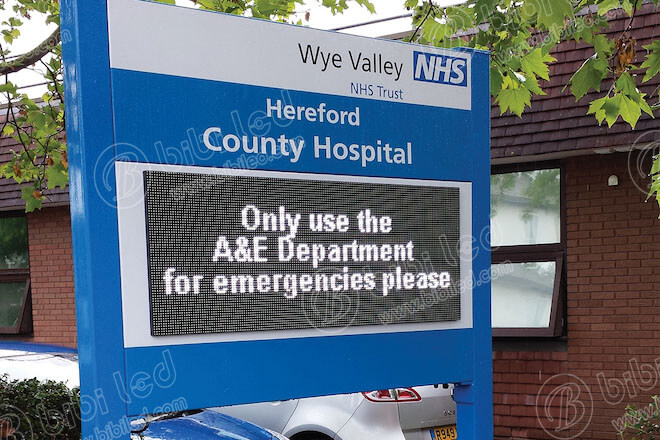
Entering a hospital can sometimes feel like entering a maze: registration, triage, waiting—the paths are complex, and information is fragmented, easily causing patients to feel lost.
LED displays act as “digital guides” in the hospital, helping every patient easily find their way.
The screens clearly guide patients through the entire process and pathways, from the registration window to the consultation room, from the waiting area to the laboratory.
Information is readily available, avoiding the embarrassment of repeatedly asking for directions or going to the wrong place.
By displaying the current process and queue status in real time, the screens also help hospitals rationally manage patient flow, alleviating congestion during peak hours and making movement and treatment smoother.
Even better, LED screens can optimize the experience in waiting areas and lobbies. Patients are no longer just staring at blank walls or anxiously waiting.
Instead, they can use the screens to learn about the treatment process, health tips, and even hospital announcements and event information, making waiting time more valuable and creating a more modern and orderly environment.
In short, LED displays are like “digital tour guides” in hospitals, not only helping patients avoid unnecessary detours but also making hospital operations more efficient.
And improving the overall patient experience—from confusion to clarity, from anxiety to peace of mind, all on one screen.
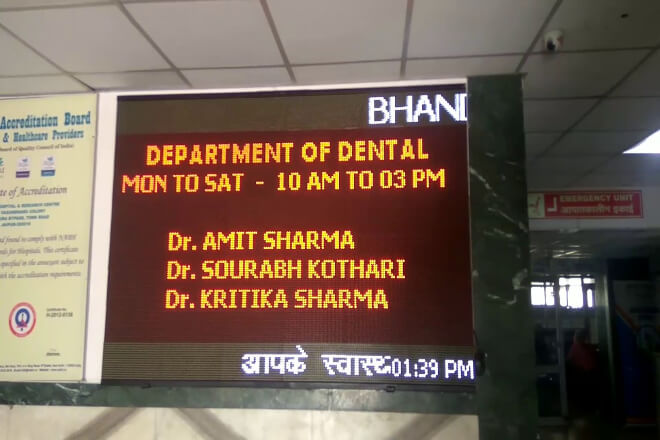
In high-density settings like hospitals, information not only needs to be “fast” but also “accessible.”
In the event of an emergency, the speed and coverage of information response directly impact on-site order and safety.
LED displays act as a hospital-wide broadcasting channel.
Whether it’s immediate notification of an emergency or rapid dissemination of public health information.
It can be simultaneously displayed across all areas, ensuring relevant individuals are quickly informed without relying on manual, one-to-one communication.
Simultaneously, LED screens play a direct role in guiding pedestrian flow and providing safety alerts.
For example, they can guide crowds during peak hours and provide alternative routes in special circumstances.
Or, they can display safety reminders in specific areas, delivering them promptly through clear and eye-catching visuals to help people move more orderly.
Compared to traditional manual notifications or scattered announcements, this method is not only faster but also has wider coverage.
Screens in multiple areas can update content simultaneously, ensuring consistent information and preventing situations where “some people know while others haven’t heard,” thereby improving overall response efficiency.
In short, LED displays in hospitals function more like a “real-time information dispatch center.”
Delivering information quickly and clearly to those who need it at critical moments, making the situation more controllable and reassuring.
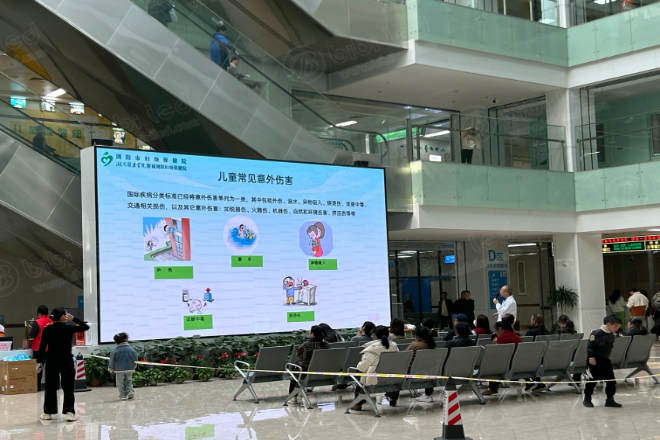
In hospitals, waiting time can be more than just “waiting.” With the right information presentation methods.
This time can become a window into health knowledge and understanding of the hospital. LED displays perfectly fulfill this role.
Through the screens, hospitals can continuously output medical and health education content, such as prevention advice for common diseases and seasonal health reminders.
Adding a sense of “learning something useful along the way” to what might otherwise be a somewhat tedious waiting time.
At the same time, patients can quickly learn about the hospital’s department setup, services.
And information on specialists and new technologies through the screens, gaining a more intuitive understanding of the hospital’s overall capabilities.
Compared to traditional posters and brochures, the advantage of LED displays is that the content can be updated at any time, and the images are more vivid and less likely to be overlooked.
Information is no longer “stuck on the wall,” but presented in a more dynamic and attention-grabbing way, achieving dissemination subtly.
In short, it’s not just about “displaying information,” but also about “telling the hospital’s story.”
It conveys health knowledge while simultaneously building a professional image, allowing patients to gain a clearer and more positive understanding of the hospital.
 English
  Español
  简体中文
简体中文  Français
  日本語
日本語  한국어
한국어  العربية