
Introduction
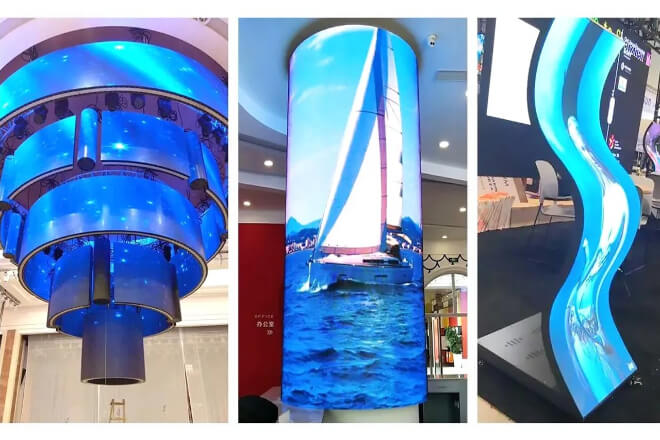
When LED displays are mentioned, many people’s first reaction is still “a large square screen.” But now, screens are no longer satisfied with being “square.”
They can bend, wrap around, hang, and even become a “glowing planet”—the boundaries of the screen are being redefined.
Table of Contents
1. How do curved LED displays create a more immersive visual space?

Traditional flat screens give the feeling of “I’m looking at a screen”, while curved LED displays offer the experience of “I’m surrounded by the image.” This is its greatest charm: turning “viewing” into “immersion.”
First, the inner and outer curved structural design adds a sense of depth to the space.
The inner curved screen acts like a “visual embrace,” giving viewers a feeling of being surrounded by the content when standing in the center.
The outer curved screen has a more architectural and futuristic feel, making it eye-catching from afar. Simply put, one is responsible for “surrounding you,” and the other for “amazing you.”
Secondly, it is very suitable for applications in exhibition halls, shopping malls, and stages.
For example, using curved screens to tell brand stories in corporate showrooms creates a more immersive experience.
Using curved screens to display advertisements in shopping mall atriums makes it hard for passersby not to take a second look.
Using curved background screens on the stage can instantly upgrade the entire stage design. Flat screens are the “background,” while curved screens are more like “part of the scene.”
At the same time, it significantly enhances the immersive feeling of the space, making it easier for viewers to “walk in.”
For example, when playing underwater world content in a digital exhibition hall, a curved screen makes you feel like schools of fish are swimming from both sides, rather than “swimming in a screen in front of you.”
This sense of immersion is difficult for flat screens to achieve.
Finally, it creates a softer, smoother visual effect. The curved design naturally reduces “hard boundaries,” resulting in more natural image transitions and softer spatial lines.
It’s like the difference between straight lines and curves—the former is “seen,” the latter is “felt.”
2. How can a cylindrical LED display become the visual focal point in a space?

If ordinary LED screens are “actors standing quietly on the wall,” then a cylindrical LED display is the protagonist standing in the center of the stage, with its own spotlight.
Its biggest feature is that it “follows you around” and “operates” wherever you go.
First, it displays content from all angles, achieving true “unobstructed visibility.” Traditional flat screens can only display in one direction, while cylindrical screens can play content simultaneously from all four sides.
For example, placing a cylindrical screen in a shopping mall atrium means customers will see it whether they’re coming from the elevator, escalator, or even a bubble tea shop—it’s hard to pretend they didn’t see it.
Second, it’s particularly suitable for “high-traffic areas” like mall atriums and brand showrooms.
For instance, a mall atrium that was originally just “a place people pass by” instantly becomes “a place where people stop to take photos” after installing a moving cylindrical screen.
Previously, people would ask, “Where’s the restroom?” Now they might ask, “Where’s that big, glowing pillar?”
At the same time, it enhances spatial recognizability, making the venue easier to remember. Imagine you’ve visited two showrooms with similar content.
But one of them features a giant, dynamic cylindrical screen in the center, looping brand videos—you’ll likely remember it when you get home: “Oh, that’s the place with the super cool big screen in the middle.”
Finally, it gives the brand a more prominent “center stage” feel. Brand logos and product animations displayed on the cylindrical screen become more impactful due to its unique structure.
While others “put up ads,” it “stands up ads.” Brands will feel: “This money was well spent, it’s impressive.”
3. How can spherical LED displays create stronger creative expression?
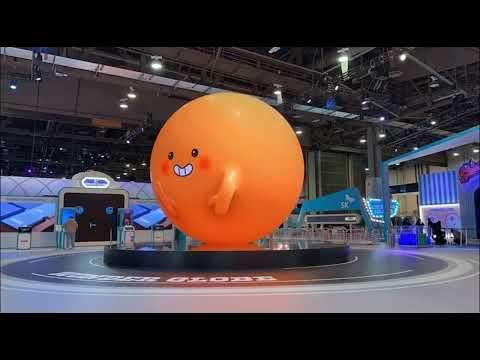
If ordinary LED screens are about “displaying content,” then spherical LED displays are more like “displaying imagination.”
After all, when a screen changes from a “flat” to a “sphere,” the creative space is instantly opened up.
First, it’s naturally suitable for displaying creative themes such as global locations and planets.
For example, when playing content such as Earth maps, galaxies, or digital planets, a spherical screen makes the image particularly “realistic”—the Earth should be round, and the universe should be three-dimensional.
Looking at an ordinary flat screen is like “looking at pictures,” looking at a spherical screen is like “looking at a rotating planet.”
Secondly, it’s ideal for science museums, large exhibitions, and brand events. For example, a dynamic globe model in a science museum will draw children in.
A glowing digital planet at a brand launch event instantly transforms the atmosphere from an “event venue” to a “sci-fi movie set.”
It’s the kind of device where, before the content even begins, the audience is already taking out their phones to take pictures.
Simultaneously, it enhances the sense of technology and interactivity, making the space more futuristic. The spherical screen itself has a built-in “futuristic technology” filter.
Combined with dynamic content, lighting, and even touch interaction, the audience will feel like they’ve stepped into a future world. The technological feel needs no explanation; it’s immediately apparent.
Finally, it creates highly recognizable visual installations that are unforgettable. Ordinary screens might be forgotten after a while.
But a suspended, rotating, glowing spherical LED screen easily becomes the “memorable point” of the entire space.
For example, someone might say, “I don’t remember much about the event, but that glowing sphere was really cool”—that’s enough.
4. How can irregularly shaped LED displays meet personalized design needs?
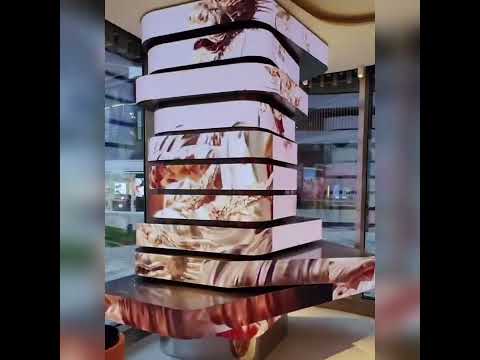
If traditional LED screens are the “standard model,” then irregularly shaped LED displays are the “high-end custom model.”
The screen no longer conforms to the space, but rather the space is designed around the screen.
First, they support various customized forms such as triangles, waves, and spliced designs. For example, in a tech brand’s showroom, LED screens can be arranged to form the shape of the company logo.
In art galleries, they can be created as “flowing wave walls”; even in retail stores, they can be used to create “glowing brand symbol walls.” While others hang screens, you’re showcasing “creativity.”
Second, they are ideal for architectural facades and art installations. For example, if a shopping mall‘s exterior wall has a traditional square screen, people will say, “Oh, there’s an advertising screen.”
But if it’s made into a wave-shaped irregular screen, when the lights come on at night, people will say, “Wow, how come this building is glowing?”—transforming from an “advertising space” into a “city landmark.”
At the same time, they satisfy the brand’s personalized expression, making the brand easier to remember. For example, a sports brand can design the screen in the shape of a “runway.”
A marine-themed hotel can be designed in a “fishtail” shape; a car brand can even be designed in the shape of a “wheel.” Brand personality isn’t just something you say; it can “grow.”
Finally, it enhances the spatial design, making the entire environment feel more sophisticated.
Designers used to say, “This area lacks a visual highlight,” but now the answer might be: “Try adding an irregularly shaped screen.” It’s not just equipment; it’s like a luminous work of art.
5. How does a naked-eye 3D irregularly shaped LED display enhance visual impact?

If a regular LED screen is “playing content,” then a naked-eye 3D irregularly shaped LED display is “creating gasps”—the viewer’s first reaction is usually not “Oh, it’s an ad,” but rather, “Wait, is it going to fall out?”
First, combining corner screens with a three-dimensional structural design creates a natural sense of spatial depth.
The most common approach is an L-shaped corner screen, where two screens are joined at a building corner, allowing the image to “fold” into the space.
For example, a car “driving out” from the screen, or a giant cat peeking out, instantly maximizes the visual impact.
Secondly, creating a naked-eye 3D effect allows viewers to “see in three dimensions” without glasses.
Through perspective design and content production, the image creates the illusion of “breaking through the screen’s boundaries.”
For example, if a bottle of beverage “pouring out” from the screen, passersby’s first reaction is often not to walk away, but to stop and ask, “Is this real?”
Simultaneously, it’s ideal for commercial advertising and urban landmark scenes.
Places with high foot traffic, such as shopping mall corners, large commercial complexes, and city squares, are natural ” traffic magnets ” for naked-eye 3D screens.
Once a brand advertisement is displayed, it immediately transforms from “promotional content” into a “spectacular event.”
Finally, it enhances dissemination and “check-in” attributes, extending offline effects online.
Many people, upon seeing a naked-eye 3D screen, don’t immediately watch it; instead, they take out their phones to record a video.
Then they share it on social media and short video platforms, instantly upgrading a screen from “on-site dissemination” to “nationwide dissemination.”
Brands will find that this screen not only displays advertisements but also “generates its own traffic.”
6. Conclusion
The value of irregularly shaped LED displays lies not only in their “unique shape” but also in making content presentation more memorable.
As screens begin to transcend shape limitations, they cease to be merely devices but become part of spatial creativity.
Sometimes, what makes you memorable isn’t the content itself, but how it’s presented.
Finally, for more information about LED displays, please contact us.


 English
  Español
  简体中文
简体中文  Français
  日本語
日本語  한국어
한국어  العربية