

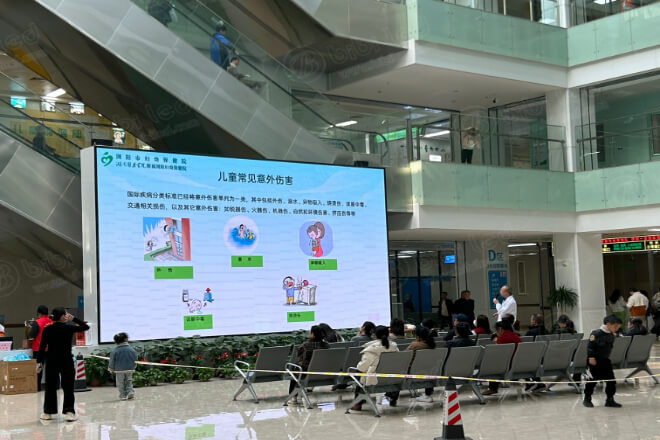
In the hospital lobby, LED displays act like “non-stop guides,” constantly helping patients quickly find their way and reducing the likelihood of “being completely lost upon entering.”
Firstly, they display registration and department information. Lobby LED screens can display real-time information such as registration windows, doctor schedules, current call numbers, and department status.
For example, upon entering the hospital, a patient can immediately see information like “Orthopedics is on the 3rd floor.”
Or “Current number of people in the pediatrics queue,” eliminating the need to ask for directions or worry about joining the wrong line.
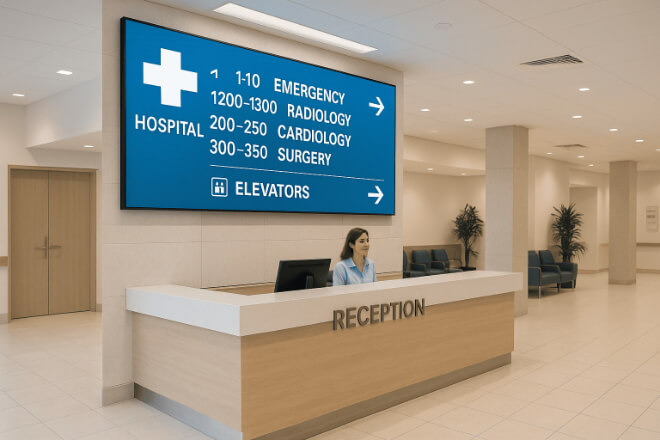
Secondly, they provide floor and route guidance. Large hospitals have many floors and complex departments, making it easy for first-time visitors to feel lost and confused.
LED screens can dynamically display floor layouts, route navigation, and elevator directions. For example, after a patient registers.
The screen directly prompts, “Please go to the Cardiology Department on the 5th floor; the elevator on the right goes directly there,” making the route clear and saving time and effort.
Secondly, it reduces the burden of patient inquiries. Previously, the most common questions heard at the information desk were, “Where is the CT room?” “How do I get blood tests?” “Where is the registration desk?”
Now, much basic information can be obtained directly through LED screens, allowing information staff to focus more on patients who genuinely need assistance.
Finally, it improves overall efficiency. Patients find their way faster, queue information is clearer, and the entire lobby flows more smoothly.
For example, during peak hours, LED screens can update window opening status and waiting progress in real time, effectively reducing crowding and back-and-forth movement.
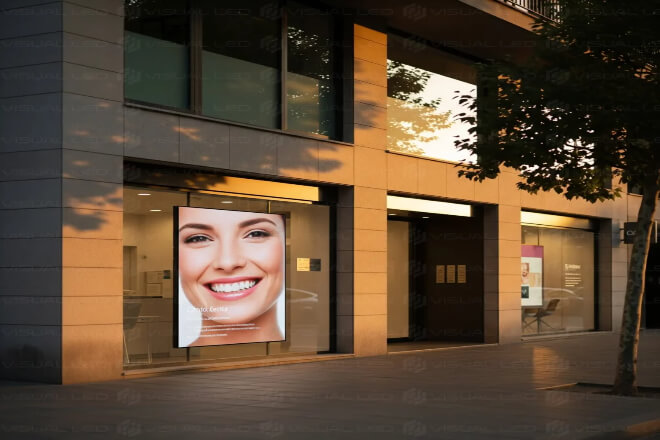
In hospital waiting areas, LED displays are not just “queue management tools,” but also act as a calming “assistant”—helping patients keep track of their queue progress and making the wait less agonizing.
First, it displays real-time call number information. One of the biggest fears for patients is looking down at their phones for a few minutes and missing their turn.
The LED screen updates the current call number, consultation room status, and waiting number in real time, so everyone can see “how many more are left before it’s my turn” at a glance.
For example, if the screen displays “Current: A1023, Next: A1024,” patients immediately feel much more at ease.
Second, it plays health education content. Waiting time is actually “golden time for health education.”
The LED screen can loop health knowledge, medication reminders, and seasonal disease prevention information.
For example, in the pediatric waiting area, it plays “The Correct Way to Handle a Child’s Fever,” allowing parents to learn practical knowledge while waiting, making the wait less agonizing.
Next, it alleviates waiting anxiety. Hospitals are inherently stressful, and if the waiting area only involves quiet queuing and “unknown waiting,” anxiety will be amplified.
Adding lighthearted health animations, soothing visuals, or real-time information updates to the LED screen makes patients feel that “time is moving,” rather than just endlessly waiting.
Finally, it improves the overall patient experience. Clear information displays reduce repetitive inquiries, and easy-to-understand content eases anxiety, making the entire waiting area more orderly and welcoming.
For example, some hospitals also display weather reminders, water recommendations, or outpatient updates on screens, making the waiting process more considerate.
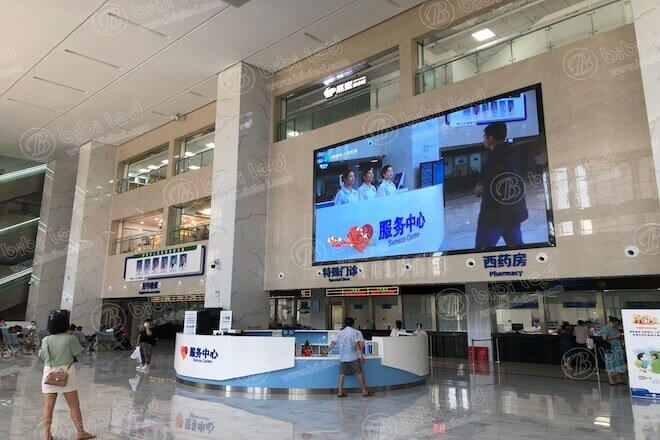
In medical conference rooms, LED displays are no longer just “tools for showing PowerPoint presentations.”
But rather like “ultra-high-definition brain-sharing screens” for doctors—details are seen more clearly, and communication efficiency is directly upgraded.
Firstly, they are used for academic conferences and remote consultations. Many hospitals now conduct cross-regional case discussions or remote consultations.
And large LED screens can simultaneously display expert images, patient data, and real-time images.
For example, on one side, a Beijing expert analyzes a case online, while on the other side, a doctor from another region asks questions simultaneously.
The whole process is like a medical version of a “video conferencing command center,” allowing everyone to communicate face-to-face without having to fly around.
Secondly, they are used to display high-definition medical images. The most dreaded question in medical training is—”Can you see this lesion?” If the screen is unclear, doctors in the back row may only be able to nod politely.
High-definition LED screens can magnify and display details in CT, MRI, and endoscopic images, making tissue edges and lesion locations easier to identify, naturally improving discussion efficiency.
Next, they improve training and communication efficiency.
Traditional projectors often require “turning off the lights + focusing + tapping,” and the image becomes grayish in slightly brighter light.
LED screens, on the other hand, have stable brightness, and the content remains clear even with meeting room lights on.
Doctors can discuss cases and take notes simultaneously without worrying about “text being too small to see.”
Finally, they meet the needs of professional medical displays. Medical images have high requirements for color, grayscale, and detail levels.
And LED screens can present image information more accurately, avoiding situations where “a slight misreading” occurs.
For live surgery, teaching and training, or case analysis, this clarity is not only a matter of experience but sometimes also a crucial basis for professional judgment.
In hospital operating rooms and monitoring centers, LED displays act as a “super information hub” for the medical team—centralizing various data, images.
And monitoring information, allowing doctors to quickly grasp the overall picture without switching between screens.
First, it provides real-time monitoring and data display. During surgery, the patient’s heart rate, blood pressure, oxygen saturation, and imaging data all need to be monitored in real time.
A large LED screen can centrally display this critical data, allowing the medical team to quickly grasp changes in patient status with a simple glance.
For example, while the doctor is focused on the procedure, the large screen simultaneously displays vital signs and endoscopic images.Enabling team members to immediately detect abnormalities and communicate promptly.
Second, it supports multi-system information synchronization. Hospital monitoring centers typically connect to multiple systems.
Such as surgical monitoring, ward data, imaging systems, and emergency alarm information.
The LED screen can simultaneously display data and images from different sources, achieving a “one-screen overview.”
Like a medical “command center,” any changes are immediately visible on the screen.
Furthermore, it improves information visualization efficiency. Compared to multiple small monitors scattered across the room, a large LED screen can clearly categorize and display key information.
For example, the left side displays real-time monitoring data, the middle displays surgical images, and the right side displays patient medical records and examination results.
Doctors and nurses don’t need to frequently switch between devices, resulting in more efficient communication.
Finally, it facilitates collaboration within the medical team. Teamwork is paramount in surgical and monitoring procedures.
LED screens synchronize information across the entire team, ensuring anesthesiologists, surgeons, and nurses all see the same data.
For example, in the event of an emergency, team members can quickly and simultaneously make a judgment, rather than one person looking at the data while others are still asking what happened.
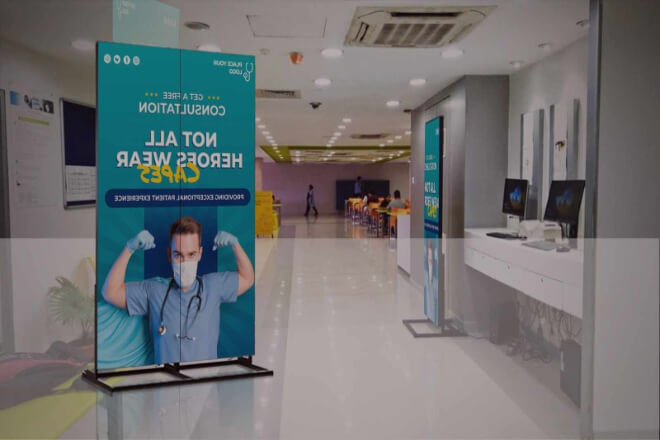
In hospitals, LED displays are no longer just “electronic bulletin boards”; they act as the hospital’s “atmosphere maker.
And information spokesperson”—both conveying messages and subtly enhancing the hospital’s professional image.
Firstly, they showcase hospital culture and announcements. Hospitals can use LED screens to display hospital history, expert teams, public welfare activities, and service philosophies.
For example, when a patient enters the lobby, seeing a screen displaying “stories of outstanding doctors.”
Or heartwarming treatment cases inspires trust more easily than a row of cold, impersonal posters, and might even make the patient think, “This hospital seems reliable.”
Secondly, they disseminate public health tips. LED screens are fast-updating and have wide coverage, making them ideal for health promotion.
For example, during flu season, screens can continuously display “correct handwashing steps” or “fever-seeking reminders,” which patients can easily read while waiting for elevators or in queues.
Compared to traditional bulletin boards, the biggest advantage of LED screens is that people might not pay close attention to the paper notices, but they’ll instinctively look up at the illuminated screen.
Secondly, they enhance the modern image of hospitals. Turning on a high-definition LED screen instantly elevates the technological feel of the entire lobby.
Especially in large hospitals, dynamic information displays, intelligent patient guidance, and unified visual content make the environment appear more professional and orderly.
Simply put, sometimes a single screen can transform an “old-fashioned bulletin board style” into a “modern medical center feel.”
Finally, they improve information dissemination efficiency. Replacing paper posters might require printing, posting, and reorganizing, while LED screens can update content in minutes.
For example, if new specialist clinics or free clinics are added that day, the backend can publish the information with a single click.
And the lobby and waiting area will be updated simultaneously, ensuring patients see it easily and don’t miss important information.


 English
  Español
  简体中文
简体中文  Français
  日本語
日本語  한국어
한국어  العربية