

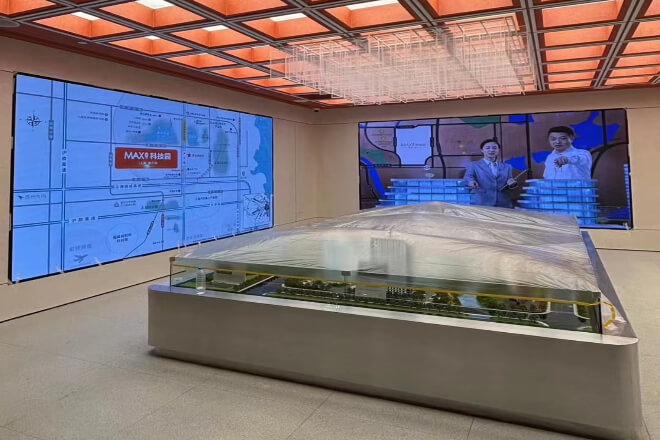
In a sales center, customers are essentially making a decision within the first 30 seconds of entering.
At this point, the LED display acts like a talking “face,” firmly establishing a strong first impression.
A large LED screen placed in the reception area or atrium easily becomes a visual focal point.
Before the property is even introduced, customers see a flowing city skyline, architectural animations, and simulated nighttime lighting.
This high-end visual style naturally elevates the atmosphere to a more “high-quality” level.
Project image videos are also crucial here. For example, showcasing the property’s location advantages, landscape design, and community amenities using dynamic visuals.
More impactful than simply presenting floor plans. Many customers aren’t first “understanding” the information, but rather “being moved.” LED screens address this crucial step.
A common scenario: a customer enters, hesitant to look around, but then looks up and sees a display combining simulated nighttime lighting of the development with aerial city views.
Their initial “just browsing” attitude shifts to “I’m serious about learning more.”
This enhanced first impression isn’t about the amount of information, but about building atmosphere and trust.
A sales center with professional, visually consistent, and high-quality visuals naturally makes customers more confident in the project’s quality.
In sales centers, many customers aren’t “unwilling to learn,” but rather “overwhelmed by the amount of information.”
A stack of floor plans, explanations of amenities, and location details—flipping through a few pages of paper brochures quickly becomes distracting.
This is where LED displays excel—they simplify complex information.
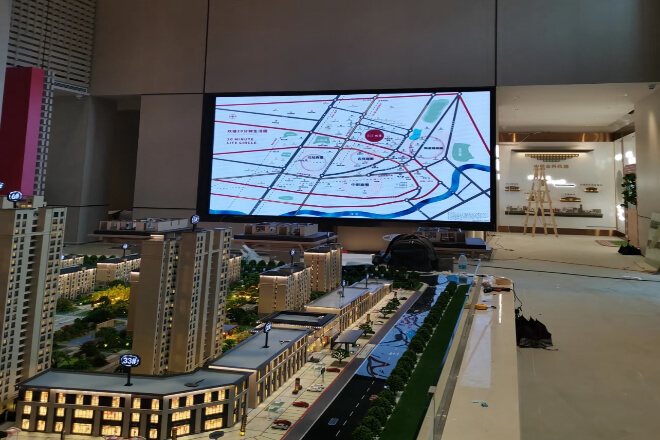
First, they provide a visual representation of floor plans, amenities, and location. For example, dynamic animations can be used to place the community’s location within a city map.
With nearby subway stations, shopping malls, and schools lighting up, providing a more intuitive experience than simply pointing to a map.
Floor plans can also be presented using 3D walkthroughs, allowing customers to “walk into the house and take a look,” which is easier to understand than looking at a floor plan.
Secondly, dynamic demonstrations create a stronger sense of immersion than printed materials.
For instance, changes in living room lighting, simulated lighting at different times of day.
And seasonal changes in the garden landscape can all be displayed on LED screens, allowing customers to directly “see what life will be like” without having to imagine it.
For a very real scenario: before the salesperson has even had a chance to explain the floor plan in detail, the LED screen has already played an animation of “morning sunlight streaming through the living room’s floor-to-ceiling windows.”
Shifting the customer’s focus from “how big is the area” to “how comfortable it will be to live in.”
Finally, the core value of this approach is helping customers quickly understand the project’s value.
It doesn’t rely on extensive textual explanations, but rather uses visuals to help customers “filter information,” transforming complex concepts into easily understandable experiences.
In a sales center, what truly keeps people engaged isn’t just a brief introduction, but rather a feeling that makes them want to linger.
In this case, LED displays are more than just a display tool; they act as a “director” of the spatial atmosphere.
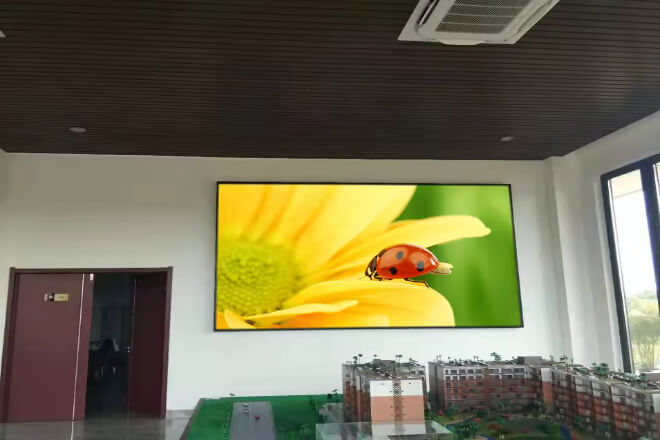
A typical approach is to link the model and the large screen in a synchronized display. While customers stand in front of the model looking at the unit layouts and building distribution.
The LED screen simultaneously presents the overall community effect, such as landscaping, nighttime lighting, and road layouts.
One shows the “structure,” the other shows the “lifestyle”—combining the two transforms the project from a model into a more complete “future scenario.”
Furthermore, the immersive experience is enhanced by the interplay of light and shadow and video.
For example, the screen can display images of morning sunlight streaming into the community, with the on-site lighting warming in sync.
Or it can showcase nighttime home routes, with the large screen’s lighting synchronized with the spatial lighting, giving customers a sense of “I’ve already moved in.”
Here’s a common scenario: A customer initially just glances at the model, but gets drawn in by the dynamic garden and seasonal changes on the large screen, and before they know it.
They’ve lingered for five or six minutes, even asking, “Can this landscape really be made like this?”—the longer they stay, the more interested they become.
The core of this immersive experience isn’t about more complex information, but about getting customers “in the zone.”
They’re not just looking at the property; they’re starting to simulate life scenarios in their minds.
At property openings or promotional events, LED displays act as “atmosphere tuners,” instantly transforming an ordinary meeting room into a visual feast.
First, there’s the on-site visual enhancement. As soon as customers enter, the screen plays aerial city shots.
And animated renderings of the property, combined with stage lighting, instantly elevating the atmosphere to a “high-end trailer mode.”
Before the property is even mentioned, the customer’s attention is already captured—like the opening seconds of a movie, you’re already hooked on the plot.
Then there’s real-time playback and guidance. The lucky draw, registration information, process prompts, and even the key points emphasized by the host can all be displayed synchronously on the screen.
Customers don’t need to look around or miss any information; watching the screen is like having an invisible assistant guiding them through the entire event.
Dynamic visuals also create pacing: when the floor plan animation is shown, the screen’s lighting changes in sync.
When announcing special offers, a countdown animation immediately creates a sense of urgency.
Throughout the event, information and visuals are synchronized, firmly capturing customer attention and naturally increasing engagement.
For example, at a sales launch, the large screen first displays an aerial view of the city at night, then a countdown animation flashes.
And as soon as the host begins speaking, the screen switches to animations of floor plans and the landscape.
Customers feel as if they are “drawn into the story,” sitting there and unconsciously imagining what it will be like to live there in the future.
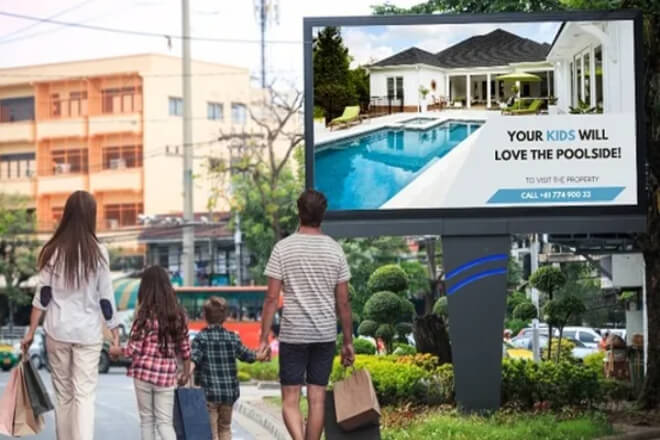
In sales centers, the most common problem for many projects is not “no one looks,” but rather “once seen, it loses its novelty.”
The value of LED displays lies in their ability to keep a project “online,” constantly refreshing customer attention.
First, different information is displayed at different stages. For example, in the early stages of a project, the focus is on the city’s image and development vision.
In the mid-stage, the emphasis is on showcasing apartment types, model homes, and amenities.
And in the later stages, promotional policies, delivery information, or actual photos of completed units can be prominently displayed.
The LED screen content changes with the project’s pace, ensuring customers see something different each time they visit.
Second, sales and event content are dynamically updated. For example, daily sales reports, best-selling unit rankings, the latest promotional policies, and visitor event reminders can all be updated on the screen in real time.
This sense of continuous change makes the site feel more lively and creates a more authentic sales atmosphere.
Combined with the flexible switching of content, the entire sales center doesn’t feel static.
Customers might have visited last week to see a planning video, this week to see actual photos of completed units and sales data.
And the next time to see holiday events or exclusive offers, naturally making the project feel constantly evolving.
A common scenario is: the first time a customer visits, they see an animation of the city’s planning.
The second time, they see an immersive display of model homes; and the third time, the large screen is scrolling through “Today’s Top Selling Units.”


 English
  Español
  简体中文
简体中文  Français
  日本語
日本語  한국어
한국어  العربية