
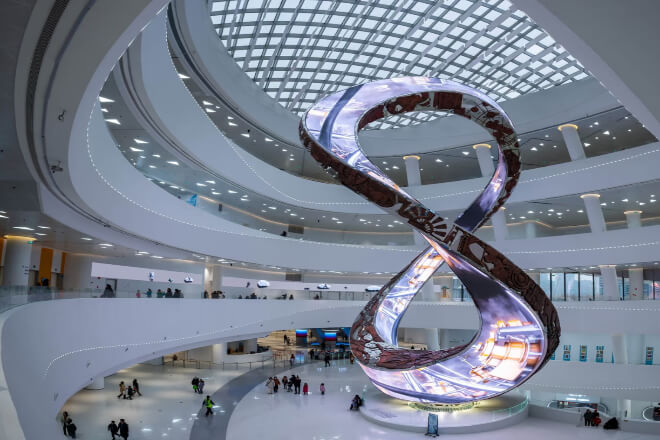
Many commercial spaces don’t suffer from a lack of space; they appear too flat.
Flat walls, flat backgrounds, flat screens—the entire space resembles an enlarged PowerPoint presentation.
Wave-shaped LED screens can utilize their undulating structure to add variation to an otherwise regular space.
The screen’s height rises and falls with the walls, ceiling, or other architectural elements, and combined with dynamic content, the visual layers become much richer.
For example, a large digital backdrop made of wave-shaped LED screens can be used in a shopping mall atrium to display flowing water ripples, ribbons, or brand animations;
A hotel lobby can opt for a softer, more natural visual style, allowing the wave shape and lighting to create a specific atmosphere;
And brand experience stores can customize the wave structure based on their logo or product lines, giving the screen a distinct brand identity.
More interestingly, the wave shape doesn’t just make the screen “look special”; it can also alter the viewer’s visual flow.
The image extends forward along the undulations, making the space appear more layered.
Therefore, the true function of wave-shaped LED screens is not simply to transform a flat surface into a curved one, but to allow the screen to “shape” itself in conjunction with the architecture.
A plain wall, with the addition of waves, can transform from a “background” into a “protagonist.”
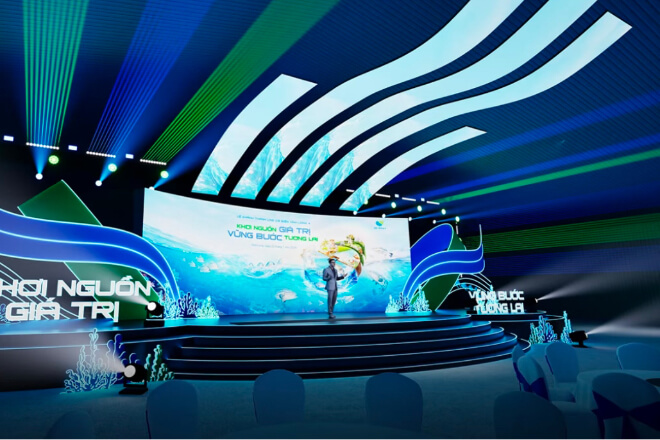
Wave-shaped LED screens already possess a sense of “undulation,” so if the image remains static.
It would be a waste of this design. Since the screen is “wavering,” the image shouldn’t be too static either.
Based on the wave structure, you can select content with a sense of flow, such as water, clouds, light, smoke, and particles, allowing the image to naturally extend along the undulations of the screen.
This way, the viewer sees not just a unique shape, but a visual effect of continuous forward flow.
For example, in an exhibition hall, blue water can flow gently along the wave screen, making the entire wall appear to be flowing; in an art space, clouds and light effects can be projected, creating layers in the image as the screen rises and falls;
In a commercial complex, brand advertising can be integrated, allowing products, logos, or lighting effects to unfold along the wave structure.
This design also has a small advantage: the shape of the LED screen itself and the content can “coordinate.”
As the wave rises, the image extends upwards; as the wave falls, the light can also sink downwards.
What was originally just playing a video becomes more like a visual performance for the space.
Of course, the dynamics don’t need to change at a constant high speed. Controlling the rhythm according to the scene makes the image more visually pleasing.
Therefore, the focus of wave LED screens is not just “the screen has waves,” but making the content flow along with the waves.
The screen is responsible for creating the waves; the image is responsible for making those waves actually move.
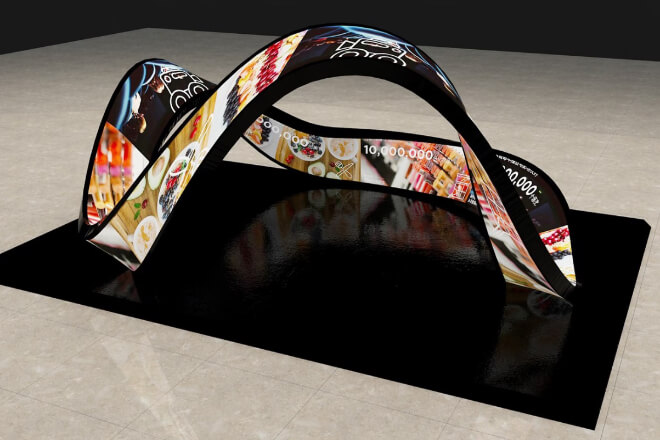
Ordinary LED screens are more like a “digital window,” with viewers standing in front of it.
Wave-shaped LED screens take this a step further—making the image appear to “grow” out of the space, rather than hanging on a wall.
In entertainment venues, themed spaces, and exhibition halls, the undulating structure of wave-shaped screens can reduce the sense of boundaries found in traditional flat screens.
Combined with music and lighting, the image, sound, and space become a unified whole.
For example, themed entertainment spaces can use wave-shaped screens to display forest, ocean, or starry sky scenes.
The image extends outwards with the screen’s undulations, and with ambient music and lighting changes, viewers entering feel not just seeing a screen, but entering another scene.
Exhibition halls can also use this method to display artworks. For example, displaying a “flowing ocean,” with water ripples following the screen’s structure and lighting gradually changing from cool tones.
Allows viewers to experience a strong sense of immersion without even needing VR equipment.
In entertainment venues, the content can also change with the rhythm of the music. When the music starts, the waves begin to “undulate”; when the lighting changes, the mood of the entire space changes accordingly.
Therefore, the immersive experience of wave-shaped LED screens doesn’t just come from their unique shape, but from the combined effect of shape, visuals, sound, and lighting.
When the screen no longer resembles a wall, viewers are more likely to forget that they are actually standing in an ordinary room.
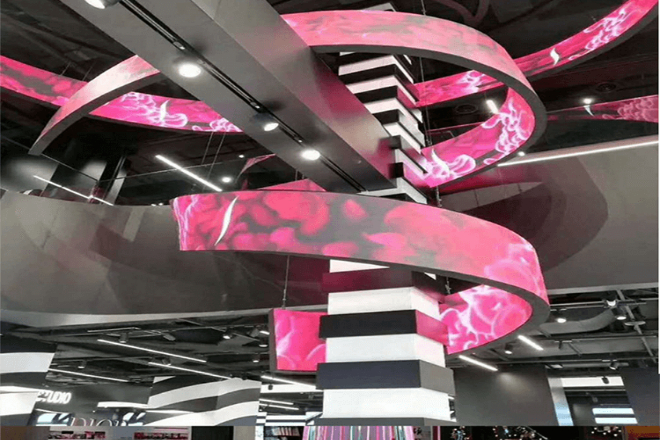
Many brand spaces are striving to create their own unique identity, but if the final result is still just a plain rectangular LED backdrop.
It feels somewhat like “the interior design is creative, but the screen follows the crowd.”
Wave-shaped LED screens can tell a brand story from the very form. Customizing the screen structure based on the brand’s visual style, logo lines.
Or product characteristics allows the LED screens to become more than just content displays; they become a direct visual symbol of the brand within the space.
For example, car showrooms can design wave-shaped screens inspired by racetrack curves and car body lines, allowing dynamic images to undulate along the screen, displaying race cars, car models, or brand stories.
Flagship stores can incorporate the curves of the brand logo to create a unique wave structure, making the space instantly recognizable to customers.
Brand experience centers can also change content based on different events. New product launches showcase product visuals, brand events play themed content, and at other times, brand stories or artistic animations can be played.
The screen’s form remains the same, but the content is constantly updated, preventing the brand space from becoming tiresome.
More importantly, when consumers take photos, share them, or post short videos, the wave-shaped LED screen itself can become part of the image. Over time, people may associate this unique shape with a particular brand.
Therefore, the true value of wave-shaped LED screens lies not in proving “we can also make irregularly shaped screens,” but in aligning the screen’s shape, content, and brand personality.
The ideal effect is: the logo may not be visible, yet customers already know “whose style this is.”
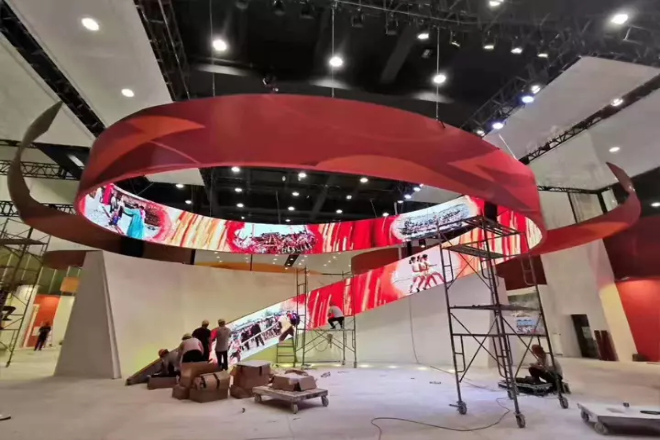
The biggest fear for wave-shaped LED screens isn’t a lack of uniqueness, but rather playing the same content 365 days a year after installation.
Even the most beautiful design will become a “familiar wall” after a while.
Therefore, content updates are key to keeping wave-shaped LED screens fresh. Shopping malls can switch between different themes for Chinese New Year, Christmas, Black Friday, anniversaries, and promotional events;
Hotels can adjust their visuals for weddings, banquets, holidays, and brand activities; and clubs can constantly change content around competitions, parties, and member events.
For example, a shopping mall might normally display soft, flowing light and shadow to create a sophisticated feel; at Christmas, the wave screen instantly transforms into a “flowing snow scene”;
And for anniversaries, it changes to the brand logo and celebratory animations. The screen itself remains the same, but the entire space feels transformed.
The same applies to event spaces. The same wave LED screen can serve as a backdrop for business events in the morning, a party backdrop in the evening, and a sports broadcast backdrop on weekends.
This not only reduces the hassle of frequently changing physical backdrops but also allows a single screen to serve multiple purposes.
Furthermore, continuously updated content keeps consumers engaged and entertained. The first visit might be, “This screen is really special,” the second, the image might have changed, and by the third, consumers might be actively taking photos.
Therefore, the long-term value of wave LED screens depends not only on their initial aesthetic appeal but also on their ongoing operation.
A good creative screen isn’t just about a “one-time wow factor,” but about the ability to make a space wow again and again over time.


 English
  Español
  简体中文
简体中文  Français
  日本語
日本語  한국어
한국어  العربية