
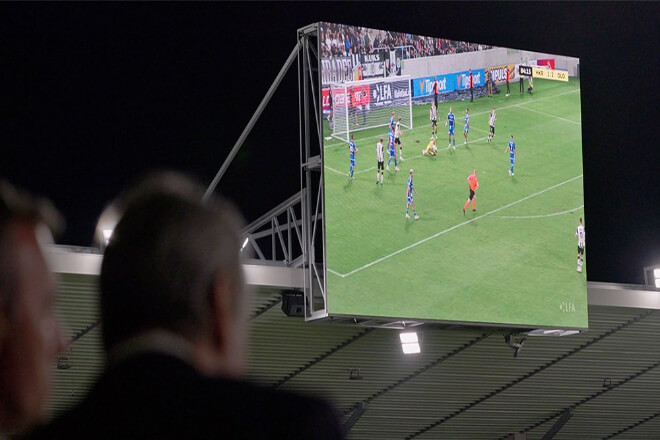
- High-Resolution Display
LED displays boast extremely high resolution, capable of presenting every detail of the game with exquisite detail.
For example, in a football match, viewers can clearly see the players’ footwork, the trajectory of the ball in the air, and even the slightest vibration of the net.
In a basketball game, the moment a player makes a precise shot and every defensive move by the opponent can be captured.
This high-definition presentation not only enhances the live viewing experience but also allows viewers far from the stadium to experience a near-live visual sensation during replays.
- High Brightness and Contrast Ratio
The high brightness and excellent contrast ratio of LED displays ensure clear images under various lighting conditions.
Even under strong sunlight during the day or in outdoor stadiums with complex lighting at night, the screen image remains vivid and rich in detail.
The advantages in brightness and contrast also make slow-motion replays clearer and the outlines of fast-moving objects more distinct.
Allowing viewers to easily capture every exciting moment and not miss any key points of the game.
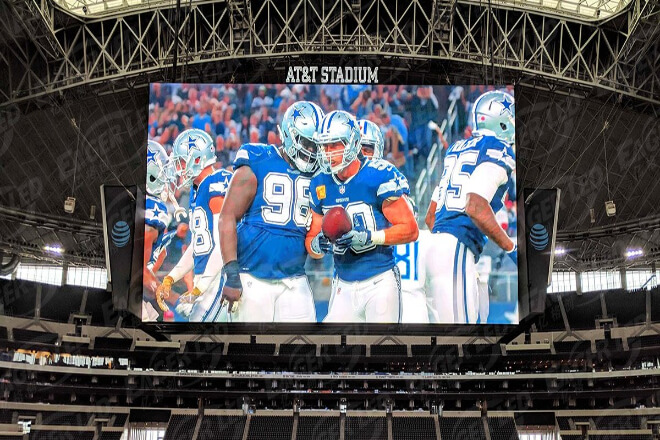
- Wide Viewing Angle Display
LED displays offer an extremely wide viewing angle, ensuring a clear view of the game whether you’re sitting in the center of the stadium, on the side, or in a corner far from the field.
Traditional screens tend to dim or distort colors when viewed from a distance, but LED displays almost never have this problem.
Viewers can enjoy the same clear visual effect without having to turn their heads or move to a different position.
- Improved Multi-Viewing Experience
In large stadiums, spectators are widely distributed, and sometimes those farther from the field may miss exciting moments on the field.
LED displays, with their uniform brightness and wide viewing angles, allow viewers at a distance and in corners to clearly see player movements, the trajectory of the ball, and even the referee’s decisions.
For example, in basketball games, even spectators sitting near the three-point line can clearly see the players’ shooting form and teammates’ coordinated movements.
In football games, spectators on the sidelines can keep up with the fast pace, experiencing almost the same tension and excitement as those in the center of the field.
This multi-faceted viewing experience ensures that no spectator misses a key moment in the game, making the atmosphere more vibrant and interactive.
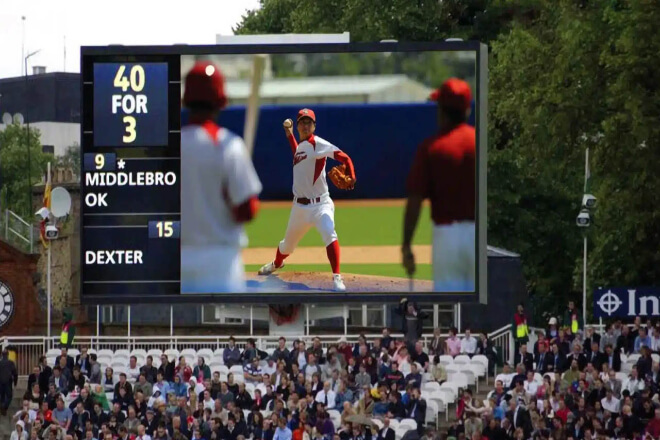
- Real-time Statistics and Data Display
LED displays can instantly show game data, such as score, player points, assists, free-throw percentage, and even remaining time.
For example, in an NBA game, when Stephen Curry makes a three-pointer, the screen immediately updates the score and displays his personal scoring statistics, allowing spectators in the arena to know the latest developments in the game.
This real-time information not only allows spectators to keep up with the pace of the game but also enables them to discuss player performances with friends, increasing interactivity.
- Slow-Motion Replay
When exciting moments occur, LED displays can immediately play slow-motion replays, allowing viewers to appreciate every detail.
For example, in a World Cup soccer match, when Messi breaks through the defense and scores, the screen replays the ball’s trajectory, the player’s footwork, and the goalkeeper’s save.
In a basketball game, when LeBron James makes a spectacular dunk, viewers can see the moment he leaps into the air and the defender’s reaction.
Slow-motion replays allow viewers not only to “understand” the game but also to feel its tension and excitement.
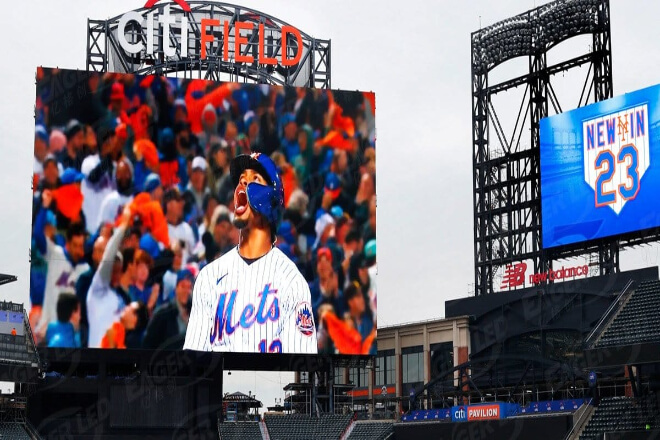
- Large Screen Splicing and Seamless Displays
LED displays can be modularly spliced to form giant screens, presenting the entire game in its entirety.
No matter the size of the venue, viewers can see a continuous and clear picture.
For example, in the Super Bowl, the LED screens in the center and on both sides of the stadium are spliced together to form a giant screen.
Allowing spectators in the farthest stands to clearly see players sprinting, passing, and even subtle movements.
It’s as if you’re in the center of the stadium. Seamless displays avoid the visual fragmentation caused by the gaps in traditional large screen splicing, making the picture more natural and fluid.
- Precise Coverage of Every Seat
Large venues often have widely distributed seating, making it difficult for spectators far from the field to see the details of the game clearly.
By combining multiple LED displays, full coverage can be achieved, ensuring that every spectator enjoys a clear view of the game.
For example, during the basketball games at the Tokyo Olympics, LED screens installed around the perimeter of the stadium allowed spectators in corners to see players shooting, rebounding.
And even the coach’s tactics, allowing every spectator to experience the tension and exciting moments of the game.
Precise coverage not only enhances the viewing experience but also strengthens the atmosphere, making the entire venue more engaging.
- Advertising and Brand Promotion
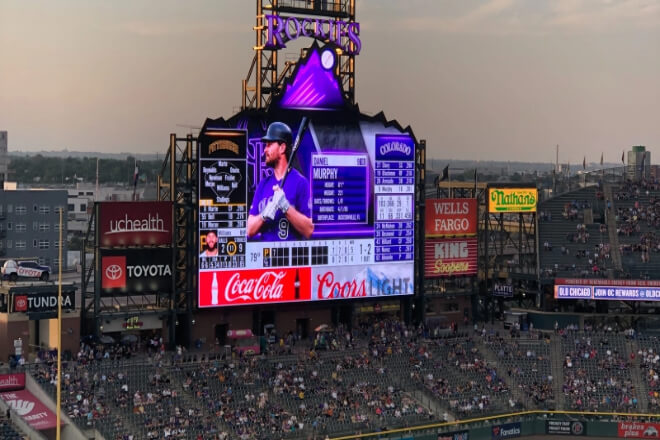
LED displays are not only used for broadcasting games but can also simultaneously display advertising and brand information, enhancing both commercial value and the viewing experience.
For example, in English Premier League matches, when a player breaks through the penalty area or scores a goal.
The screen instantly updates the score and game data while simultaneously displaying sponsor advertisements.
Or brand promotions, allowing viewers to easily receive brand information while enjoying the game.
This approach avoids disrupting the game’s flow while providing advertisers with high-frequency exposure opportunities, achieving a win-win situation for both the event and the business.
- Multi-screen display
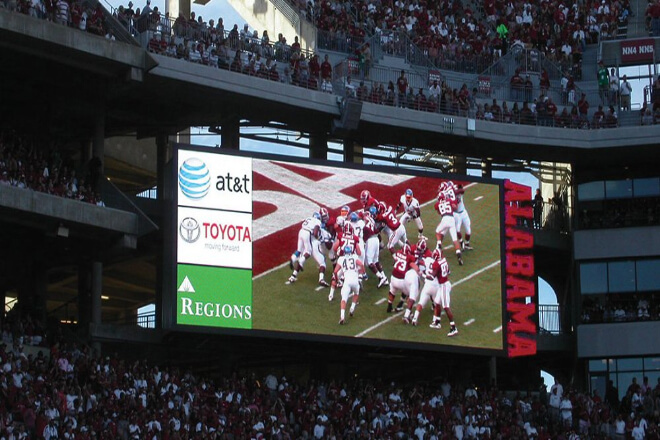
LED displays can show multiple images or information on a single screen, allowing viewers to grasp more content.
For example, in a large basketball game, the main screen displays live footage, a smaller screen in the lower left corner can replay key shots.
And the upper right corner displays player statistics, even showing the live score of another game.
This way, whether viewers want to watch the entire game or focus on player performance and statistics, everything is readily available.
Multi-screen displays enrich the event information and provide viewers with an immersive, multi-angle experience, increasing viewing enjoyment and engagement.
- High refresh rate and low latency
LED displays have a fast refresh rate and low latency, ensuring a very smooth broadcast without any stuttering or jerky movements.
For example, in a basketball game, when a player makes a quick layup, the screen can display the ball’s trajectory and the player’s movements completely and continuously, making viewers feel as if they are watching the game courtside.
High refresh rates also make fast-paced action clearer, ensuring no exciting moment is missed.
- Real-time synchronization
LED displays also ensure complete synchronization between the game footage and data. For example, in a football match.
When the score changes, the scoreboard, player statistics, and match time are updated instantly, perfectly matching the live game.
This way, viewers won’t be confused by information lag or miss any crucial moments, resulting in a smoother and more immersive viewing experience.
 English
  Español
  简体中文
简体中文  Français
  日本語
日本語  한국어
한국어  العربية