

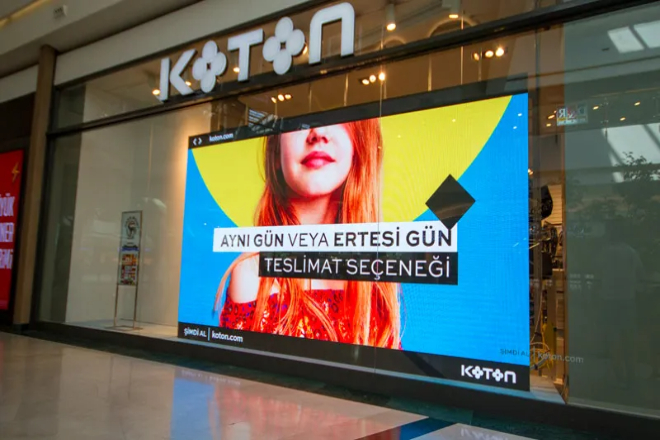
In commercial complexes, customers pass countless shops and brands daily. The problem is: being seen once is easy, but being remembered is not.
The value of LED displays lies in their continuous, high-frequency content display, keeping brands constantly in the customer’s view.
Firstly, LED screens can continuously play tenant advertisements around the clock, keeping brands constantly “present.”
Whether it’s new product launches, limited-time offers, or brand promotional videos, these can be repeatedly displayed on the mall’s main passageways, atrium, or entrance screens.
Customers might only glance at a brand the first time, have some impression the second time, and start remembering the brand name the third time.
For example, you might not be planning to buy sneakers, but if a brand’s ad appears in front of you several times a day, it’s likely to be the first brand that comes to mind when you actually need to buy a pair.
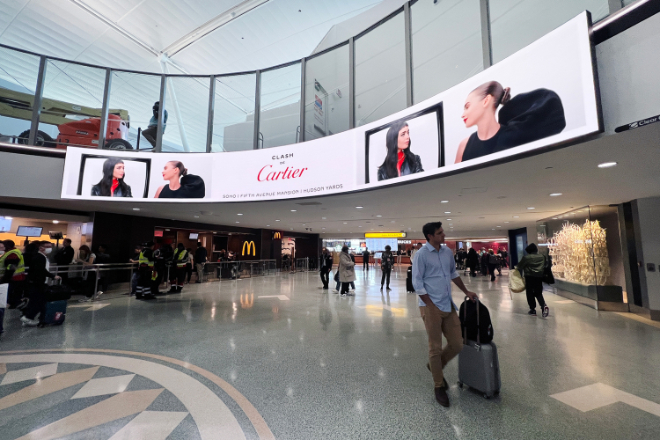
Secondly, it increases customer attention to the brand, making it easier to spot. Compared to static posters, the dynamic images, video content, and visual effects of LED screens are more likely to attract attention.
Especially in high-traffic areas, a large, eye-catching screen is often more attractive than ten ordinary posters.
Simply put: static advertising is like saying “I’m here”; LED advertising is like saying “Hey, look at me.”
At the same time, it enhances tenant awareness, helping brands gain more exposure. For newly opened brands or new tenants, LED screens can quickly increase exposure.
Even if customers don’t immediately enter the store, they’ve already become familiar with the brand.
Interestingly speaking, in shopping malls, some brands seem “everywhere” not necessarily because they have the most stores.
But because they always seem to appear perfectly within the customer’s line of sight.
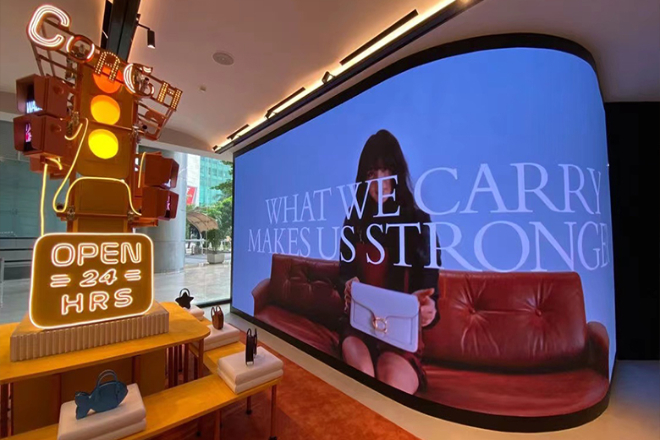
In commercial complexes, customers are bombarded with various advertisements every day.
Static posters are easily overlooked, while dynamic LED display content acts like “moving eyes,” making it hard to ignore.
First, videos, animations, and interactive content are more eye-catching than static images.
For example, a beverage brand playing a slow-motion animation of an iced drink sliding into a glass on an LED screen.
Or a 3D animation showcasing a new shoe model rotating, is more likely to draw attention than a regular poster.
Second, it guides customers to actively engage with the tenant’s products or activities.
LED screens not only display visual content but can also incorporate interactive elements, such as scanning QR codes for prize draws, voting, and AR experiences, transforming passive viewers into active participants.
For instance, a clothing brand displaying “Scan to try on new AR styles” on its screen will inevitably prompt customers to stop and experience the new look.
Simultaneously, it increases store traffic and sales opportunities.
Once customers are attracted by an LED screen, they are more likely to enter the store to learn about the products and even make a purchase.
Dynamic content not only grabs attention but also creates real commercial value.
To put it more interestingly, static posters are like “shouting out advertisements,” while dynamic LED content is like a “performance show.”
Making customers unconsciously want to approach, interact, and even take photos to share.
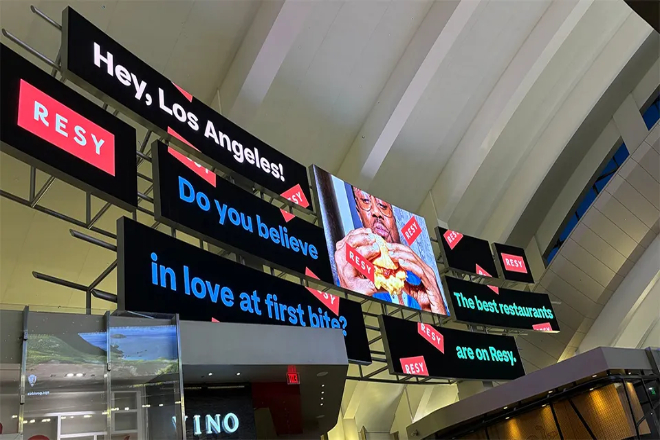
In a commercial complex, while a single LED screen is crucial, customer routes are constantly changing, making it difficult for a single display to reach all potential customers.
This is where a multi-point LED display layout comes in handy—making the brand “ubiquitous,” naturally increasing reach.
First, install LED screens at key locations such as mall entrances, elevator entrances, main passageways, and corridors.
Entrance screens capture the first impression, elevator screens attract attention while customers wait, and corridor screens maintain visual impact.
This way, brand information is continuously displayed regardless of which direction customers enter or move from.
For example, customers see new product promotions at the entrance, promotional information appears on screens while using the elevators, and interactive activities are displayed in the corridors.
Multiple exposures create a deeper brand impression—like “invisibly etching the brand into their minds.”
Second, maximize customer contact frequency and increase exposure opportunities. Research shows that when the same brand appears more than three times, customer recall and interest significantly increase.
A multi-point LED screen layout perfectly fulfills this need, naturally increasing brand reach frequency.
Simultaneously, it increases tenant exposure, allowing more customers to see advertising content.
Not only anchor tenants, but also secondary shops can gain continuous exposure through cleverly placed LED screens, fairly sharing the mall’s foot traffic benefits.
To put it more interestingly: Previously, you might have simply passed by a newly opened coffee shop without noticing it.
Now, it’s “staring at you” from the entrance, corridors, and escalators, making you think—”Oh, this shop seems really popular!”
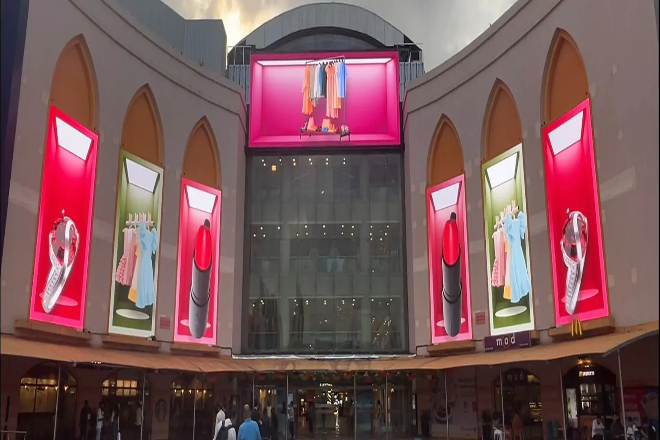
In commercial complexes, advertising is no longer as simple as “playing the same content on a loop all day.”
Truly effective advertising requires showing the right content to the right people at the right time. LED displays combined with data analysis can achieve more precise content operation.
First, the content played can be adjusted based on foot traffic and time of day, making the advertising more targeted.
For example, during weekday lunch hours, restaurant brand advertisements can be played more frequently.
During evenings and weekend peak hours, new product promotions, limited-time offers, or popular brands can be emphasized.
For example, playing a coffee promotion at 3 PM might not be very effective.
However, playing a “buy one get one half price” ad during the afternoon tea peak will have a completely different appeal.
Secondly, precise targeting improves ad conversion rates. Different areas have different audiences.
Areas near children’s businesses are suitable for playing content related to family activities and children’s brands.
Fashion floors are better suited for promoting clothing, cosmetics, and trendy new products.
Simply put, instead of showing everyone the same ad, it’s better to show different groups content that better meets their needs.
At the same time, it helps tenants evaluate the ROI of their promotions, making ad performance visible.
Through foot traffic statistics, playback time analysis, and event data comparison, the mall and tenants can understand:
Which time slots are most effective
Which ad content receives the most attention
Which events bring more foot traffic and spending
This way, subsequent promotions no longer rely on guesswork but are continuously optimized based on real data.
To put it more interestingly: Previously, ad placement was like “casting a wide net,” hoping someone would bite.
Now it’s more like “intelligent navigation”—the system can find the best route for you, determining where the crowds are, when it’s most effective, and what content is most likely to generate sales.
Finally, for tenants, this data-driven operation offers an additional benefit: it allows for clearer measurement of where advertising budgets are spent and what results they generate.
After all, what people want to see most isn’t “how many times the ad was played,” but “how much business the ad brought in.”
In commercial complexes, customers don’t just “see ads”; they want to participate and experience.
LED displays combined with interactive marketing can transform static displays into engaging interactive stages, creating a genuine connection between brands and customers.
Firstly, LED screens can be combined with features like QR code scanning, raffles, and social interaction.
For example, customers seeing a raffle notification on the screen can scan a code to participate and have a chance to win coupons or small gifts.
Or they can post photos and comments on a social wall, which are immediately displayed on the large screen, enhancing engagement.
For instance, a clothing brand held a “Styling Challenge” on a mall’s LED screen.
Customers scanned a code to upload photos of their outfits, and after judging, the photos were projected directly onto the screen, allowing all customers to see their own or their friends’ work.
This not only increased engagement but also made the brand image more vivid and engaging.
Secondly, increasing the frequency of brand-customer interaction ensures that brands are no longer just fleeting impressions.
Traditional advertising relies on visual memory, while interactive advertising relies on participatory memory.
When customers participate in an activity and see their content appear on the screen, they naturally develop a strong impression of the brand.
Simultaneously, it enhances the marketing effectiveness and memorability for tenants. Interaction not only increases exposure but also boosts conversion opportunities.
Customers who participate are more likely to enter the store and make a purchase, or share on social media, creating secondary dissemination.
To put it more interestingly: Previously, brand advertising was like “shouting slogans,” but now LED interactive marketing is like “inviting customers to perform on stage.”
Once customers are on stage, brand memory is firmly etched in their minds.

 English
  Español
  简体中文
简体中文  Français
  日本語
日本語  한국어
한국어  العربية