
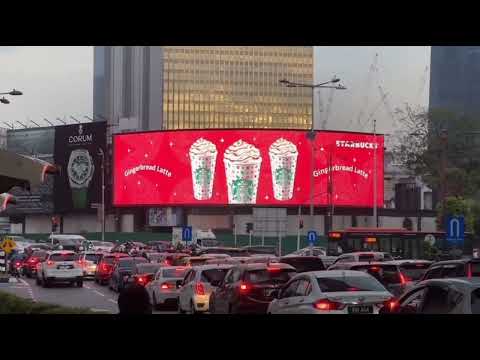
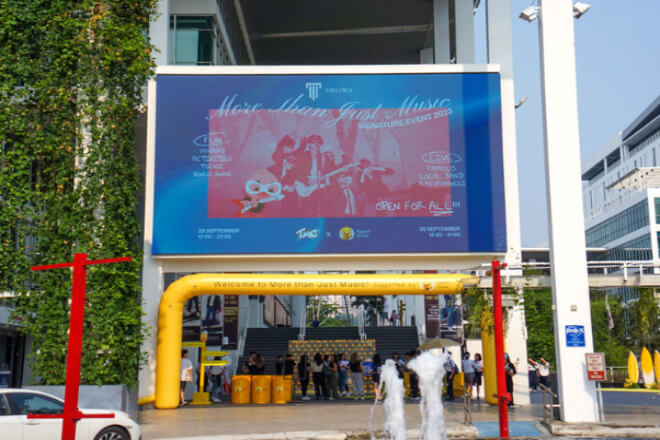
At high-traffic intersections, a daily “battle for attention” is taking place—signs, advertisements, traffic, and crowds all vie for your fleeting glances.
The advantage of LED displays lies in the fact that they aren’t the quietest, but rather the easiest to “see naturally.”
Firstly, there’s the “instinctive attraction” of dynamic images. Humans are naturally more sensitive to moving objects.
You might be waiting at a traffic light, but a moving image catches your eye out of the corner of your eye, and you subconsciously take another look.
Often, advertisements don’t appear on your own initiative; they “jump into your field of vision.”
Secondly, there’s the amplification effect in areas with heavy traffic and pedestrian flow. Intersections are places where people pause and slow down, and those few seconds are crucial.
LED screens offer high brightness and clear images, acting like a “spotlight” in a crowd, making it easier to leave an impression during those brief moments.
Another advantage is increasing the “number of times” you’re seen. You might pass by once today, again tomorrow, but you might only truly remember the brand on the third visit.
LED screens, appearing repeatedly in fixed locations, are like a familiar face greeting you every day; over time, you naturally remember them.
Another interesting phenomenon is that you might not have intended to see the advertisement at all.
But after walking away, you might suddenly think, “I vaguely remember that one.” This is the effect of high-frequency exposure combined with dynamic visuals.
To put it more vividly: at a busy intersection, an LED display screen is like someone constantly “waving hello”—not always responding, but hard to ignore.
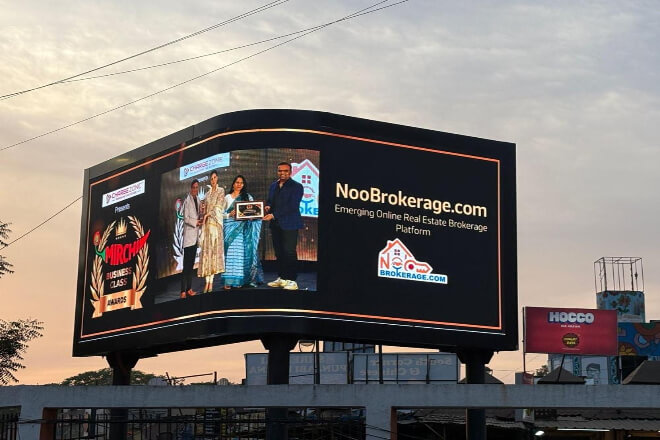
If advertising is likened to “greeting,” then many traditional light boxes are somewhat reliant on luck—they might be overshadowed by the sun during the day, or too bright to be seen at night.
LED displays are more like a self-regulating “social media expert”: they know exactly when to be bright and when to be soft.
First, there’s their daytime performance. Under bright sunlight, many images fade, but LED screens are self-illuminating and bright enough to steadily highlight content, like having their own mini-sun.
When you pass by, you don’t need to actively seek them out; they’re already firmly in your sight.
Second, there’s their nighttime adaptability. At night, they don’t stubbornly maintain high brightness but automatically dim, keeping the image clear but not glaring.
Simply put: visible, but not blinding—this comfort is a significant plus.
Furthermore, there’s a stable output throughout the day. Whether it’s midday sun, evening backlighting, or nighttime lighting conditions.
They maintain a “just right” display effect, without flickering brightness or suddenly becoming unsightly.
Another interesting point is that, unlike inkjet printing, which relies on light, LED screens “live by their own light.” No matter how the environment changes, it maintains its presence.
To put it more vividly: an LED display screen is like a “24/7 online performer”—not overshadowed during the day.
Not stealing the spotlight at night, always maintaining a comfortable and easily noticeable state.
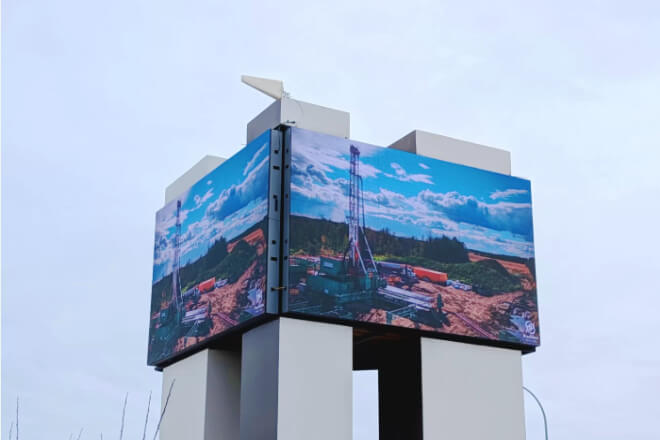
If traditional advertising is like a “poster that’s stuck on and doesn’t move.”
Then an LED display screen is more like a stage actor with a script—not just performing one show, but changing the plot at any time.
First, there’s the ability to remotely and quickly change content. Previously, changing ads was like “moving house on-site”; now, with just a click from the backend, the image is updated.
You can even be drinking coffee in your office while the screens on the street have already changed their content, giving you the feeling of “remotely controlling city advertising.”
Second, there’s the ability to deploy content according to time and scene.
The same screen can talk about “convenience on the way to work” during the day, “what to eat” at lunchtime, and then switch to “discounts and entertainment” in the evening.
Like a skilled conversationalist who automatically changes topics according to the time, it’s seamless, organized, and quite thoughtful.
Furthermore, multiple brands can share the same advertising space. A single advertising space no longer belongs to a single brand.
But rather operates like a “shift stage,” with each brand taking turns to perform. The screen itself becomes a “prime time scheduler.”
Another interesting change is that advertisements are no longer “permanently plastered on the wall.”
But rather “dynamic, dynamic, and scheduled.” The same location can host several different short dramas throughout the day.
To illustrate further, an LED display screen is like a “tireless advertising host,” broadcasting morning rush hour content, switching to everyday life scenes at noon.
And changing to a promotional atmosphere in the evening—separating effortlessly throughout the day.
If traditional advertising is about “saying a sentence,” then LED displays are more like performing an entire story for you.
Firstly, there’s the upgraded expression brought by dynamic video. Static images can only convey a moment.
But LED screens can use image transitions, rhythm changes, and even short storylines to “tell the whole story.”
Introducing the same product, one uses images, the other a dynamic demonstration—the viewing experience is on a completely different level.
Secondly, it’s more suitable for high-end brands and creative content. Many brands don’t just need to be seen, but rather to be remembered and perceived as high-quality.
The high brightness, high-definition image quality, and large size of LED screens give the visuals a more theatrical feel, making them ideal for content with strong design and high visual impact.
Another advantage is enhancing advertising memorability. People are more likely to remember things that are moving, especially in urban environments.
The dynamic visuals of LED screens often grab attention quickly, keeping the brand in mind for a few seconds—and those few seconds are sometimes enough to form a lasting impression.
Another crucial point is strengthening brand image.
Brands that are consistently displayed on high-quality LED screens gradually develop a more modern and technologically advanced visual perception, not just seen once, but repeatedly reinforced.
To put it more vividly: static advertisements are like “a sentence written on a wall,” while LED displays are more like “a short film playing in front of you.”
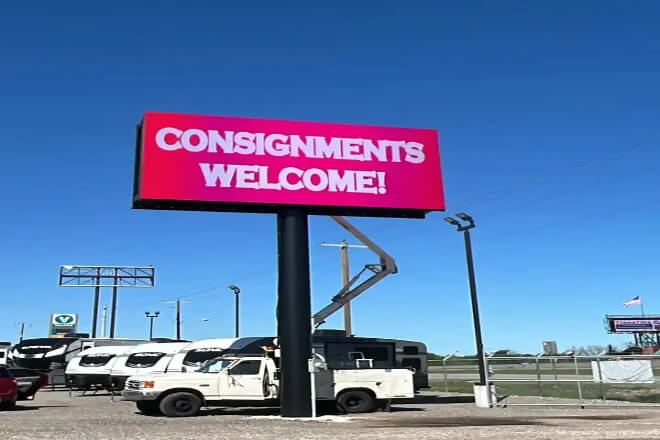
While LED displays seem “all-rounder,” in reality, they’re a bit like a strong athlete—they need to choose the right match to perform well, otherwise it’s a waste.
First, their effectiveness is limited in low-traffic areas. If there aren’t many people on the street, even the brightest screen can easily become a “self-indulgent spectacle.”
It excels at making its presence felt in busy areas; when there are few people, it’s like having all the stage lights on but the audience empty—a bit awkward.
Second, cost and benefit must be balanced. An LED screen isn’t a “money-making” device; it’s more like a continuously operating project: equipment, maintenance, electricity, and content all consume resources.
If the placement location doesn’t provide sufficient exposure, it can easily become “looks lively, but not cost-effective.”
Furthermore, content quality directly determines the effect. This is quite real: the same screen can look “high-end” with a carefully designed video.
But just “a roadside information board” with randomly pieced-together material.
The characteristic of LED screens is that they don’t beautify the content; they simply amplify it for everyone to see clearly.
Another crucial point: different goals require different approaches. Some aim for brand exposure, others for traffic generation, and still others for information dissemination.
If you deploy the screen without clearly defining your objectives, it easily becomes a case of “having the equipment but lacking a strategy.”
To illustrate further: an LED display screen is like a powerful megaphone—if you speak well, it amplifies your message far; if you speak casually, it will still reach a wider audience.


 English
  Español
  简体中文
简体中文  Français
  日本語
日本語  한국어
한국어  العربية