
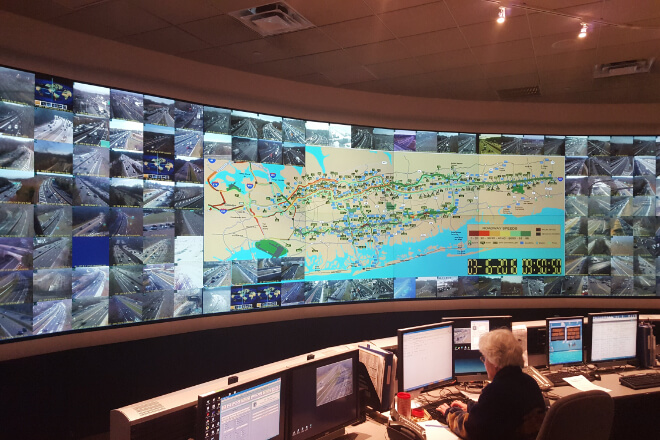
In a security monitoring center, an LED display is no longer just a “large screen”; it is a core tool of the entire monitoring system, helping staff quickly grasp information, make decisions, and improve response efficiency.
It can be said that with a large screen, the overall work efficiency and situation control capabilities of the entire monitoring center will be greatly improved.
1). Video Wall
In traditional monitoring systems, if staff need to view footage from different areas, they often need to switch between multiple monitors or monitoring windows, which is inefficient and can lead to missing important information.
An LED video wall can display footage from dozens or even hundreds of cameras on a single large screen.
With just a glance, staff can simultaneously see the real-time situation in various key areas, instantly determine where anomalies occur, and significantly enhance overall control capabilities.
2). Real-time Alarm Information Display
The biggest fear in a monitoring center is not being able to detect emergencies in time. LED displays can display system alarm information in real time,
such as intrusions in a certain area, equipment failures, or security incidents. Alarm information is usually identified with colors, flashing lights, or icons, allowing staff to notice it immediately.
This allows for quick responses in both security patrols and command and dispatch, shortening processing time and preventing risks from escalating.
3). Data Visualization
In addition to video footage, modern monitoring centers also need to monitor various data in real time: traffic flow, environmental monitoring data, safety indices, energy consumption, etc.
LED screens can transform these tedious numbers into charts, heat maps, curves, or animations, presenting them intuitively.
Managers don’t need to look through reports; they can see the overall situation at a glance and make faster and more accurate decisions.
In short, in a security monitoring center, the role of LED displays is not just to “make things clearer,” but also a key tool for information centralization, rapid response, and data-driven decision-making.
With a large screen, monitoring is no longer just passive observation, but active control, making the entire system more efficient and secure.
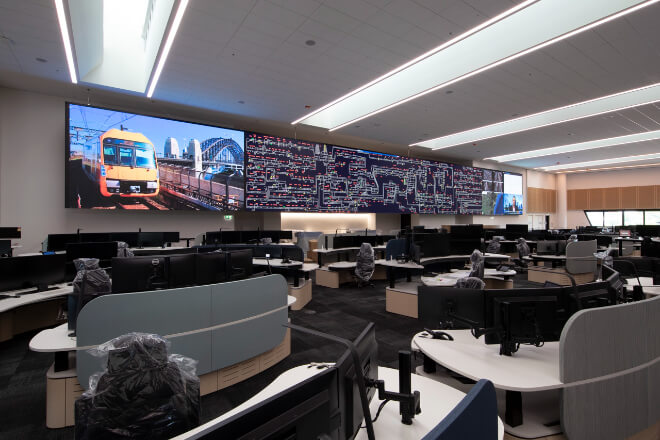
In a monitoring center, the amount of information is enormous, and the speed of decision-making is often more important than simply seeing the footage.
The function of LED displays is to make complex information immediately visible and easily controllable, allowing staff to make faster and more accurate judgments.
1). Multi-screen display, monitoring multiple areas simultaneously
In the past, monitoring personnel might have had to switch between several monitors to view footage from different areas, which was not only inefficient but also prone to missing critical moments.
LED video walls can consolidate footage from different cameras onto one large screen, displaying multiple areas simultaneously.
For example, a traffic control center can simultaneously view the situation at several important intersections, and a security monitoring center can simultaneously monitor the dynamics of the factory area, warehouse, and main gate.
This way, regardless of where an anomaly occurs, staff can detect it immediately and prioritize accordingly.
2). High-definition display, clearer details
High-resolution LED screens not only display large images but also clearly present every small detail. License plate numbers, actions in building corners, and personnel distribution will not be blurred.
This is crucial for making quick judgments, as many decisions depend on details: traffic information on a single lane, or an abnormal flashing of a piece of equipment, can all affect the entire command plan.
3). Information overlay and multi-source data integration
Modern monitoring is not just about “watching videos,” but also about combining various types of data.
LED displays can overlay alarm information, real-time statistical data, maps, or charts onto the screen, achieving multi-source data integration.
For example, when an anomaly occurs in a certain area, the screen will not only display the video but also indicate the event type, time, and scope of impact, while simultaneously providing relevant statistical information.
Staff only need to look at the screen to see complete information, significantly shortening analysis time and improving decision-making efficiency.
In short, LED displays transform the monitoring center from “passively watching screens” to “actively controlling the overall situation.”
Centralized information, clear images, and data visualization—these advantages make decision-making faster and more accurate, and also elevate the efficiency and reliability of the entire monitoring system to a higher level.
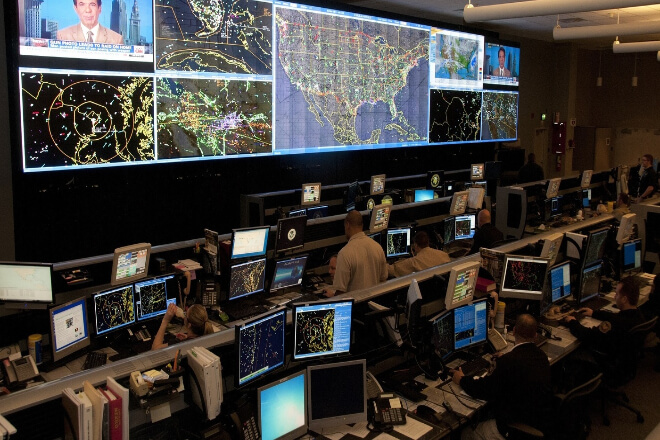
In a monitoring center, relying on one person and one screen to view information is no longer sufficient; team collaboration and information sharing are key.
LED displays solve this problem, allowing different departments to simultaneously see the content they are interested in, while also quickly adjusting the display for unified command and coordination.
1). Multi-screen partitioned display to meet the needs of different departments
LED video walls can be divided into multiple display areas, each displaying different content.
For example, the security department focuses on entrances, exits, and perimeter protection.
The transportation department focuses on road and traffic conditions, and the environmental monitoring department focuses on air quality or water level information.
In this way, each department can simultaneously obtain the real-time information they care about without interfering with each other, while maintaining the integrity of the overall situation.
2). Remote control and content switching for instant command
The LED screen supports remote control and content switching.
When an emergency occurs, managers can immediately adjust the display content, enlarge key images, or switch to relevant data, allowing the entire team’s attention to quickly focus on the event.
Whether it’s dispatching vehicles, directing security personnel, or arranging repair crews, rapid response can be achieved.
3). Linkage with emergency systems, transportation systems, fire protection systems, etc.
The LED display screen can also be linked with other systems. For example, when the fire protection system detects a fire alarm, relevant images, alarm information, and command data will automatically appear on the screen.
When traffic congestion or accidents occur, the screen will display real-time traffic maps and dispatch plans.
This linkage eliminates the need for manual information transfer, significantly improves decision-making efficiency, and reduces the risk of information errors.
 English
  Español
  简体中文
简体中文  Français
  日本語
日本語  한국어
한국어  العربية