
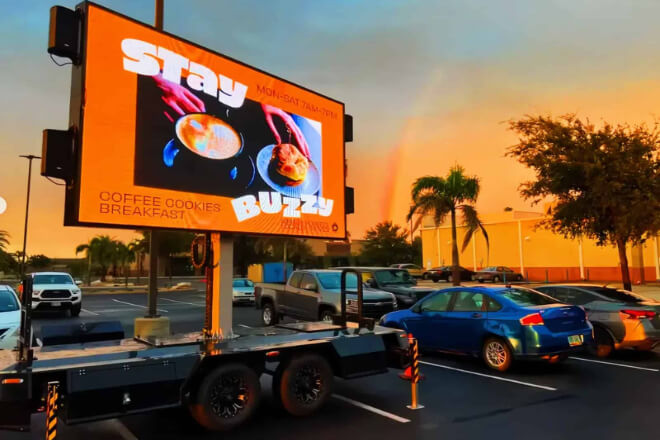
During the morning rush hour, LED displays target a group of people who are “time-sensitive.”
Most people are rushing and have very limited time to linger, meaning there isn’t much room for content to “unfold slowly.”
First, the content needs to be concise and intuitive. Complex information structures are difficult to understand in a short time.
In contrast, clear images, well-defined hierarchies, and direct expression are easier to capture quickly.
This can be understood as—not more information is better, but information that is easy to understand at a glance is more effective.
Secondly, core information must be highlighted. In a limited few seconds, viewers can often only remember one key point.
Therefore, content needs a clear visual focus, allowing viewers to immediately understand “what the key point is,” rather than requiring time to discern.
Simultaneously, appropriate guidance is also crucial. Whether it’s directional cues, event information.
Or simple action instructions, clear expression can effectively convey information in a short time.
Simply put: during rush hour, the focus isn’t on “explaining everything,” but on “clearly stating the most important part in the shortest amount of time.”
When information is direct and the key points are prominent, LED displays can achieve effective communication within seconds.
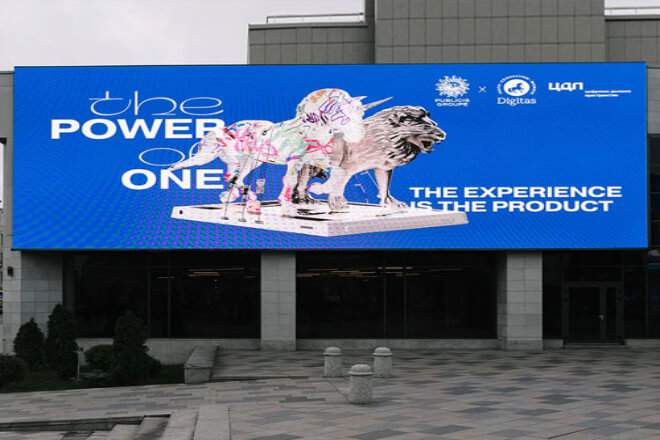
The biggest challenge in using LED displays during the day isn’t “whether it can be bright enough,” but “whether it can still be seen clearly in strong light.”
The stronger the ambient light, the higher the requirements for content presentation.
First, the matching of brightness and contrast is critical. Simply increasing brightness isn’t necessarily effective; if the contrast is insufficient, the image may still appear “grayish.”
Only through reasonable brightness configuration and clear color contrast can content remain prominent in strong light environments.
Secondly, the information structure needs to be clear enough. In daylight, viewers are more likely to skim than look closely, so the content hierarchy must be clear.
Highlighting key points so that viewers can grasp the crucial information at a glance, rather than having to “search” for content on the screen.
At the same time, this environment is also suitable for brand and product displays. As long as the content is designed properly.
Such as emphasizing visual focus and reducing unnecessary information interference, it can still maintain good readability and recognizability even under strong light conditions.
Simply put: daytime isn’t just about being “bright enough,” but about being “bright enough to see clearly.”
When brightness, contrast, and content structure are properly matched, LED displays can achieve a stable and clear display effect even during the day.
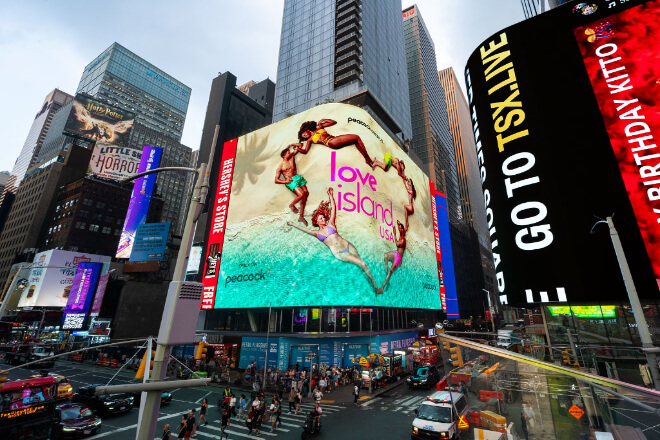
Compared to the rush of the morning rush hour, the pace slows down significantly at midday, providing LED displays with more “room to shine”—users are more likely to stop and look longer than just pass by.
Firstly, the content can be made more engaging. During this time, viewers’ attention is less strained; light, rhythmic, or emotionally expressive content is more likely to attract attention rather than being quickly skipped.
Secondly, the content can be more layered. Compared to simple, direct information delivery, midday is more suitable for segmented content or multi-level presentations.
Allowing viewers to gradually acquire information while watching, thus naturally extending their viewing time.
Simultaneously, this is also a good time to enhance interactivity. Whether through visual guidance, changes in content rhythm.
Or engaging presentation methods, viewers can be encouraged to move from “glancing once” to “looking several times.”
Simply put, the focus at midday is not just on “being seen,” but on “making people want to stay a little longer.”
When the content is more interesting, rhythmic, and layered, LED displays are more likely to increase viewing time and the overall experience during this period.
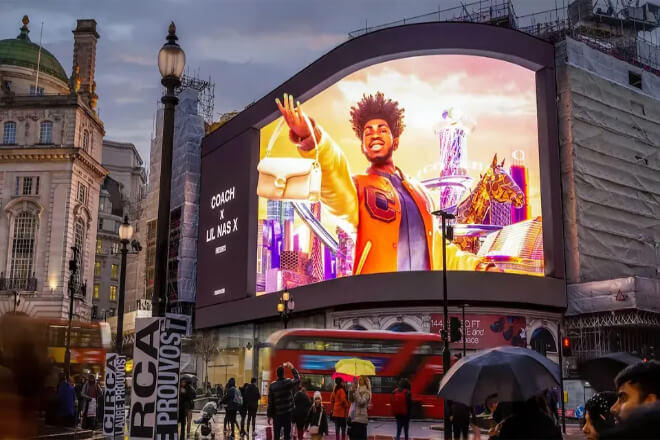
Evening rush hour sees a large flow of people, but there’s a reality: everyone is busy, and their attention is scattered.
Some are rushing, some are looking at their phones, and others are thinking about “what to eat for dinner.” The time left for the screen is actually only a few seconds.
At this time, the image cannot be too “understated.” Appropriately enhancing dynamic effects, such as rhythmic changes, scene transitions, or visual flow, makes LED displays more noticeable amidst a sea of information.
Simply put, it’s about giving content a “presence,” rather than it silently fading into the background.
At the same time, key information must be prominently displayed. During rush hour, viewing is more about “glancing” than “reading carefully.”
If viewers need time to understand the content, they’re likely to miss it altogether.
Therefore, placing the most important information in the most prominent position is more effective.
Furthermore, this is a great opportunity to establish brand memorability.
Using consistent visual elements, recurring key information, or a distinctive visual style can leave an impression in a short time.
Even a single glance can leave a “some impression.”
Simply put: content during rush hour doesn’t need to be complex, but it needs to be “obvious and memorable.”
When the visuals are rhythmic, the key points are clear, and the style is memorable, LED displays are more likely to be noticed in crowds, rather than being lost in the flow of people.
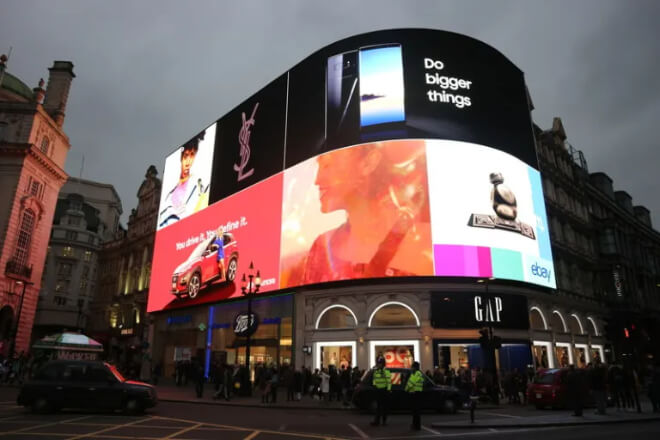
At night, LED displays actually enter a more expressive period.
With weaker ambient light, the screen no longer needs to compete with sunlight for attention, making it easier to become the visual center of the space.
Firstly, the advantages of low-light environments can be better utilized. The brightness, color, and contrast of the image become more prominent, and details are more easily perceived.
At this time, the screen is not only displaying content but also shaping the visual atmosphere of the space.
Secondly, nighttime is more suitable for emphasizing visual impact and emotional expression.
Compared to the more functional content of the daytime, nighttime can use more rhythmic visuals, more emotional colors.
Or more stylized content to create a more direct experience for the audience, rather than simply providing information.
Simultaneously, LED displays can also participate in the overall spatial experience. Through coordination with lighting, architecture, or the surrounding environment.
The screen can become part of the spatial atmosphere, rather than a standalone display device.
Simply put: LEDs at night are not just “clearer,” but “more evocative.”
When content design is well-integrated with the environment, LED displays can not only convey information at night but also reinforce brand atmosphere, making the entire space more memorable.
 English
  Español
  简体中文
简体中文  Français
  日本語
日本語  한국어
한국어  العربية