

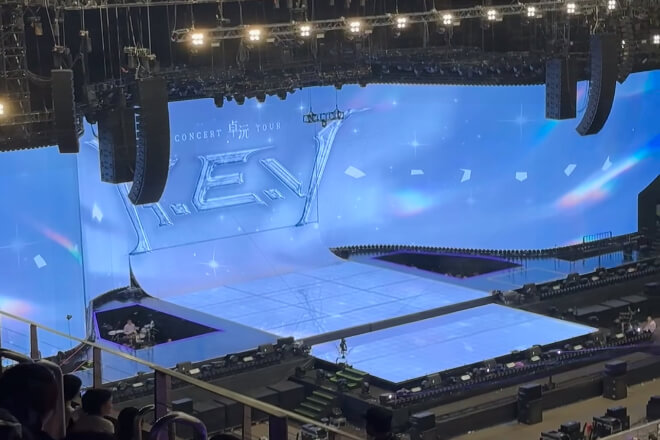
As concerts grow larger, a significant change is that stages are no longer just “platforms” but rather transformed into entire LED display visual spaces.
Firstly, larger venues demand higher levels of visual appeal. Audiences sit further back, and without large LED screens, it’s difficult to ensure everyone can see the content clearly.
Therefore, main screens, side screens, and extended screens have become almost standard.
For example, the same song might be sufficient with lighting ambiance in a smaller venue, but in a stadium with tens of thousands of seats, LED screens are essential to “magnify” the image for the entire audience.
Secondly, LED displays have become a standard feature of ステージ structures.
No longer optional decoration, but a core component—without LED displays, it would be difficult to support today’s immersive visual performances.
Even more interestingly, many stage designs now prioritize the screens over the stage itself, making the visual element an integral part of the structure.
For example, a common scene: the singer stands in the center, with a giant LED display showing dynamic visuals behind them; the entire stage resembles a constantly changing background system.
Finally, large-scale tours have driven increased rental frequency. A mature LED display system can be repeatedly set up and used in different cities.
The more concerts and tours there are, the faster the equipment turnover, naturally increasing demand.
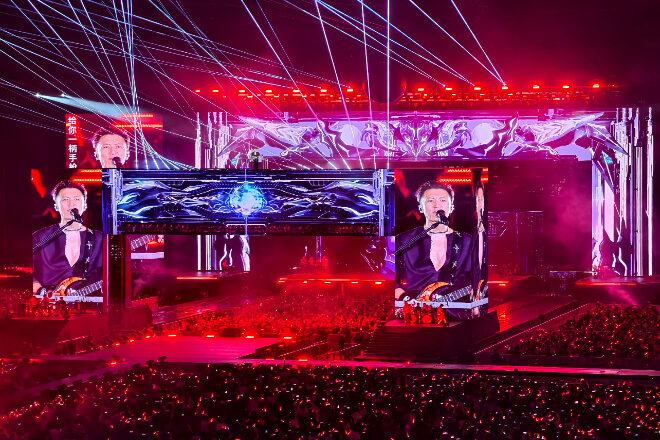
Today’s stages are increasingly “immersive,” no longer simply about placing an LED background screen; rather, the entire space must become a screen.
Firstly, the combination of an LED background screen + side screens + floor screen has become the mainstream configuration.
The main screen is responsible for “looking forward,” the side screens are responsible for “covering the sides,” and the floor screen is responsible for “stepping into.”
With these three working together, the ステージ is no longer flat, but a space visually enveloped.
To illustrate this visually: the main screen represents the sky, the side screens are extended clouds, and the floor screen is a flowing, light-and-shadowy surface. The actors, standing in the center, are enveloped in a “visual world.”
Secondly, this combination transforms the stage from a “viewing point” into an “immersive space.”
Audiences no longer focus on just one direction; instead, content moves in all directions, and their vision is completely surrounded, naturally increasing their focus.
Even more interestingly, this design creates an illusion: it’s not watching a performance, but rather “stepping into a scene.”
For example, in a single moment: the music changes, the main screen displays a city skyline, the side screens extend street lighting.
And the floor screen synchronously transforms into a flowing river of lights—the entire space instantly “changes worlds.”
Finally, this “fully enclosed stage” directly increases the demand for LEDディスプレイ. Because it’s not just a single screen solving the problem.
But multiple surfaces working together to construct the space, the more screens there are, the more complete the space, and the stronger the sense of immersion.
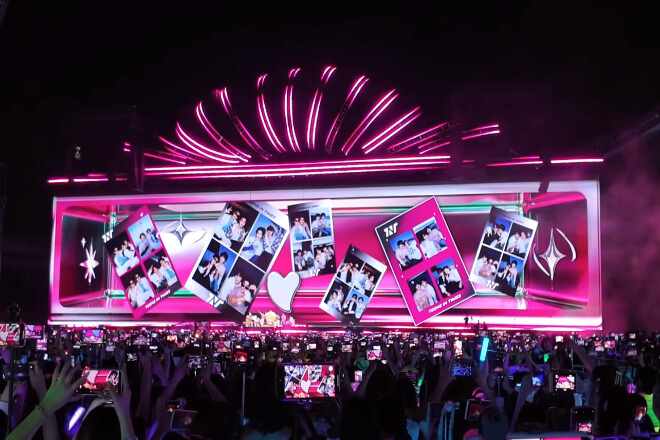
Concerts are increasingly resembling “nationwide flash mob projects”—today in Shanghai, tomorrow in Chengdu, the day after in Guangzhou. This pace has directly fueled the growth of the rental LED display market.
Firstly, the rapid disassembly and reuse between cities transforms LED display equipment into “liquid assets.”
A mature LED display system can be quickly disassembled, installed, and debugged, allowing it to travel nationwide with the tour team, rather than being fixed in a single venue.
For example, the same ステージ LED display can be re-installed and used in city B a few days after a performance in city A.
Secondly, this model significantly reduces per-show costs and increases equipment utilization.
Previously, a single set of equipment might only serve one fixed venue; now it can be reused in multiple cities, naturally reducing the cost per performance.
Even more interestingly, this is essentially “trading time for efficiency”—the equipment isn’t idle but continuously operating between different cities.
Another typical example is this: the screen dismantling at one stop has just finished, and the setup for the next stop has already begun; the entire team is like a relay race.
Finally, the frequent cross-city nature of tours makes the demand for rental LED displays more stable and frequent.
The more complex the stage and the more immersive the visual experience, the stronger the reliance on the screen, naturally driving the continuous turnover of the rental market.
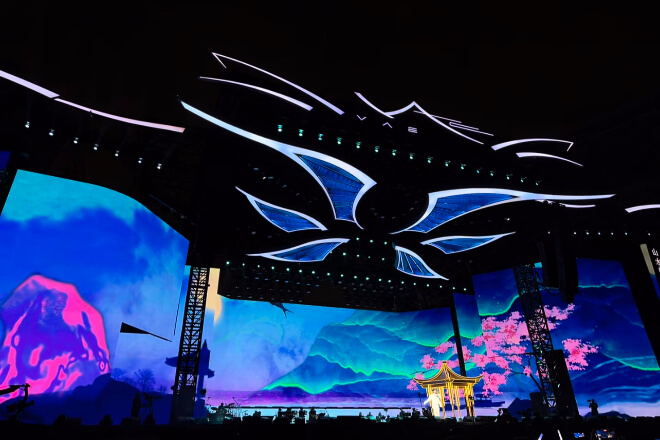
The requirements for LED displays on stages today are very direct: it’s not just about “being able to display images,” but about “the image having to hold up for the entire performance.”
First, the demand for ultra-high definition and high リフレッシュレート is very significant. Because audiences are increasingly shooting videos, live streaming, and sharing content.
If the LED display image is blurry or flickering when viewed on a mobile phone, the overall quality will drop significantly.
For example, on the same ステージ: at a low refresh rate, dancers’ rapid turns will have motion blur; at a high refresh rate, the movements will be very clean and crisp, looking like a “movie.”
Second, the integration of dynamic visuals and real-time special effects is already very common.
Many performances don’t just play static videos; instead, the LED displays are synchronized with lighting, rhythm, and even live effects.
For example, during a live performance, as the chorus begins, the particle effects on the LED screen suddenly accelerate and “explode,” the lights flash in sync, and even smoke machines work together, making the entire stage appear to be on fire.
Another example is interactive stages: when a singer walks to the edge of the stage, light diffuses across the LED floor tiles;
When they stop, the image slowly shrinks back, making it look like “the person is controlling the space.”
Finally, the demands for visual expressiveness in star performances are increasing. For example, some tours specifically design “a unique visual language for each song on the LED screen”:
Ballads: Slow-moving light and shadow + soft-focus background
Upbeat songs: High-frequency switching + strong contrast visual impact
Climax: Full-screen explosive animation + multi-screen interaction
The audience doesn’t just see “changing backgrounds,” but rather “a complete world for each song.”
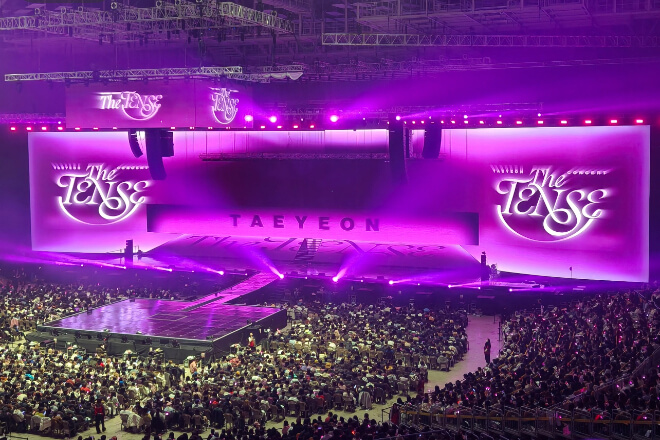
Today, LED displays on concert stages are no longer just “for show,” but are directly involved in generating revenue.
First, the integration of sponsor advertising and ステージ content is becoming increasingly natural. Previously, advertising and performance were separate;
Now, many brands are directly “embedded” into the stage visuals, appearing in background visuals, side screen animations, and even transitional visuals.
For example, a common live performance might show a singer performing, and the background LED screens don’t just display special effects;
Instead, the brand and theme visuals are integrated, making it look less like an advertisement and more like part of the stage itself.
Second, LEDディスプレイ themselves have become a significant advertising medium. The main screen handles content delivery.
While side and circular screens can handle brand exposure, event information, and even interactive content playback, essentially creating a “built-in advertising system on stage.”
More interestingly, this advertising isn’t a forced insertion but rather “follows the rhythm”—appearing at appropriate times.
Such as at the beginning, during intermissions, or during scene changes, making it more readily accepted than traditional advertising.
For example, in a live performance, as the chorus ends and the interlude begins, the LED display naturally switches to the brand’s visuals while maintaining a consistent stage style.
Finally, this directly increases the overall commercial revenue of the performance. Because LED display systems can be broken down into multiple value zones (main visual, side screen exposure, interactive content, etc.)
A performance can generate revenue beyond just ticket sales, offering multi-dimensional monetization.


 English
  Español
  简体中文
简体中文  Français
  日本語
日本語  한국어
한국어  العربية