

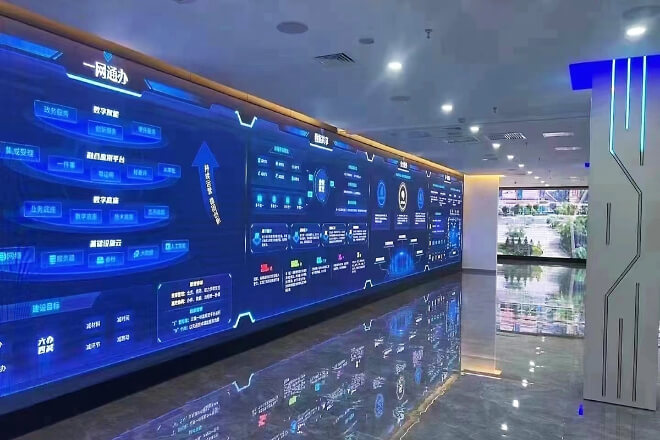
The core of a digital LED表示 showroom isn’t simply “amazing,” but rather enabling customers to quickly judge whether the company is professional, trustworthy, and capable of handling complex projects.
First, the first impression comes from the “systematic presentation.” Upon entering the showroom, customers don’t look at individual screens, but rather at whether the entire information is logical and structured.
For example, instead of simply showing product videos, it’s about: Product → Application Scenarios → Real-world Cases → Solutions—explained clearly along a single line.
This “clear explanation” is more important than “flashy presentation.”
Many customers’ genuine reaction isn’t “Wow, that’s cool,” but rather, “This company has a clear approach.”
Secondly, stable operation itself demonstrates trust. An LED displays showroom isn’t a one-time demonstration; it’s a space for long-term operation.
The stability of the LED screen, the smoothness of content switching, and the lack of system lag all convey capability.
For example, if a client sees: no delay in multi-screen synchronization, consistent and error-free long-term operation, and clean transitions, they will naturally associate this system with a real-world project, not just a demonstration.
Thirdly, solution capability is more important than visuals. Clients don’t care about how flashy you are; they care about your problem-solving ability.
For example, in a demonstration: instead of simply saying “We have LED screens,” directly simulate the actual application effect of a shopping mall/showroom/stadium. Clients will more easily understand: “Oh, how would this work in my space?”
Finally, first impressions are about “reducing the cost of understanding.” A good digital showroom essentially helps clients quickly understand what you do, your strengths, and whether you’re a suitable partner.
If clients need a long explanation to understand, the impression will be weaker. But if they can understand 80% of it upon entering, trust will be established quickly.
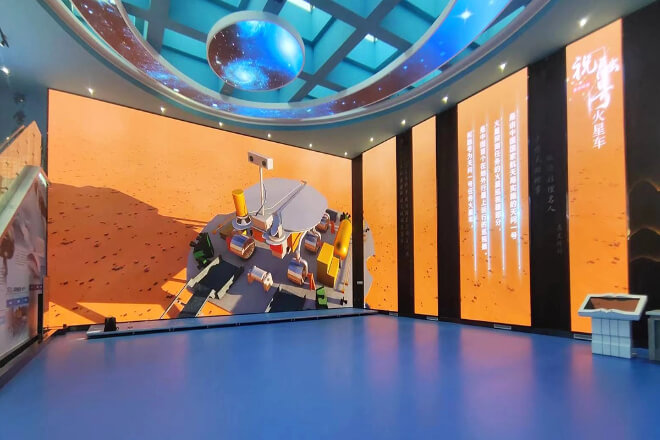
The biggest pitfall for a company story in an exhibition hall is presenting it in a flat, straightforward manner, like an annual report.
The value of a digital LED 展示 hall lies in transforming this information into a rhythmic and emotionally resonant narrative, making it engaging and understandable.
First, replacing static display boards with dynamic videos fundamentally changes the “reading experience.”
Traditional exhibition halls present fragmented information, with visitors seeing only individual signs. LED displays exhibition halls, on the other hand, guide the audience through a continuous story.
For example, instead of directly introducing themselves, the company might use a dynamic visual presentation:
Unfolding the story step-by-step from industry background → market changes → the opportunity that led to the company’s emergence. This approach is far more engaging than a series of texts.
Simply put: it’s not about “reading information,” but about being “led into the story.”
Second, the development timeline isn’t just a timeline, but a presentation of key turning points.
Many companies use a “year + event” format, but this rarely creates memorable moments. The advantage of LED displays is their ability to make these key moments visually impactful.
For example, instead of simply stating “The company established overseas business in 2018,” use an animated map combined with footage of project implementation to immediately demonstrate that “the business has truly gone global.”
The key is not in “recording,” but in “showing people the change.”
Third, brand philosophy isn’t about words, but about conveying it through scenarios.
Many companies like to use slogans like “innovation, professionalism, and reliability,” but these feel empty on their own. LED displays showrooms are better suited to “translating” these words visually.
For example, “innovation” can be transformed into animations of technological iterations; “professionalism” can be shown as real-world examples of complex projects;
And “reliability” can be demonstrated through footage of long-term operational projects. Viewers don’t need explanations; they can feel it for themselves.
Finally, impact comes from rhythm, not information overload. A well-crafted corporate story isn’t about “talking a lot,” but about “when to show what content.”
LED displays systems can control the rhythm of the visuals, creating a narrative with ups and downs, such as initiation—breakthrough—expansion—stability, each segment using different visual language.
For example, an ending that gradually expands from a small project scene to a global project map is more impactful than simply saying “Our business spans the globe.”
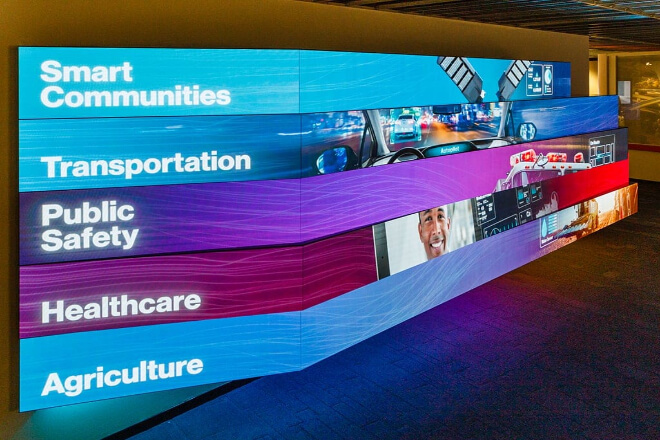
The most significant difference between digital LEDディスプレイ showrooms isn’t simply how visually appealing the display is.
But rather whether customers can quickly understand what your products and solutions do and what problems they solve.
First, complex product structures become much easier to understand through a visual breakdown.
Many products have complex structures, and relying solely on drawings or parameter descriptions can easily lead customers to give up halfway through.
LED displays showrooms can use dynamic breakdowns to “unfold” the internal structure layer by layer.
For example, an LED displays control system no longer focuses on interfaces and modules, but instead uses animation to demonstrate the entire process of signal input, distribution, and display, making its operation immediately clear.
Simply put: it’s not about “explaining the structure,” but about “demonstrating the structure.”
Second, multi-scenario application demonstrations are more persuasive than simple introductions.
If you only talk about the “powerful functions” of a product, customers find it difficult to connect with the concept. However, placing it in different scenarios makes its value much easier to grasp.
For example, an LED displays solution can be used in various ways: in a stadium, it provides scores, replays, and interactive elements;
In a shopping mall, it offers advertising, wayfinding, and interactive check-ins; and in an exhibition hall, it showcases brands and provides immersive content.
Customers don’t see “product parameters,” but rather “how this will work for me.”
Third, technological advantages aren’t just about words; “comparative presentations” are more impactful.
LED displays exhibition halls are perfect for “comparative demonstrations,” such as showing the difference between traditional methods and the new system, allowing customers to experience the improvements firsthand.
For example: old systems have delayed screen transitions → new systems switch in real-time; ordinary displays are flat → new solutions offer multi-layered, interconnected visuals.
Single-screen displays → multi-screen collaborative displays showcasing a complete information flow. This approach is more intuitive than simply saying “we’re more advanced.”
Finally, the key is to improve customer comprehension efficiency, not to overwhelm them with information.
The problem with exhibition halls isn’t a lack of content, but rather that “customers can’t understand the key points.”
LED displays’s advantage lies in its ability to present complex information in layers, allowing customers to gradually understand.
For example: first, look at the overall effect → then the application scenario → finally, the technical breakdown. The logic is progressive, rather than throwing everything at them at once.
It’s somewhat like this: Previously, it was about “giving customers an instruction manual”; now it’s about “showing customers how the product works.”
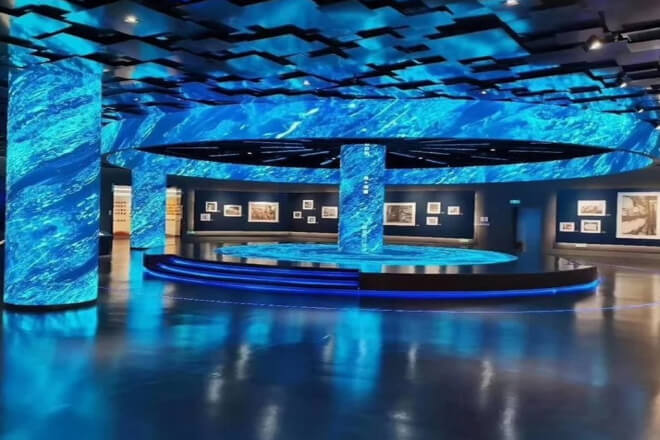
The problem with traditional showrooms is obvious: customers are mostly “passively watching,” finishing after a quick look.
Digital LED displays showrooms aim to allow customers not only to watch, but also to participate, operate, and even change the content.
First, touch and interaction transform customers from “viewers” to “participants.” For example, an interactive LED displays no longer just plays content;
Customers can click to select different products, solutions, and even switch industry application scenarios.
Customers might do something very natural: click on “Stadium Solution,” and the screen immediately switches to a stadium application scene;
Click on “ショッピングモール Solution,” and the content instantly becomes a commercial space case study.
Simply put: it’s not “What are you showing me?” but “I choose what I want to see.”
Second, real-time dynamic data switching makes the display more “live-on.” Compared to fixed videos, real-time data or dynamic content makes customers feel that “this system is alive.”
For example, real-time display of project data from different cities, simulated equipment operation status, or changes in project distribution maps allows customers to more intuitively grasp the system’s scale and capabilities, rather than through static introductions.
Third, an immersive tour path makes the experience feel more like “walking into a story.” A good LED displays showroom isn’t just a room, but an “experience route.”
From the entrance, customers are continuously guided into different themed spaces, each with a different content rhythm.
For example: the entrance is about brand atmosphere → the middle section is product display → the latter part is solution simulation → and finally, case studies and implementation demonstrations.
Customers don’t just “see and leave,” but are “guided step by step to understand.”
Finally, the essence of interaction is to enhance engagement, not just add features. Many showrooms easily become “feature stacking,” but what’s truly effective is getting customers to stop, click, and look longer.
For example, when a customer participates in a small interactive selection, the screen immediately provides feedback on the result; this “instant response” makes the experience more memorable.
To put it figuratively, previously, showrooms were about “customers visiting you,” now it’s more like “customers and the showroom playing together.”
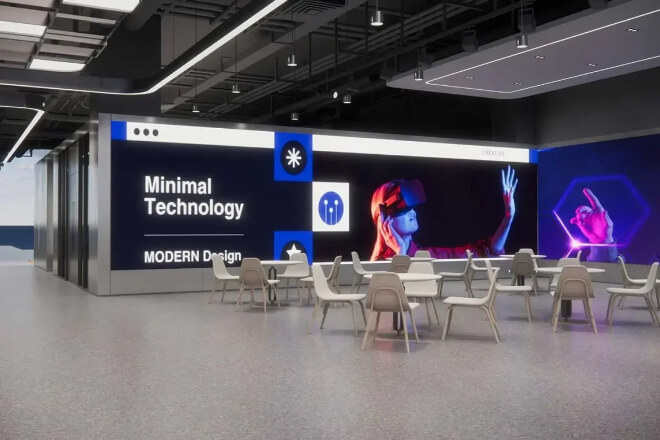
In a showroom, what truly influences a sale is often not how professional the presentation is, but rather whether the customer stops and is willing to look for a while longer.
The role of LEDディスプレイ showrooms is to transform “a quick glance and leave” into “a willingness to chat.”
First, it increases customer dwell time. Traditional showrooms often use static display boards; information is quickly scanned, and the show is over.
LED displays content, however, is dynamic and constantly changing, such as product demonstrations, case study videos, and data comparisons, which encourage customers to linger for several more minutes.
For example, a customer might initially be passing by, but become captivated by a dynamic product demonstration and stand to watch the entire presentation.
Second, it significantly improves communication efficiency. Salespeople don’t need to explain everything from scratch.
Much basic information can be conveyed through the screen, such as product structure, application scenarios, and advantages comparisons. Communication becomes “supplementing explanations based on the visuals.”
Even more interestingly, this approach makes communication feel more like “jointly viewing a system,” rather than a one-way explanation.
For example, a common scenario is a customer viewing different options on the screen while discussing with sales which one best suits their needs, leading to a much faster understanding.
Simultaneously, it deepens the likelihood of cooperation. Because LED displays showrooms can visualize case studies, results, and data, customers can more easily “see the effects” rather than just hear descriptions; this “visual trust” is crucial.
Finally, it directly increases the overall probability of a sale. Longer viewing time, clearer understanding, and smoother communication naturally shorten the decision-making path and increase conversion rates.


 English
  Español
  简体中文
简体中文  Français
  日本語
日本語  한국어
한국어  العربية