

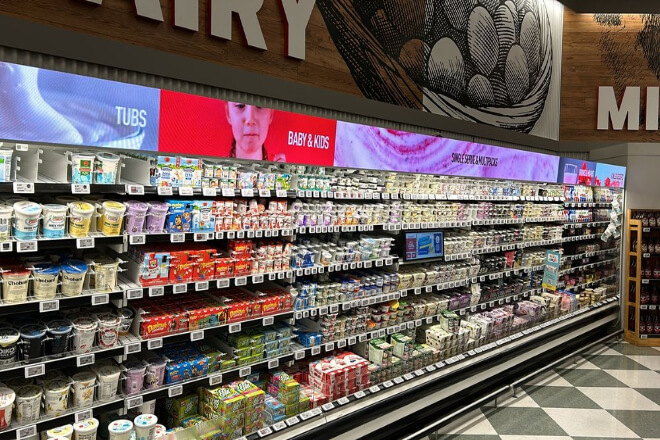
The entrance to a convenience store essentially has only one task: to get passersby to “stop for a moment.” Small LED displays are precisely the tool to solve this “0.5-second attention span.”
First, they attract passersby. The entrance itself is a visual convergence point, and with dynamic visuals, it easily “stands out” among static signs.
For example, a scrolling “Second item half price today” is more likely to be glanced at than a static poster.
Second, they provide a real-time display of promotions and new product information. Convenience stores have fast product updates and frequent promotions.
Small LED screens can quickly switch content, such as “limited-time discounts,” “new arrivals,” and “combo offers.”
Eliminating the need for frequent replacements of paper materials and allowing for more flexible information updates.
Furthermore, it significantly enhances the store’s first impression. Compared to simple light boxes or posters.
Dynamic visuals make the entrance appear more vibrant, subconsciously giving the impression that the store is “updated faster and has more content.”
Finally, it impacts conversion rates. When customers are just “passing by,” a dynamic display at the entrance might make them linger for an extra half second.
And that half second can sometimes determine whether they enter the store or not.
Simply put, the value of small LED screens at convenience store entrances lies not in their “eye-catching” appearance.
But in making people who wouldn’t normally stop take a second look and take a step further.
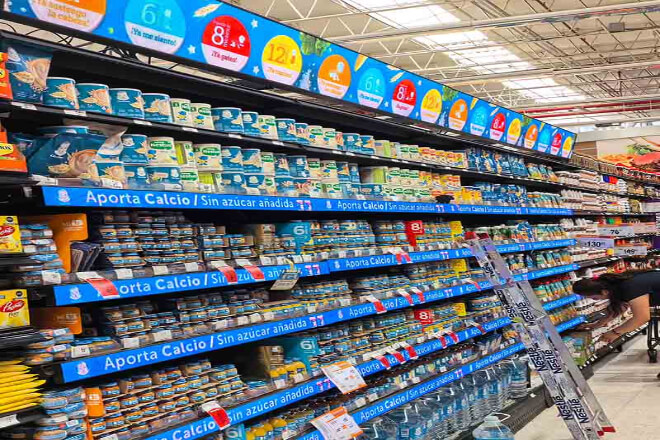
If the core of convenience store promotions is “speed,” then the advantage of small LED 디스플레이 lies precisely in this rhythm: fast information updates, fast display methods, and faster attention capture.
First, the ability to quickly update discount and promotional information is crucial.
Promotions change frequently, such as “buy one get one half price today” or “discounts for orders over a certain amount tomorrow.”
With traditional materials, each change requires remaking and reposting.
LED screens, however, can be updated directly in the background, switching content in seconds, making them ideal for high-frequency promotional scenarios.
Second, they can replace traditional paper posters. While paper posters are inexpensive, once posted, they are “fixed,” lacking flexibility.
LED screens can loop different promotional content, allowing limited display space to handle multiple information tasks simultaneously—essentially “one screen equals multiple posters.”
Furthermore, dynamic displays are inherently more eye-catching. In the limited space of convenience stores, customers’ attention span is short, making dynamic images more easily noticed than static text.
For example, a scrolling “limited-time special offer” is more attention-grabbing than a small poster.
Finally, there’s improved information delivery efficiency. It’s not just about “seeing it,” but “understanding it at a glance.” LED screens can use text, color.
And animation to compress information into a more easily understood format, reducing the customer’s reading burden.
In short, the value of small LED displays in promotions isn’t as a “more sophisticated poster,” but rather as a way to present information in a way that is seen, understood, and reacted to more quickly.
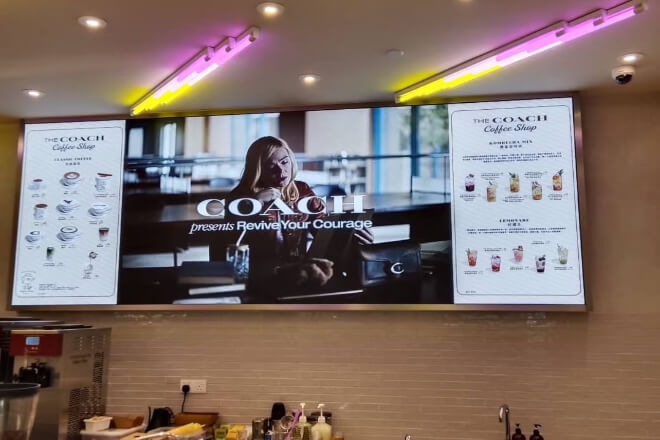
Convenience store interiors are actually quite “picky”: limited space, fast pace, and short customer dwell times.
Therefore, whether the equipment can be placed isn’t just about “whether it can be installed,” but also about whether it will appear superfluous.
First, there’s the compatibility with the checkout counter and wall area. The checkout counter is a natural “attention point.”
The few seconds customers spend queuing, paying, and waiting for change are precisely when information is most easily seen.
Placing a small LED screen here is like a casually handed reminder—unobtrusive, yet easily noticed.
Secondly, its space-saving feature is a major plus. Convenience stores are most afraid of being “crowded.”
Small LED screens can be mounted on walls, embedded above the checkout counter, or even made into a narrow strip, without taking up space, yet still continuously displaying information.
Compared to a pile of paper posters, it’s more like a “lightweight information window.”
Another advantage is its alignment with store traffic flow. Customers enter the store—grab items—queue to checkout—this path is almost fixed.
As long as the screen appears at a “must-pass” point, it’s a natural exposure, requiring no deliberate guidance.
For example, seeing “buy one get one half price” at checkout is more likely to trigger a reaction than glancing at it at the entrance.
Finally, it enhances information display capabilities. The small screen can loop different content, such as promotions, new product recommendations.
And member reminders, unlike posters, which are “fixed once posted,” allowing the limited space to constantly “change content to speak.”
Simply put, its role in a convenience store isn’t just “installing a screen,” but rather transforming a static corner into a constantly updated information point, conveniently located where customers can easily see it.
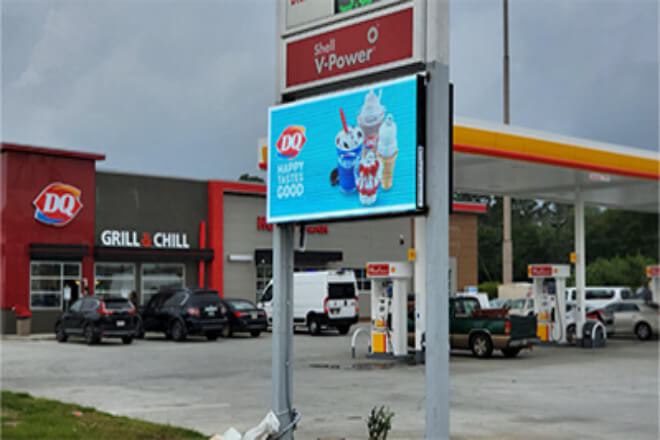
If you only consider the “purchase moment,” a small LED display might seem a bit more expensive than paper posters, but in the long run, its logic is: one-time investment, long-term reuse.
Firstly, it has a longer lifespan. LED 디스플레이 are inherently durable display media.
As long as the environment is suitable and usage is standardized, they can operate stably for extended periods, unlike paper materials, which require frequent replacements.
Over time, the cost per display is continuously amortized.
Secondly, the content can be repeatedly updated, which is crucial. Convenience stores have a fast-paced promotional rhythm, with discounts one day and new products the next.
With traditional posters, each change requires redesign, printing, and posting.
LED screens, however, only need to be updated in the backend, allowing for rapid content switching—essentially “one screen used as multiple posters.”
Furthermore, printing and replacement costs are significantly reduced.
Paper posters not only have production costs but also labor costs for replacement, resulting in a continuous expense in the long run.
LED screens experience almost no physical wear and tear during content updates, eliminating the need for repeated material costs.
Finally, operational efficiency is improved. Information can be centrally managed and updated uniformly.
Eliminating the need for store staff to repeatedly post materials, reducing errors and omissions, and making operations more standardized and stable.
To put it more intuitively: paper posters are like “having to rewrite everything on a new sheet of paper and stick it on each time.”
While a small LED screen is more like “an electronic bulletin board whose content can be constantly updated.”
Simply put, its economic advantage isn’t about being “cheap,” but about the lower the average cost, the longer it’s used, and the more frequently it’s updated.
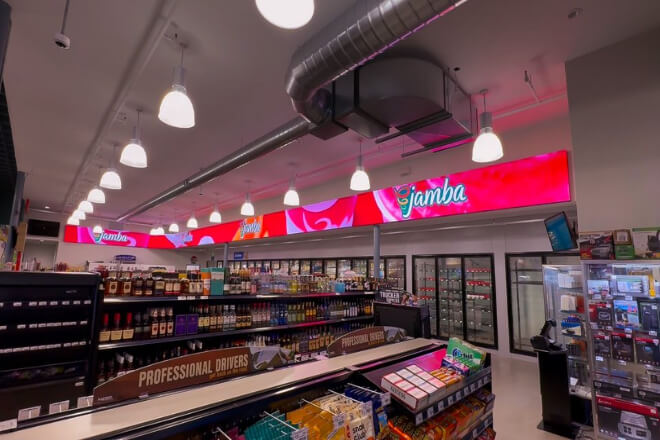
In a high-frequency shopping scenario like a convenience store, brand image is often built not with a slogan, but with small details.
A small LED display is precisely that kind of easily noticeable “detail bonus.”
First, it enhances the store’s technological feel. Compared to static posters or light boxes, dynamic visuals inherently make the space appear “more modern.”
For example, a small LED screen scrolling content at the entrance or checkout area creates a more “up-to-date” atmosphere than a traditional store, even for simple promotional information, making it feel more vibrant.
Second, it enhances brand professionalism. A unified digital display method subconsciously makes customers feel that the store operates more systematically and updates information more promptly, rather than just displaying whatever is available.
This feeling, though subtle, affects overall trust.
Another key factor is visual consistency. Many stores suffer from inconsistent poster styles and update frequencies, resulting in a cluttered appearance.
LED screens can centrally display standardized content, ensuring brand visual consistency. For example, consistent fonts, color schemes, and display rhythm create a more stable brand identity.
Finally, it enhances customer impressions and perception.
Customers may not remember specific details, but they will remember that “this store looks cleaner, more modern, and more up-to-date.” This impression influences their willingness to return.
Simply put, the added value of small LED displays isn’t a “showy upgrade,” but rather making the convenience store more consistent, modern, and memorable in its details.


 English
  Español
  简体中文
简体中文  Français
  日本語
日本語  한국어
한국어  العربية