

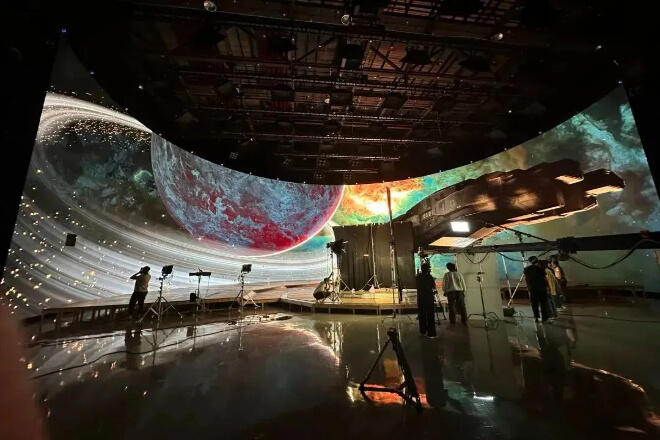
In the past, green screens were almost a “universal tool” in film and television production.
Whether it was a sci-fi city, an alien world, or a historical scene, post-production staff could use compositing technology to gradually build the image.
However, with the increasingly fast pace of film, advertising, and short video production, the green screen model has begun to encounter some new problems.
The biggest challenge is that many scenes don’t actually appear until post-production.
During filming, actors often only face a green background, making it difficult to accurately perceive the light, space, and atmosphere of the environment.
Directors need to rely on imagination to guide the performances, and actors also need to “mentally fill in” what scene they are in, which limits emotional expression and on-set interaction.
At the same time, the pressure on post-production is also increasing.
Complex scenes require extensive keying, rendering, and adjustments, increasing both production time and project costs.
For commercials or film projects requiring frequent revisions, the post-production workload can easily escalate.
Today, the film and advertising industries increasingly demand faster and more flexible production methods.
Brands need to release content quickly, and film crews need to improve shooting efficiency. Traditional green screens can no longer fully meet the demands of this high-frequency, multi-scene production.
This is why more and more production teams are turning their attention to LED表示 virtual shooting.
It transforms scenes from “post-production imagination” to “on-set visibility,” allowing actors, directors, and cinematographers to directly enter the real environment during filming.
On traditional green screen sets, actors sometimes face a “small challenge”: facing a green screen and imagining themselves in another world.
The director says, “This is a futuristic city.” The actors need to imagine. The cinematographer needs to imagine. The post-production team then “fills in” this world.
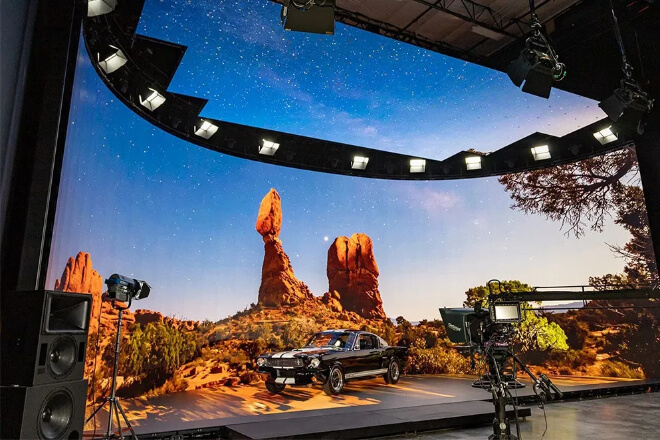
LED display virtual shooting changes this process.
Through LEDディスプレイ、 digital backgrounds and virtual scenes can appear directly on set.
Whether it’s a sci-fi city, a seaside villa, or extreme weather conditions, everything can be presented to the actors in real time, making the virtual world more than just computer-generated material.
The biggest change is that actors can finally “see where they are.”
When the lighting, colors, and spatial effects in the background are realistically presented, actors’ performances become more natural.
Faced with buildings, vehicles, or special environments in virtual scenes, actors don’t need to rely entirely on imagination, and their emotions and movements are more easily conveyed.
For directors and the cinematography team, the LED screen is also like a pre-released “preview of the final product.”
During filming, the team can directly adjust the background, composition, and visual effects, identifying problems in time.
Rather than waiting months later to see the final version and discovering the need for revisions.
This not only reduces the pressure of post-production compositing but also makes the production process more flexible.
The biggest change brought about by LED virtual shooting is that it transforms the set from “imagining the future” to “seeing the future.”
When actors, directors, and cinematographers can all see the target visuals on set, creative efficiency naturally increases.
Previously, filming a production requiring multiple scene changes often involved a series of scenarios:
Building a city street one day, a forest the next, and then moving to another location for a car commercial the day after.
The more complex the scene, the longer the setup time and the higher the budget. The advent of LED表示 virtual shooting has made scene changes much simpler.
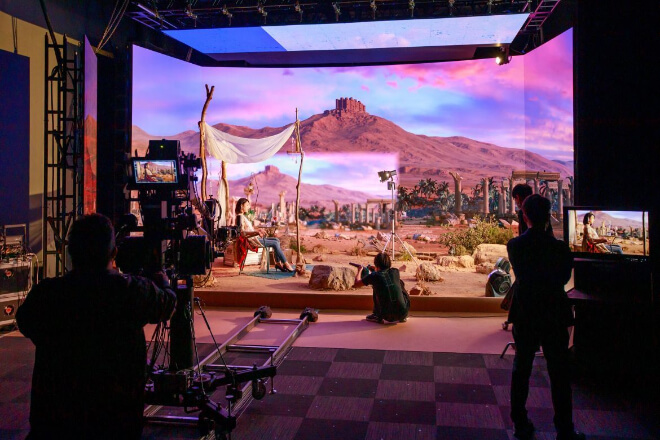
Through LED displays, production teams can quickly switch between different digital backgrounds, transforming the studio into a futuristic city, desert, seaside, or even space environment.
Scenes that used to take days to build can now be quickly transitioned to a new shooting state simply by changing the visual content.
This method is particularly convenient for car commercials.
Vehicles can be filmed in a safe and controlled studio, while the background can be switched at any time to highways, city nightscapes, or extreme environments, allowing brands to create more creative visuals within a limited time.
Film and television productions also benefit.
Complex scenes in TV series and movies don’t necessarily require real construction.
With LED screens, teams can reduce the cost of physical set construction while maintaining the realism and visual impact of the images.
More importantly, most of the effects can be seen on set.
Directors can adjust shots in real time, and cinematographers can optimize compositions, eliminating the need to wait until post-production to discover “something’s not right.”
LED display virtual shooting is like installing a “digital deformer” in a film studio.
It unlocks endless possibilities for a space and transforms film and advertising production from “constantly building sets” to “rapidly creating scenes.”
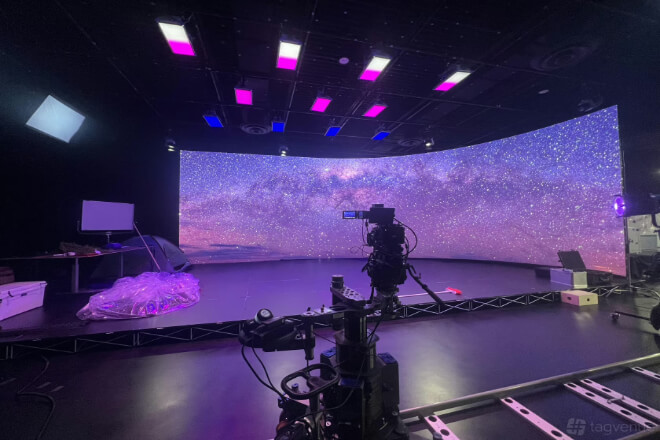
In ordinary scenes, an LED screen may only need to “look clear.”
However, on a virtual shooting set, the LED screen is not just a background; it directly enters the frame, becoming part of the image. Therefore, every detail on the screen can affect the final result.
First, a high リフレッシュレート is a key factor in virtual shooting.
When a camera shoots an LED screen, insufficient refresh rates can easily lead to moiré patterns, scan lines, and other problems, resulting in unnatural textures in the image.
High refresh rate LED displays allow the camera to capture a more stable and cleaner image, reducing visual interference during shooting.
Second, 輝度 and grayscale performance are equally important.
Virtual scenes need to simulate changes in light at different times and in different environments, such as dawn, dusk, night, or complex lighting conditions.
If the LED screen’s brightness is insufficient, the image will easily appear “fake”; and if grayscale performance is inadequate, details in highlights and shadows will be easily lost.
Furthermore, accurate color reproduction is a key focus for production teams.
Film and advertising are extremely sensitive to color; even slight deviations can affect the overall visual effect.
Excellent LEDディスプレイ need to accurately reproduce various colors, allowing virtual backgrounds to blend naturally with real actors, props, and lighting.
Simply put, LED screens in virtual filming are not just responsible for “displaying images,” but also participate in the creative process like photographic equipment.
For virtual production teams, a high-performance LED display is like a “second camera” on set. The stronger its expressiveness, the closer the virtual world will be to the real world.
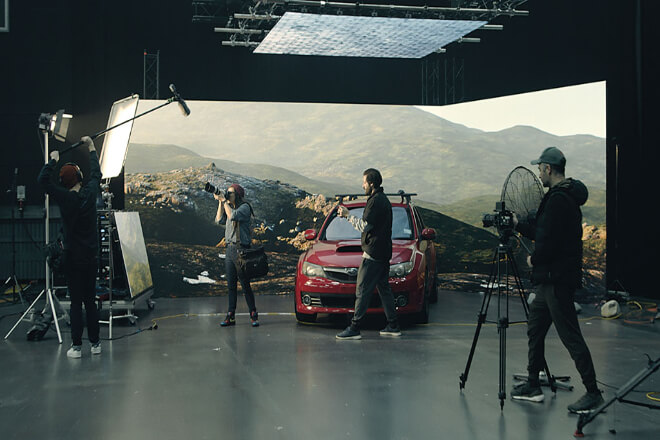
In the past, when people mentioned virtual filming, many thought of large film sets, complex equipment, and high costs.
However, with the development of LED display technology, virtual filming is gradually moving towards more application scenarios, no longer just an “exclusive feature” of blockbuster films.
For small and medium-sized photography studios, LED virtual shooting can facilitate digital upgrades.
Previously, shooting different themes might require building different scenes and preparing numerous props;
Now, by changing the digital content on the LEDスクリーン, a space can quickly transform into a cityscape, a natural environment, or a futuristic technological scene, improving the studio’s efficiency.
Brands and businesses can also find new ways to create content.
Corporate promotional videos, product advertisements, release videos, and even live streaming content can utilize LED display virtual scenes to create more appealing visuals.
This flexibility can save considerable time and production costs, especially for brands that need to frequently update content.
Furthermore, game streaming, virtual anchors, digital humans, and other interactive entertainment content may become new directions for LED virtual shooting.
Future content creation may no longer be limited to “where to shoot,” but rather to “what scene to create.”
LED display virtual shooting is changing not only shooting methods but also redefining the possibilities of content production.
A photography studio and an LED screen have the potential to become a new gateway connecting the real and digital worlds.


 English
  Español
  简体中文
简体中文  Français
  日本語
日本語  한국어
한국어  العربية