
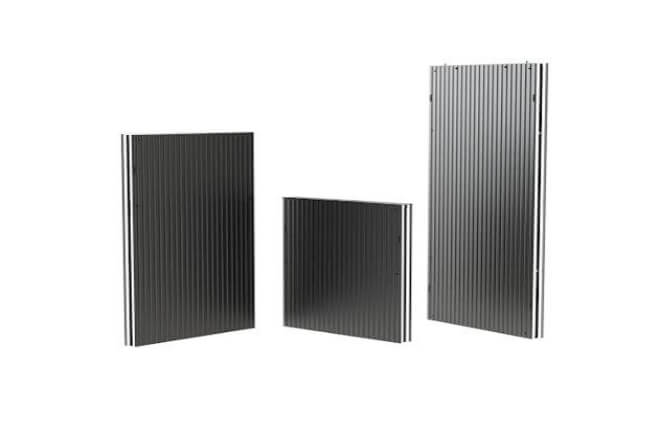
When companies purchase MIP LED displays, screen size, price, and display quality are often the primary considerations.
However, another parameter is equally important: pixel density. It not only affects image detail but also viewing distance, content presentation, and overall project cost.
So, why is pixel density so crucial?

Imagine continuously zooming in on a high-definition photograph.
Initially, you see clear people and objects, but upon further zooming, you might discover tiny colored squares.
These basic units that make up the image help us understand the pixels of an LED display.
Pixel density refers to the number of pixels contained within a unit area, usually expressed as pixels per square meter.
The higher the pixel density, the more pixels can be arranged per unit area, and the screen can typically display richer image details.
Pixel density is particularly important for MIP LED displays. MIP, with its independently packaged unit technology.
Provides greater flexibility for the integration of micro-LED chips and the manufacturing of display modules, creating conditions for high-density display solutions.
Here, it’s important to distinguish between two easily confused concepts:
ピクセルピッチ: The distance between the centers of adjacent pixels, usually measured in millimeters.
画素密度: The number of pixels per unit area, usually expressed as pixels per square meter.
In regularly arranged displays, the smaller the pixel pitch, the higher the pixel density.
For example, all other things being equal, a P1.2 display has a higher pixel density than a P2.5 display.
Understanding these two parameters is crucial for corporate procurement managers.
Because what truly affects the display effect of a project is not just the size of the screen, but also how much image information can be presented per unit area.
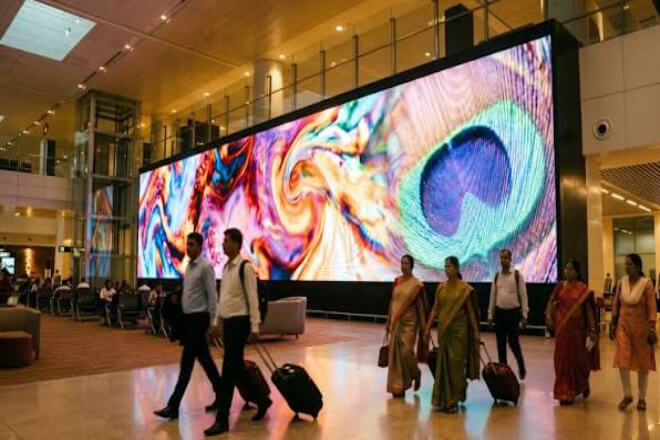
Why do some high-end conference rooms and control centers prefer high-pixel-density LED displays?
The reason is simple: these scenarios often require displaying a large amount of detail, and even slightly insufficient image detail can affect information readability.
Higher pixel density mainly brings the following advantages:
1). Presenting finer image details
With an increased number of pixels, the screen can use more display units to reproduce the details in the image.
For example, when playing high-definition product promotional videos in a corporate showroom.
The texture, fine structure, and color transitions of the product surface can be presented in greater detail.
2). Improve the readability of text and data
For scenarios such as control centers and conference rooms, displays are not only tools for playing videos but also for displaying text, charts, and data.
For example, in a financial data center, staff may need to view multiple sets of data curves, numbers, and charts simultaneously.
If the pixel density is insufficient, small text and complex lines may not be clear enough, increasing the difficulty of reading information.
3). Improve the close-up viewing experience
High-end commercial spaces and corporate showrooms typically need to consider the needs of viewers viewing at close range.
If the screen pixel density is low, viewers are more likely to notice the graininess of the image when they get close.
Higher pixel density helps to present the image more smoothly and naturally.
However, it is important to note that higher pixel density is not always better. It must be selected in conjunction with the viewing distance, screen size.
And the actual content being played; otherwise, it may increase procurement costs without bringing a significant improvement in the experience.
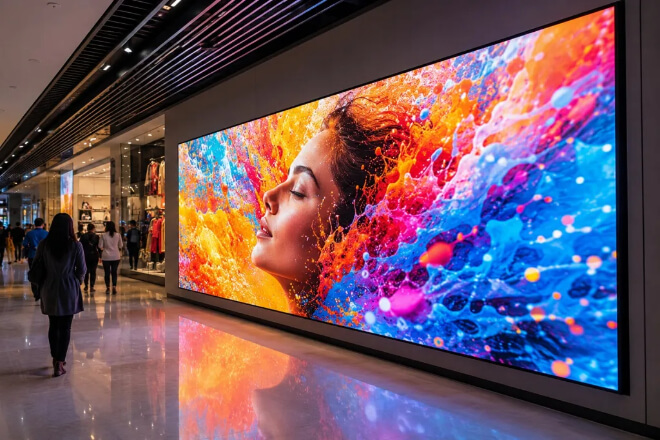
If pixel density determines how much detail a screen can display, then the application scenario determines how important that detail is.
Different projects have different requirements for display quality; therefore, companies cannot simply apply the same configuration when choosing MIP LED displays.
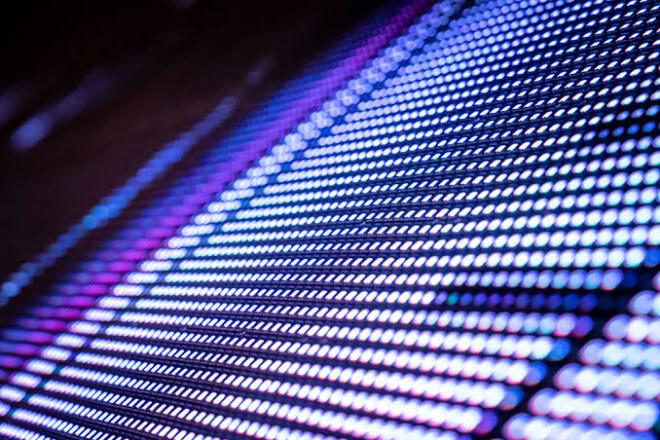
Seeing the advantages of high pixel density, some procurement managers might think:
Since more pixels result in a finer image, can’t we just choose the highest configuration?
Actually, no.
Increased pixel density usually means requiring more pixel units, potentially leading to higher procurement costs, increased complexity, and system configuration requirements.
Therefore, companies need to make a comprehensive judgment based on project needs.
1). 視聴距離
This is one of the most important factors to consider when choosing pixel density.
Closer viewing distances generally require more attention to smaller pixel pitch;
At longer viewing distances, excessively high pixel density may not provide significant visual benefits.
2). Screen size and resolution
Pixel density and screen resolution need to be considered together.
Increasing screen area requires increasing the total number of pixels to maintain the same pixel density.
Simultaneously, the input signal and playback content should also have sufficient resolution;
Otherwise, a high-density screen cannot create more original image details out of thin air.
3). Display content type
If the project mainly displays high-definition images, detailed charts, and small-font text, pixel density should be given more attention.
If it mainly plays large dynamic videos and long-distance advertisements, the configuration can be adjusted appropriately according to viewing conditions.
4). Overall procurement and operating costs
Besides the display module itself, the control system, signal processing equipment.
Installation structure, power consumption, and subsequent maintenance must also be considered.
A truly reasonable choice is to find a balance between display effect and overall investment, rather than simply pursuing leading parameters.
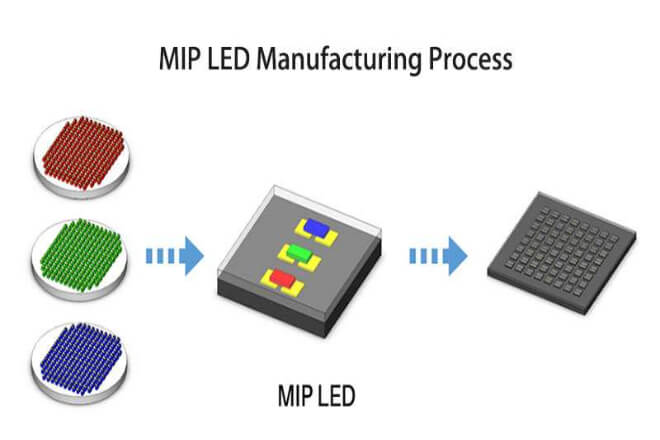
Since pixel density is so important, what role does MIP packaging technology play in it?
Micro-in-Package (MIP) provides independent packaging units for micro-LED chips, which are then applied to display modules.
This technology allows for the pre-integration, testing, and packaging of some chips, providing different process options for display module manufacturing.
Specifically, its value lies mainly in the following aspects:
1). Providing a technical path for high-density displays:
As display pixel pitch continues to shrink, chip size, packaging precision, and transfer processes face higher requirements.
MIP technology, through its independent packaging unit design, provides another path for the integration and application of micro-LED chips.
2). Facilitating quality inspection in the packaging stage:
Independent packaging units can be inspected before entering subsequent display module manufacturing, helping to identify defective units.
However, the reliability of the final product still depends on multiple stages such as packaging, transfer, soldering, and module manufacturing.
3). Providing flexibility for different display solutions:
Different projects have different requirements for pixel pitch, display size, and product performance.
MIP technology can combine different chip specifications and module designs to develop display products suitable for various application scenarios.
For business decision-makers, the value of MIP (Multi-Installation Package) lies not only in possessing a new packaging technology.
But also in finding a more suitable solution between display accuracy, product performance, and manufacturing costs based on project requirements.
Therefore, when purchasing MIP LED displays, in addition to focusing on pixel density, it’s crucial to understand the product’s actual resolution, packaging quality, display consistency, and overall screen performance.
Only when these aspects work together can high pixel density truly translate into a better visual experience.


 English
 Español
 简体中文
 Français
 日本語
 한국어
 العربية