
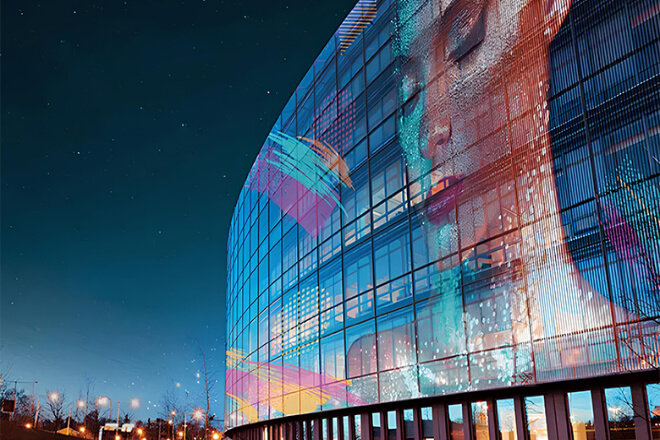
Many people believe that the difficulty of an LED表示 project lies in “buying the screen.” However, the real determining factor is often the installation itself.
No matter how good the screen is, if it’s installed incorrectly, the wiring is wrong, or the adjustments are inadequate, it can turn a “high-definition screen” into a “costly lesson.”
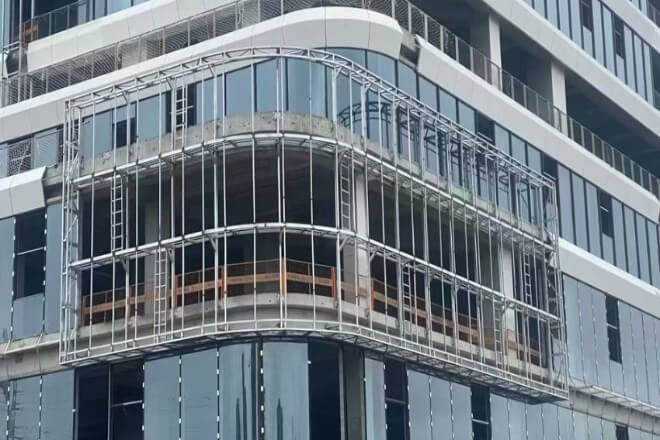
Sometimes, the safety issue with LED displays isn’t “equipment failure,” but rather “structural collapse.”
If there are hidden dangers in the installation design or construction, the consequences often suddenly become apparent under high loads or long-term operation.
First, the insufficient load-bearing capacity of the steel structure can lead to overall stress imbalance or even the risk of partial collapse.
For example, some large ステージ LED background screens, if the weight of the screen and the load-bearing capacity of the suspension system were not fully calculated during construction.
May experience structural fatigue during long performances or frequent structural lifting.
Similar situations have been repeatedly emphasized in some large-scale performance accidents.
For example, some large stage screens, due to uneven stress on the suspension points, have shifted or even fallen during disassembly, assembly, or performances, posing a significant safety risk on site.
Secondly, improper installation location amplifies external environmental risks. For example, in high-altitude outdoor large screen projects, if the site is located near a wind vent or the edge of a building,
Without adequate wind load design, the stress on the screen will be magnified many times over during strong winds.
This type of problem is common in some outdoor advertising screen accidents, essentially stemming from a combination of environmental and structural factors leading to uncontrolled damage.
Meanwhile, unreliable fixing methods are a direct trigger for many hidden dangers. For example, mismatched bolt specifications, substandard welding processes.
Or long-term neglect of maintenance of connectors can cause them to gradually loosen under vibration and thermal expansion and contraction.
After repeated assembly and disassembly, LEDスクリーン in some performance venues may experience partial detachment or sagging if timely reinforcement and inspection are not carried out.
Similar safety lessons repeatedly reported in the industry regarding large performance venues (such as LED systems for concert stages) are essentially due to “connection point failure.”
Finally, deformation and loosening during long-term operation are the most easily overlooked accumulation of hidden dangers.
For example, fixed screens in stages or venues are constantly exposed to heat from lighting and structural stress.
Without regular inspection and calibration, this can lead to slight frame deformation, module misalignment, and, in severe cases, even affect the overall structural stability.
Some large venues (including well-known performance venues whose past performance accidents have exposed problems) have reminded the industry that equipment is not “safe once installed,” but rather “safe only through continuous maintenance.”
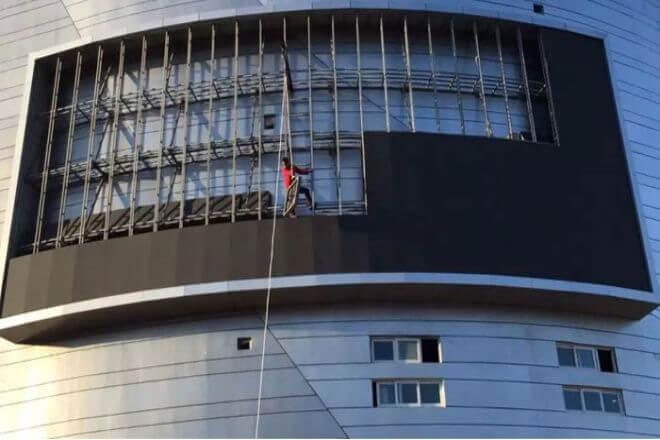
The image on an LED表示 is essentially “pieced together” from individual modules. A well-pieced image resembles a single piece of glass.
A poorly pieced image becomes a “puzzle,” affecting the viewing experience even with high-quality content.
First, uneven module installation directly disrupts the continuity of the image. For example, a slight bulge or depression in a module might only appear “tiny” to the naked eye.
However, when displaying the image, a change in the angle of light can make this area particularly noticeable, like a small step on a smooth wall.
Second, excessively large seams affect the integrity of the image. For example, when playing a face or a video clip:
If the gaps between the screen panels are noticeable, it creates a “cut-off” effect—eyes, text, or lines are clearly separated, disrupting the visual experience.
What was originally a continuous image becomes “segmented playback.”
Simultaneously, local height differences create a sense of visual fragmentation, making the image inconsistent.
For example, a slightly raised left module and a slightly lower right module might not be noticeable in static images.
However, in dynamic videos, differences in 輝度 and angle can make the image appear “wavy” or “uneven,” affecting the overall viewing experience.
Finally, the overall display quality will be significantly reduced, even for high-quality content.
For example, playing a 4K promotional video on a high-precision screen will produce a “cinema-like effect.”
But on a poorly spliced screen, viewers might only notice that “the screen looks a bit uneven.”
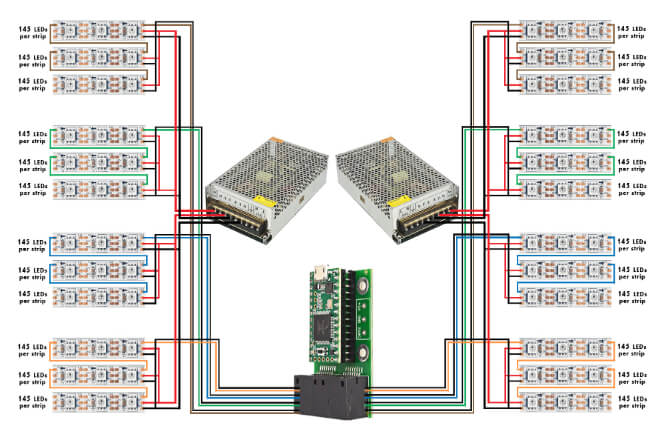
LEDディスプレイ appear to be “screens emitting light,” but behind the scenes, they are actually a typical “power + signal coordination system.”
If power supply and cabling are not handled properly, the problems are often not minor malfunctions, but rather overall screen instability or even intermittent shutdowns.
First, an insufficient 電源 will directly lead to operational abnormalities. For example, if the screen’s power requirement is 10kW.
But only a power supply close to the critical value is provided, this can cause voltage instability, localized power outages, or even modules that are only half-lit and half-darkened during operation.
Especially in high-輝度 mode or after extended periods. Simply put, the power supply cannot keep up with the light output.
Second, disorganized wiring significantly increases the risk of malfunctions.
For example, if high-voltage, low-voltage, and signal cables are not routed separately, or if cables are severely tangled, interference or poor contact problems may occur.
The on-site manifestations might include occasional screen flickering, flashing in a certain area, or even random blackouts—difficult to troubleshoot completely in one go.
Simultaneously, unstable signal transmission can lead to blackouts or flickering screens. For example, substandard network cables, excessively long transmission distances without signal amplification, or loose connectors can all cause intermittent control signals.
In this situation, the screen may not be completely broken, but rather intermittently working, making troubleshooting extremely time-consuming.
Finally, the difficulty of later maintenance will increase significantly. If the wiring is not standardized from the beginning, it is difficult to quickly locate the problem point during later maintenance.
For example, determining which module or receiver card a signal cable is connected to may require checking each one individually, greatly reducing maintenance efficiency.
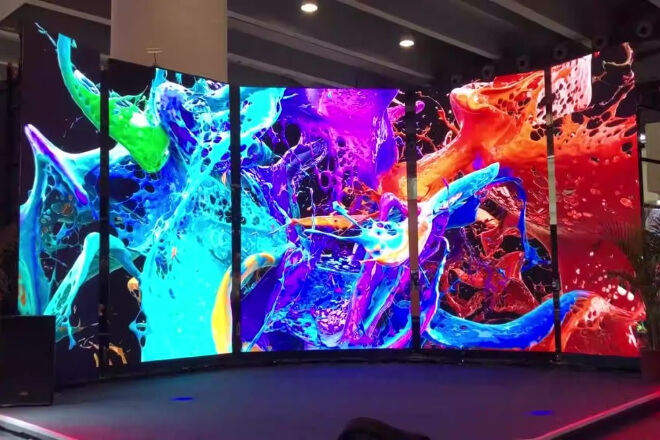
Ideally, LEDディスプレイ are “lighting wonders,” but if the environment is not properly considered, they can easily become “devices that malfunction with changes in weather.”
First, inadequate waterproofing and dustproofing are like leaving the screen without a raincoat.
For example, if an 屋外用 LED スクリーン is not properly sealed, heavy rain may allow moisture to seep into the cabinet, causing minor flickering or even a complete blackout.
Coastal cities are even more typical, with high humidity and salt content, which can easily lead to “slow rusting” failures over time.
Second, an insufficient heat dissipation design is like making the screen “work overtime in a high-temperature room.”
For example, imagine direct sunlight in summer combined with a bright screen displaying advertisements.
If the airflow is obstructed, the internal temperature will skyrocket. The LEDs and 電源 are essentially “forced to run a marathon.”
Which might hold out in the short term, but will lead to premature aging and 輝度 degradation in the long run.
Simultaneously, ignoring environmental factors like sunlight and humidity is like not “choosing the right workspace” for the screen.
For instance, in strong sunlight, insufficient brightness will cause the screen image to appear washed out and grayish, making it difficult for viewers to see even with squinting eyes.
In a humid environment, the circuitry may slowly oxidize, resulting in random malfunctions—”normal today, erratic tomorrow.”
Finally, the overall performance will be gradually worn down by the environment. Initially, it might just be occasional uneven brightness, but over time.
It will develop into localized darkening, inconsistent colors, and even frequent maintenance.
Just as people feel uncomfortable if they are not adapted to their environment for a long time, screens also “get tired.”
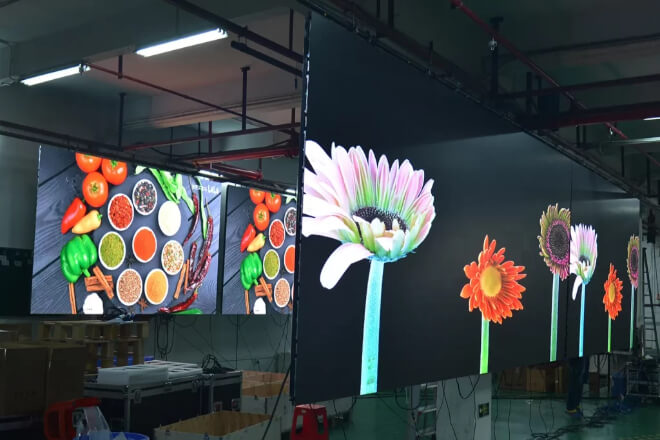
LED displays are not simply devices that can be installed and then forgotten; they are more like stage actors requiring meticulous “makeup and calibration.”
If the calibration is not done properly, even if the equipment itself is excellent, the final product may appear “off-target.”
First, inconsistent 輝度 and color calibration will make the image look like it’s been “filtered” in different areas.
For example, the left side might be cooler than the right, or certain areas might be significantly brighter, resulting in an inconsistent overall image.
For instance, if the same brand poster appears spliced with color differences on the screen, the viewer’s first reaction might not be the brand, but rather, “Is this screen not properly calibrated?”
Second, incorrect content display ratio settings will cause the image to be “stretched or cropped.”
For example, if a 16:9 video is incorrectly set to full-screen stretching, faces may appear “rounder,” and subtitles may be squeezed out of the frame.
Or, the top and bottom of the image might be cropped, causing important information to “disappear.” The content, which should be the main focus, becomes the “collateral damage.”
Furthermore, improper configuration of control system parameters will affect overall stability and smoothness.
For example, if the リフレッシュレート, grayscale, and brightness curves are not properly adjusted, slight flickering, ghosting, or loss of detail in low-light environments may occur.
Viewers may not be able to pinpoint exactly what’s wrong, but they’ll find it “uncomfortable to watch.”
Ultimately, the overall user experience after going live will be significantly degraded.
For instance, an LED screen used for ショッピングモール displays, if not properly adjusted, might result in issues like “unclear visibility during the day, excessive glare at night.
And choppy video”—the equipment itself may be fine, but the viewer experience is compromised.


 English
  Español
  简体中文
简体中文  Français
  日本語
日本語  한국어
한국어  العربية