

アン LED表示 that operates stably in a showroom doesn’t guarantee its reliability in real-world environments.
Wind, rain, temperature fluctuations, prolonged operation, complex electrical environments… the real challenges often arise after continuous use.
This makes the question more practical: how to ensure a screen remains stable in complex environments?

Extreme sun exposure, torrential rain, strong winds, temperature drops—sometimes even experiencing all four seasons in a single day.
Therefore, the key to stable operation for 屋外用 LED ディスプレイ is to first learn to “coexist with the weather over the long term.”
First and foremost is a waterproof, dustproof, and windproof design. Outdoor screens typically employ high-level protective structures, such as waterproof enclosures.
Sealed interfaces, and drainage designs, to prevent rainwater from entering the internal circuitry.
Especially in heavy rain, inadequate sealing can lead to minor issues like partial screen blackouts or even complete screen breakage.
Simultaneously, wind resistance must be considered.
For example, large building screens and stadium screens require reinforced steel structures to prevent swaying in strong winds.
Simply put, outdoor LED screens not only need to “light up,” but also need to “stand firmly.”
Secondly, they must cope with high and low temperatures and heavy rain. In summer, under intense sunlight, the internal temperature of the screen rises rapidly.
So many outdoor LED screens are equipped with cooling systems, such as fans, heat sinks, or even intelligent temperature control.
In winter, in low temperatures, it’s necessary to ensure a stable power supply and module startup, preventing them from “freezing out for a few seconds upon startup.”
For a very real scenario: in a commercial street at midday in summer, a large screen continuously plays advertisements under the sun.
If heat dissipation is poor, the image may begin to dim or even shut down; however, with proper temperature control.
Even under intense sunlight, it can maintain normal display and won’t suddenly “overheat and shut down.”
Furthermore, with long-term outdoor use, the effects of dust, moisture, and diurnal temperature variations must be considered.
Therefore, many screens undergo all-weather operation testing to ensure stability during extended operation.
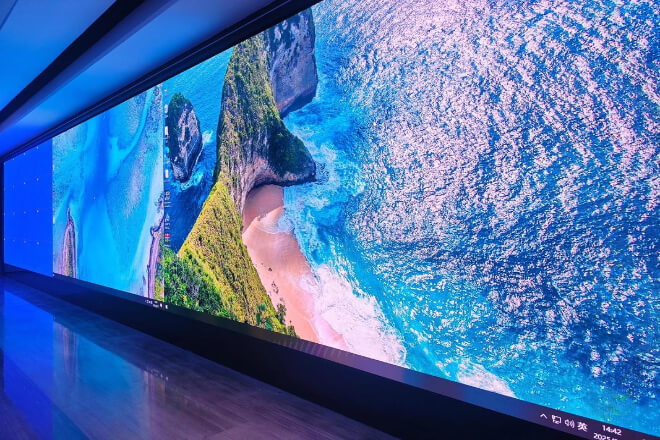
Many LED displays don’t just “brighten up occasionally,” but operate continuously from morning till night, even 24 hours a day.
Especially in commercial districts, スタジアム, and transportation hubs, the workload on these screens is actually higher than many people imagine.
First, they must support long-term continuous operation. In high-frequency usage scenarios, the screen cannot “suddenly stop playing.”
Therefore, LED displays are designed with more stable power systems and industrial-grade components to ensure stable operation even during extended playback.
For example, a large screen in a ショッピングモール atrium might be on from 10 am when the store opens until closing time, almost without interruption.
Second, overheating and performance degradation must be avoided. The biggest enemy of a screen during continuous operation is heat. High temperatures affect brightness, color, and even operational stability.
Therefore, many high-frequency large screens incorporate intelligent cooling systems, such as air cooling.
Temperature control, and even automatic 輝度 adjustment based on ambient temperature.
Simply put, the goal is to prevent the screen from becoming increasingly fatigued over time.
Here’s a real-world example: A stadium LED screen might play continuously for over ten hours on a match day, from warm-up animations to live game broadcasts and post-match advertisements.
If the heat dissipation and power supply systems are unstable, localized dimming or stuttering can easily occur.
However, a professional solution will ensure the image remains stable throughout the entire event.
Another example is a naked-eye 3D LED screen in a commercial area. Operating at high brightness during the day and continuously attracting foot traffic at night.
Without a long-term stable design, uneven brightness or significant color degradation may appear within a few months.
Therefore, the core issue in high-frequency usage scenarios is not “whether it can light up,” but “whether it can maintain stable brightness.”
In the operation of LED displays, electricity is actually the “invisible protagonist”—no matter how beautiful the image.
If the power supply is unstable, the effect can be directly compromised. Therefore, in complex electrical environments, the core is to “stabilize the power.”
First, there’s the issue of stable power supply and voltage protection. Many large LED screens are equipped with voltage regulators and power management systems to filter out unstable voltage fluctuations.
In places like shopping malls and outdoor plazas, where there are many electrical devices, voltage fluctuations can occur.
In these situations, voltage stabilizing modules act as “buffers,” smoothing out the power before sending it to the screen.
Secondly, they prevent voltage fluctuations from affecting operation. Without protection mechanisms, fluctuating voltage can cause screen flickering, or even module restarts or damage.
Therefore, systems typically have overvoltage and undervoltage protection. If the current is abnormal, it automatically adjusts or disconnects the at-risk component to prevent cascading problems.
For a clear example, at large events, if the temporary power supply is unstable, ordinary equipment might experience screen flickering or brief blackouts.
However, an LED system with voltage protection will automatically adjust smoothly, preventing viewers from witnessing power instability.
Another example is during peak nighttime electricity consumption in commercial areas.
Where surrounding air conditioners, elevators, and lighting operate simultaneously, causing significant grid load changes.
However, the LED screen, through its power management system, can maintain a continuous and stable output, unaffected by these fluctuations.
Finally, all these measures aim to ensure equipment safety and continuous operation. It’s not just about preventing screen power outages.
But more importantly, about avoiding long-term power fluctuations that can damage internal components.

A very real problem in the daily use of LED displays is that the larger the screen and the longer it’s used.
The more daunting it becomes to have to spend ages disassembling it if something breaks.
Therefore, the key to reducing maintenance costs is to make repairs simpler and faster.
First, modular design facilitates maintenance. Most mainstream LED screens now use a modular structure, meaning the large screen is broken down into individual small units.
If one part malfunctions, only that part needs to be addressed, rather than the entire screen.
For example, if a small module on a mall atrium screen malfunctions, it can be replaced individually without affecting overall operation.
Second, a rapid replacement and repair mechanism is crucial. This is where the advantage of modularity comes in—replacement isn’t a “major project,” but a “point-to-point operation.”
Many maintenance tasks can even be completed quickly, such as disassembling and reassembling directly from the back or front maintenance structure, reducing downtime.
This is especially critical for scenarios like ショッピングモール と スタジアム, where prolonged downtime is unacceptable.
Here’s a very real example: If a traditional 大型LEDスクリーン malfunctions, the entire screen might need to be shut down for repair; however, with a modular LED screen.
Only the “defective area” needs to be replaced, and the rest of the display continues to play normally. Viewers might not even notice the repair is in progress.
Furthermore, this design significantly reduces long-term operating costs. Because frequent complete disassembly is unnecessary.
It reduces manual maintenance time and difficulty, resulting in lower repair costs and downtime losses in the long run.
In the long-term operation of an LED display, what truly determines its reliability is not whether the screen is bright or not, but whether the underlying system will suddenly malfunction.
After all, viewers see the image, while engineers worry about—no freezing, no crashes, no system failures.
First and foremost is a stable control system. Think of it as the screen’s “command center.” How all the images are switched, when they are played, and for how long are all arranged by it.
When the system is stable, it’s like a reliable on-set director: clear pacing and crisp transitions.
When the system is unstable, minor blunders like “failed to change visuals when it should” or “advertisements freezing during playback” can occur.
Secondly, smooth content playback is crucial. The biggest problem with LED screens isn’t complex content, but rather “starting to contemplate life mid-play.”
Therefore, the system performs various optimizations, such as pre-loading content and segmented decoding, to ensure smooth transitions.
For example, when playing three consecutive advertisements in a shopping mall, a well-handled system will provide a smooth transition.
A poorly handled system might result in a two-second pause halfway through an advertisement.
To illustrate with a relatable example: when playing brand videos on a large screen in a shopping mall.
An unstable system might cause a sudden freeze during a climax—like a movie abruptly pausing at a crucial moment, instantly pulling the viewer’s attention away.
However, with a stable system, the entire playback is seamless, and viewers won’t even realize how much “scheduling” went into it.
For example, stadium LEDスクリーン need to quickly switch between scores, replays, and advertisements within the rhythm of a match.
If the system is even slightly slow to react, the audience might already be cheering for a goal while the screen is still stuck on the previous frame, which is simply “out of sync.”


 English
  Español
  简体中文
简体中文  Français
  日本語
日本語  한국어
한국어  العربية