
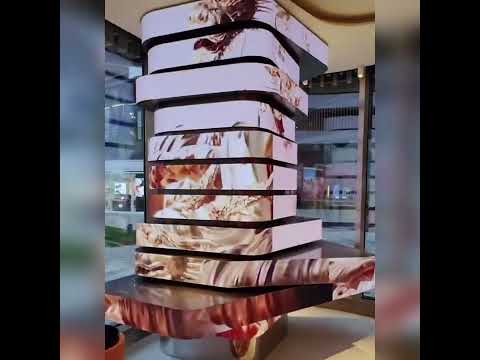
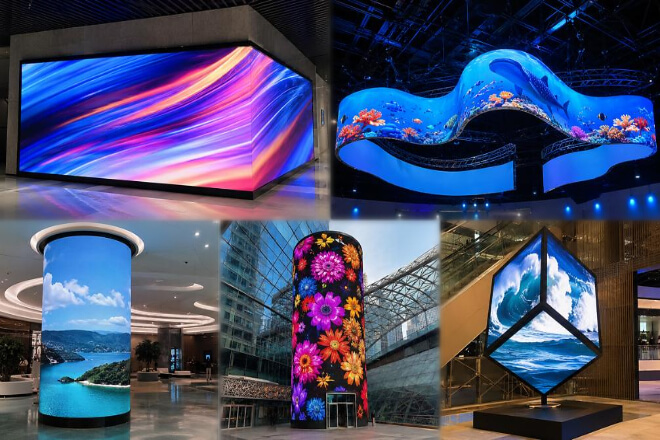
The defining characteristic of irregular LED displays is that they are not confined to traditional rectangular structures.
They can take the form of spheres, arcs, cylinders, waves, or even bespoke artistic shapes.
However, the more unique the shape, the more complex the structural design tends to be.
For instance, spherical LED displays require accounting for varying curvature across different zones;
Cylindrical screens necessitate managing the wrap-around structure and seam placement;
And wave-shaped screens require ensuring that the curvature transitions seamlessly between individual modules.
If the initial structural planning is flawed, post-installation issues—such as uneven gaps, an irregular surface, or localized deformation—may arise.
Therefore, the design process for irregular LED displays must first address three key areas:
Overall form: Determining the screen’s shape based on the architectural space, the exhibition theme, and the installation location.
Structural dimensions: Calculating curvature, arcs, installation radii, and the dimensional relationships between different sections.
Load-bearing and safety: Evaluating the screen’s weight, the supporting structure, and the mounting methods to ensure long-term operational stability.
For large-scale irregular LED display projects, 3D modeling and structural simulations should be conducted in advance;
In some cases, creating partial prototypes for installation testing is also advisable.
A visual concept rendering is not the same as an engineering blueprint ready for construction.
A rendering might look perfectly smooth, but actual implementation requires addressing practical challenges such as cabinet fabrication, module assembly, cabling, and on-site installation.
Thorough planning during the design phase minimizes the likelihood of costly rework later on.
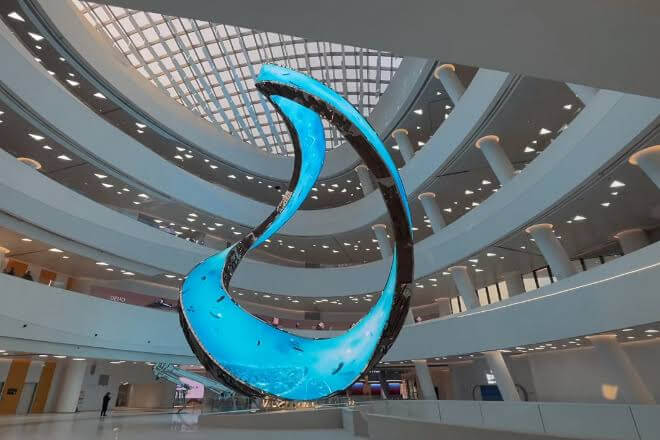 Once the physical form of the irregular LED display is established, the next step is to consider how the content will be presented.
Standard rectangular displays feature a regular pixel arrangement, making content creation and display control relatively straightforward.
In contrast, irregularly shaped displays may incorporate curves, inclines, or non-uniform zones.
If the pixel layout is poorly planned, it can easily lead to image distortion, aspect ratio errors, or discontinuities in the visual display.
First, select the appropriate pixel pitch based on the intended viewing distance.
A smaller pixel pitch generally indicates a higher pixel density per unit area, allowing for finer, more detailed imagery when viewed from close range.
However, it is not always necessary to use the finest pixel pitch across the entire surface of an irregularly shaped LED display.
For installations mounted at significant heights—often intended to enhance a space’s atmosphere—the choice should be balanced against actual viewing distances and budget constraints.
Second, careful attention must be paid to the dimensions and arrangement of the display modules.
For instance, with a cylindrical LED display, calculate the number of modules required based on the cylinder’s diameter and the module width to prevent noticeable misalignment at the seam where the ends meet.
For spherical displays, the module arrangement must be planned according to the geometric characteristics of different areas on the sphere, minimizing visual errors at the edges.
Furthermore, the visual performance of irregularly shaped LED displays must be considered from various viewing angles.
This is especially critical for installations in shopping mall atriums, exhibition halls, or public spaces, where viewers may approach from multiple directions.
Evaluating display quality solely from a head-on perspective risks overlooking visual issues that may arise from side or angled views.
Therefore, during the design phase, pixel mapping and visual testing should be conducted using 3D models to ensure that the final displayed content aligns perfectly with the physical structure.
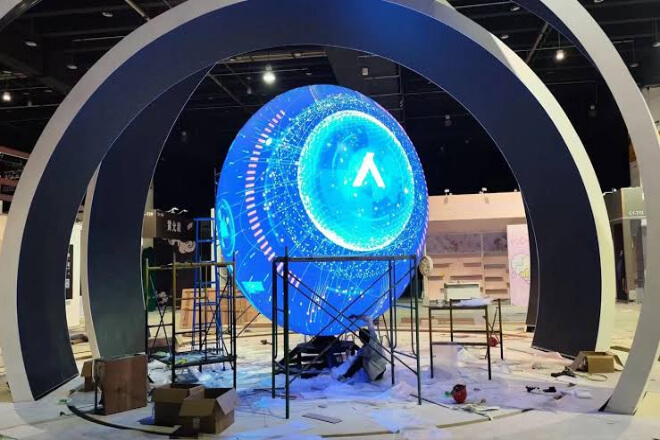
Irregularly shaped LED displays place demands not only on the hardware but also on the control system.
While standard LED displays typically output content based on conventional rectangular resolutions, irregularly shaped displays often possess non-standard physical structures.
For example, a cylindrical screen requires mapping flat content onto a curved, wrap-around surface, while a spherical screen requires managing image distribution across various orientations.
If content creation and the control system are not properly adapted in advance, even a high-quality display screen may suffer from image misalignment, stretching, or incomplete content display.
Therefore, for projects involving irregularly shaped LED displays, it is essential to determine the display area, pixel coordinates, and signal distribution method in advance.
For projects with complex structures, specialized control systems are typically required to manage the display via zoning.
Designers must establish a display mapping relationship based on the actual arrangement of the modules, ensuring the control system can accurately identify each display zone’s location.
Content creation should not wait until after the equipment is installed.
For instance, if a video featuring people is played on a cylindrical LED display using a standard landscape-format source, the figures may appear distorted at the seams where the panels join.
Similarly, with spherical displays, content that has not been adapted to the spherical geometry may suffer from abnormal aspect ratios.
Consequently, during project planning, the display design team and the content creation team should collaborate to define the aspect ratio, resolution, playback orientation, and dynamic effects of the visual assets.
In short, displaying content on an irregularly shaped LED screen is not as simple as merely playing a standard video on a uniquely shaped surface.
Hardware structure and content design must be considered together to fully leverage the advantages of these displays.
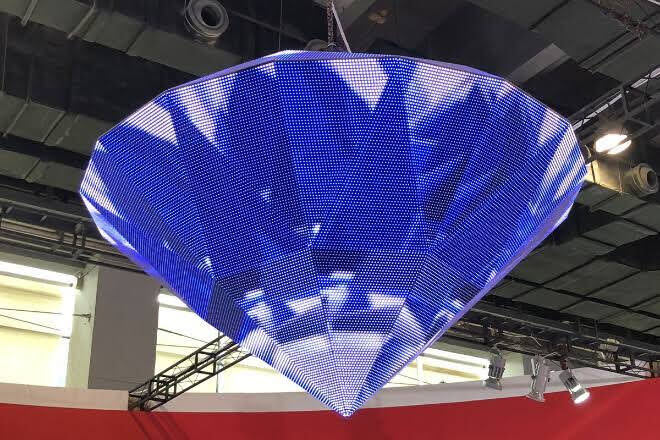
To achieve distinctive forms, some irregularly shaped LED display projects utilize enclosed cabinets, compact structures, or specialized mounting methods.
While these designs enhance visual appeal, they can introduce new challenges for heat dissipation and power supply.
First, consider heat dissipation.
LED beads, driver ICs, and power supply units all generate heat during operation.
If the internal space is confined and airflow is restricted, heat can accumulate in specific areas.
Prolonged exposure to high temperatures can accelerate the aging of electronic components and compromise the equipment’s stability.
Therefore, when designing irregularly shaped LED displays, heat dissipation channels must be planned, and appropriate cooling methods selected based on the product’s structure.
For enclosed designs, it is crucial to assess internal temperature fluctuations—not just the exterior’s visual integrity.
Second, consider the power supply design.
Module arrangements in irregularly shaped screens can be complex, leading to variations in circuit lengths and load distribution across zones.
If the power supply circuitry is not planned effectively, it increases the risks of voltage drops, poor electrical contact, or localized power supply irregularities.
Designers should plan the power supply system based on the display’s total power consumption, the number of power zones, and the actual load.
This involves strategically positioning power supplies, routing cables, and incorporating access points for maintenance.
For large-scale, irregularly shaped LED displays, it is also essential to implement a zoning strategy for both power and signal distribution;
This facilitates troubleshooting and fault diagnosis later on.
Heat dissipation and power supply are not issues to be addressed solely during the installation phase.
They must be integrated into the structural design process from the outset.
Otherwise, the original design might later require modification to accommodate additional ventilation space or to adjust internal wiring.
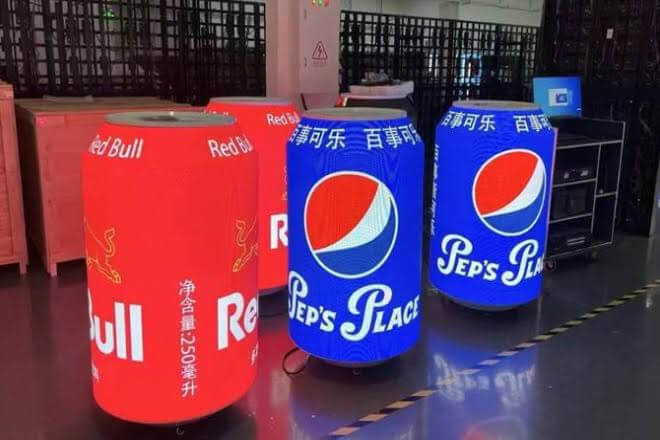
Projects involving irregularly shaped LED displays often create the impression that success is largely guaranteed simply by achieving a visually striking design.
However, operationally, completing the installation is only the beginning.
The ease of future maintenance—such as quickly replacing individual modules—significantly affects the project’s long-term cost of ownership.
For instance, if a curved LED display installed at a significant height lacks proper access pathways, replacing a faulty module might require scaffolding or specialized lifting equipment.
Similarly, if a fully enclosed spherical display lacks an internal structure designed for easy access, repairing even a localized fault can become extremely complex.
Therefore, maintenance strategies must be considered during the design phase of any irregularly shaped LED display.
First, the module mounting structure should be designed to allow for efficient removal and installation.
Ideally, areas prone to common faults should be independently accessible, preventing the need to dismantle large sections of the display just to replace a single module.
Second, adequate provisions must be made for power, signal, and maintenance access points.
Furthermore, the internal wiring layout should be clearly defined to simplify maintenance tasks.
Third, construction plans should be tailored to the specific installation environment.
For large curved, spherical, or elevated displays, factors such as transportation routes, hoisting methods, available installation space, and on-site construction conditions must be evaluated in advance.
Finally, enterprises should require suppliers to provide comprehensive structural drawings, wiring documentation, and maintenance manuals.
Upon project delivery, technical training for staff should be arranged, and detailed maintenance records for the equipment should be established.
From a long-term investment perspective, an irregularly shaped LED display that is easy to maintain typically holds greater commercial value than one that merely looks impressive but proves difficult to service.


 English
 Español
 简体中文
 Français
 日本語
 한국어
 العربية