

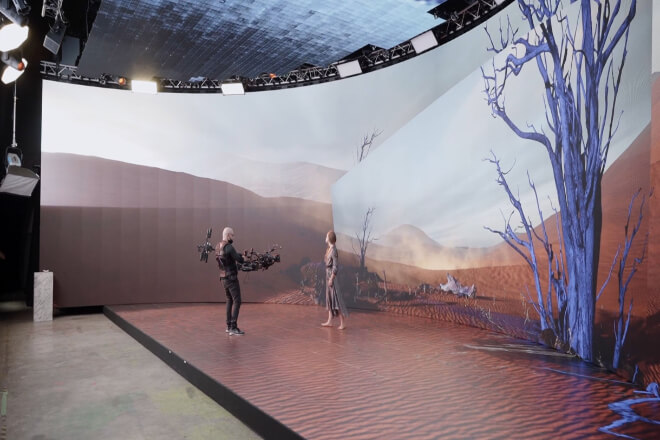
In the past, changing a film or television production meant a major relocation.
Building streets, arranging buildings, and transporting props—production crews often invested significant time and resources to recreate a single scene.
However, with the rapid pace of content updates and the increasing variety of scenes audiences see, traditional set construction is facing limitations.
The biggest problem is that a single soundstage can hardly accommodate all stories simultaneously.
Today, they might need to film a futuristic city; tomorrow, a desert or snow-capped mountains;
And the day after, a luxury hotel. Rebuilding each time would not only be time-consuming but also continuously increase costs.
pantallas LED are changing the way film and television bases create scenes.
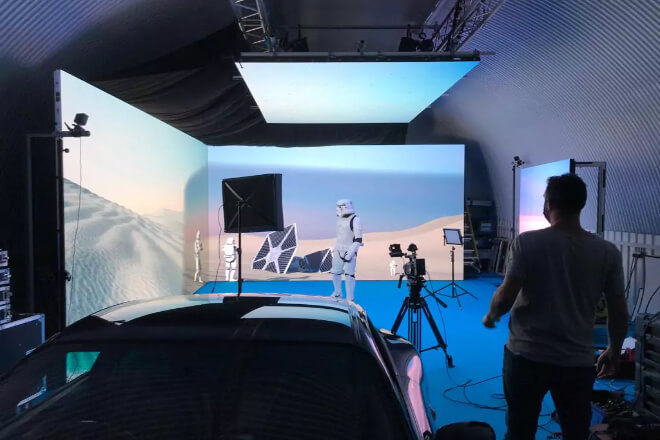
Through LED virtual shooting, film crews can directly present different digital environments on the screen, quickly switching between various scenes such as cities, nature, and science fiction.
Backgrounds that previously required days or even longer to build can now be completed quickly by changing digital content.
For film and television bases, this means that a single space can serve more types of projects.
A single LED virtual shooting wall can meet the diverse shooting needs of movies, TV series, commercials, and short videos, improving the efficiency of the studio and giving the venue greater commercial value.
Simply put, LED displays are like installing a “digital set replacement system” for film and television bases.
It doesn’t require expanding the space, yet it allows for more possibilities within a single space, enabling creators to quickly enter the story world they want.
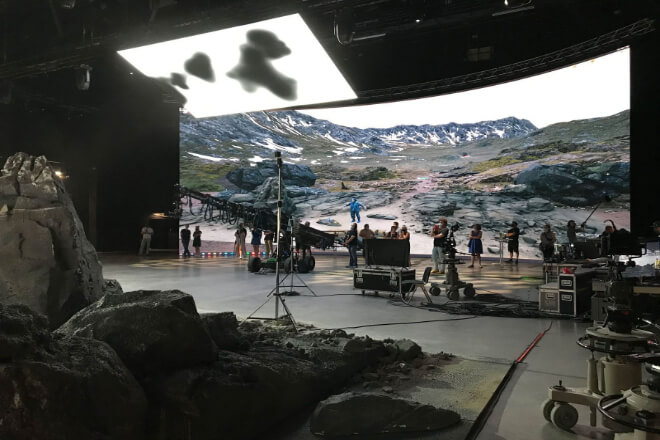
On a virtual shooting set, an LED display is not simply a “backdrop.”
It must allow actors to see realistic digital scenes while also meeting the high demands of the camera.
After all, what the human eye considers “okay” may immediately reveal problems after being magnified by the lens.
Therefore, when choosing an LED solution for a virtual shooting studio, one should not only consider the size of the screen, but also whether it is suitable for shooting.
First, a suitable tamaño de píxel needs to be selected based on the shooting distance.
If the actors and LED screen are close together, the camera will capture more details, and screen graininess and image layering will affect the final result.
A more suitable pixel pitch will make the virtual background look more natural, avoiding the “obviously screen-like” appearance.
Second, image detail and camera performance are also crucial.
Virtual shooting needs to simulate the changes in light and shadow in a real environment, such as city night scenes, natural landscapes, or science fiction scenes.
If the screen’s color and detail are insufficient, the resulting footage will easily lack realism.
Furthermore, a high frecuencia de actualización is also an important standard for professional virtual shooting LED displays.
When the camera is shooting at high speed, if the screen refresh rate is insufficient, problems such as moiré patterns and scan lines may appear.
Affecting the final product. Stable display performance makes the shooting process smoother.
Simply put, the LED screen used for virtual shooting is not just “for on-set viewing,” but also “for the camera to capture.”
Choosing the right solution is essential to ensure that the digital scene truly integrates into the story, rather than becoming a background element that goes wrong.
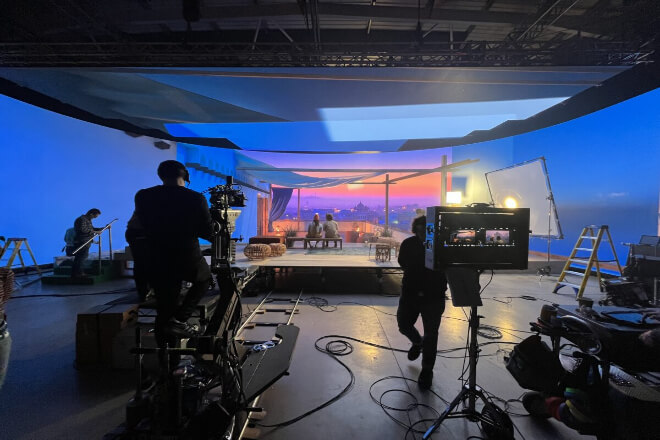
Filming needs in film and television bases cannot be met with a “one-size-fits-all” approach.
While shooting movies, commercials, and live streams may all involve creating content, the requirements for pantallas LED are completely different.
If the configuration isn’t chosen correctly, the screen might work, but the final result might be unsatisfactory.
For film production, image quality and color reproduction are paramount.
Film shots demand greater detail, and virtual backgrounds need to blend seamlessly with real actors and props.
Therefore, LED displays need to offer more delicate image quality, more accurate colors, and stable display performance to support complex scene shooting.
Commercial production prioritizes “speed of change.”
Shooting a car commercial today and a brand promotional video tomorrow—the faster the scene transitions, the higher the production efficiency.
Therefore, advertising production focuses on the flexibility of the LED system, its ability to quickly change digital backgrounds to meet diverse creative needs.
Live stream production focuses on real-time performance.
Whether it’s a live stream studio, an event broadcast, or a virtual anchor scene, the LED display needs to maintain stable operation and support real-time content updates to avoid affecting the live stream’s quality.
For small studios, space utilization and installation flexibility are even more important.
Limited space needs to accommodate more filming tasks; therefore, LED solutions need to be easily adjustable and managed, allowing a single space to adapt to a wider range of content production.
For film and television bases, LED displays are not simply about “buying a large screen.”
Different shooting scenes, like different types of actors, require suitable “equipment” to achieve the best results.
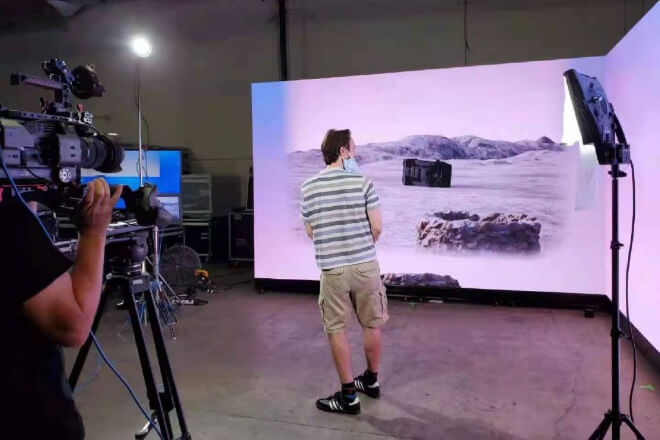
What is one of the most awkward situations on a film and television shooting set?
The actors are in character, the cameras are ready, the atmosphere is perfect, and then suddenly the LED screen malfunctions…
This kind of “minor incident” not only affects the shooting rhythm but can also disrupt the entire crew’s schedule.
For film and television bases, pantallas LED are not just occasional display devices but crucial partners in virtual filming.
Film, television series, and commercial shoots often require continuous operation for hours, or even 24/7, making stability extremely critical.
First, LED displays need to withstand long-term operation.
Virtual scenes require a continuous output of high-quality images while maintaining coordination with cameras and rendering systems.
Unstable screen brillo or abnormal image quality can negatively impact the shooting results.
Secondly, heat dissipation and maintenance are also crucial aspects of long-term operation.
Filming studios are used frequently, and equipment operates for long periods. Inadequate heat dissipation design can easily increase the risk of malfunctions.
Easy-to-maintain LED systems can help film and television bases reduce downtime and make shooting schedules smoother.
More importantly, stable equipment can reduce long-term operating costs.
Less maintenance waiting time and more normal shooting time translate into tangible benefits for film and television bases that need to continuously take on projects.
A good virtual shooting LED screen not only needs to perform well on camera but also needs to be reliable behind the scenes.
After all, film crews can wait for inspiration, but they usually don’t want to wait for equipment repairs.
For film and television bases, the greatest value of a soundstage is not just “what can be filmed,” but more importantly, “how much more can be filmed.”
If a soundstage can only shoot one type of content, its usage time and commercial opportunities will be limited.
The addition of LED virtual shooting technology opens up more possibilities for soundstages.
In the past, a scene might take several days to build and then be completely dismantled after filming.
Now, by switching digital scenes through LED displays, the same space can transform into city streets, futuristic spaces, natural environments, or even entirely fictional worlds.
This allows film and television bases to accommodate a wider range of projects without frequent site modifications.
This also enhances the market competitiveness of sound stages.
Faced with diverse needs such as film, television series, car commercials, brand promotional videos, and live production, bases with LED virtual shooting capabilities are more likely to attract production teams to collaborate.
For commercial clients, their concerns extend beyond simply “having a location”; they also care about saving time and reducing production complexity.
A mature LED virtual shooting solution can help film and television bases upgrade from simply renting out space to providing digital production services.
Ultimately, the value of pantallas LED goes beyond simply making sound stages “look more advanced”; it’s about opening up more revenue opportunities within a limited space.
Previously, a studio could only shoot one story; now, it can open the door to many more.


 English
  Español
  简体中文
简体中文  Français
  日本語
日本語  한국어
한국어  العربية