
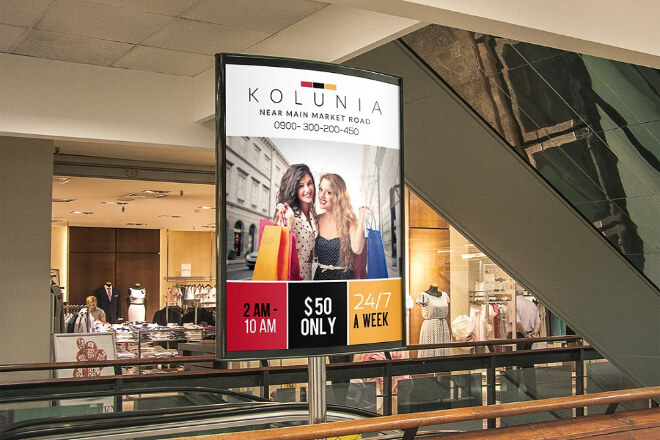
Have you ever wondered why some LED 디스플레이 look clear and sharp, while others appear blurry and coarse? What factors are at play? This article will reveal the secrets behind LED display clarity.
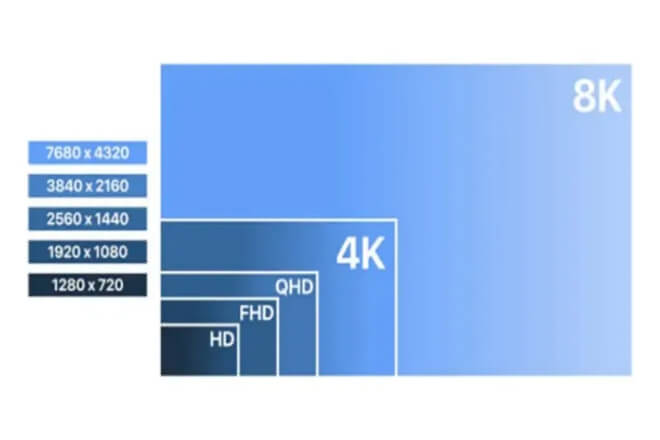
그만큼 해결 of an LED display has a direct and significant impact on its clarity. Resolution refers to the number of pixels the display can show in the horizontal and vertical directions.
High resolution means that more pixels can be used to render images or text, resulting in richer details and a clearer picture.
For example, when displaying a high-definition landscape photo, a high-resolution display can clearly show the texture of distant mountains, the layers of clouds in the sky, and the subtle veins of nearby flowers and plants.
In contrast, a low-resolution display may lose these details, blurring the mountain textures, reducing the layering of the clouds, and failing to show the veins of the flowers and plants.
For another example, when displaying text, a high-resolution display can make the edges of the text sharper and the strokes finer, maintaining readability even at very small font sizes.
A low-resolution display, however, may cause jagged edges and blurry strokes, affecting the reading experience.
In terms of video playback, a high-resolution display can better present the details of dynamic images.
For example, when playing a video of a fast-moving sporting event, a high-resolution display can clearly show the details of the athletes’ movements, including the stretching and contracting of leg muscles as players run, and the trajectory of the football in the air.
A low-resolution display may result in blurry images, especially in fast-moving scenes, where the athletes’ movements may become unclear, and the trajectory of the football may be difficult to discern.
These examples illustrate the direct impact of resolution on LED display clarity: the higher the resolution, the richer the details of the displayed content, and the clearer the image.
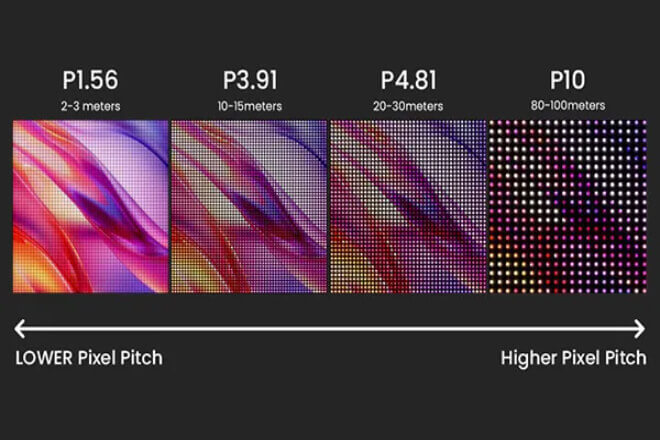
그만큼 픽셀 피치 (dot pitch) of an LED display is like the size of the “grid” on the screen. The smaller the “grid,” the finer the image; the larger the “grid,” the “coarser” the image appears.
This pixel pitch has a particularly significant impact on visual effects, especially at different viewing distances.
For example, in an office meeting, everyone sits very close to the screen. In this case, if you use a display with a small pixel pitch, such as P1.2 or P1.5, the text and charts on the screen will be exceptionally clear, with details easily visible.
The edges of the text are as smooth as if drawn with a pencil on paper, and the data on the charts is clearly visible. However, if you switch to a screen with a larger pixel pitch,
such as P3 or P4, it will appear somewhat blurry when viewed from a close distance.
The edges of the text may be jagged, like a mosaic pattern, and the details are significantly reduced.
Another example is outdoors, such as large advertising screens on the roadside or displays in 스포츠 stadiums, where the audience is far from the screen. In this case, using a screen with a larger pixel pitch, such as P4, P5, or P6, is perfectly fine.
Because the audience is far away, they won’t notice the pixels, and the overall image still looks complete and impressive.
From a distance, the graininess of the image is not obvious, and the large text and patterns on the advertisement can clearly convey the information.
In practical applications, different scenarios have different requirements for pixel pitch. If it’s indoors, such as a high-end conference room or control room.
Where the audience needs to view details on the screen from a close distance, then a display with a small pixel pitch is suitable.
For example, a P1.0 or P1.2 screen provides an image as delicate as a high-definition photograph, and even when viewed up close, there is no noticeable graininess. Although this type of screen is more expensive, the effect is indeed better.
Outdoors, such as large advertising screens or sports stadiums, the audience is far from the screen.
And the overall effect of the image is more important than the details. In this case, a screen with a larger pixel pitch, such as P4 or P6, is sufficient.
This type of screen is relatively less expensive, and from a distance, the image is still very clear, and the advertising effect is also very good.
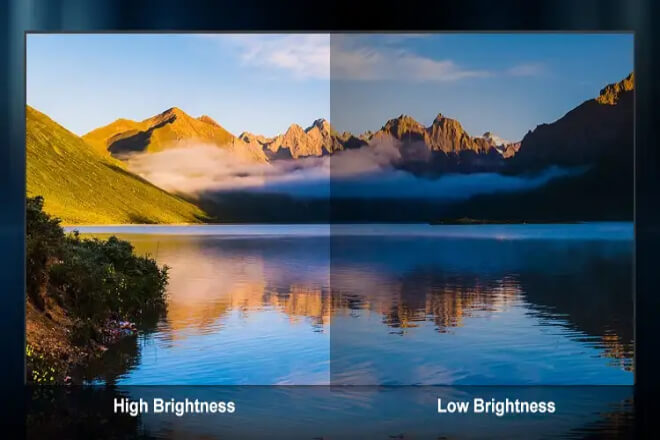
The brightness and contrast of an LED display are like the “brightness switch” and “color level adjuster” of the image.
명도 determines how bright the screen is, while contrast determines how rich the colors and details of the image are. These two factors have a significant impact on visual clarity in different environments.
Let’s talk about brightness first. Indoors, such as in meeting rooms or classrooms, the lighting is relatively soft, and the screen doesn’t need to be too bright to be clearly visible. Generally, a brightness of 300-800 nits is sufficient.
Imagine if the screen were as bright as a small sun; your eyes would definitely be overwhelmed and would “give up” after a short time.
Therefore, moderate screen brightness indoors allows for clear viewing without straining the eyes.
However, the situation is different outdoors. When exposed to direct sunlight, if the screen isn’t bright enough, the image will be practically invisible.
그러므로, 옥외 LED 스크린 usually need to be adjusted to 3000 nits or even higher.
For example, on outdoor advertising screens, high brightness allows the advertising content to be clearly visible even in bright sunlight, attracting the attention of passersby.
Now let’s talk about contrast. High contrast results in richer colors and details in the image.
Like looking at a photograph, a high-contrast photo has deeper blacks, brighter whites, and richer shades of gray in between, giving it a more three-dimensional look.
Indoors, with soft lighting, the contrast can be set higher, allowing the details and nuances of the image to be better displayed.
For example, when playing high-definition videos or displaying detailed images, high contrast makes the image look more vivid.
Outdoors, although contrast is also important, the effect of contrast can sometimes be “overwhelmed” by the strong sunlight. In this case, brightness becomes even more important.
For example, on large screens in sports stadiums, high brightness allows spectators to clearly see the game even in sunlight.
There are also some special situations, such as at the entrance of a shopping mall or in shaded areas, where the light changes rapidly.
In these places, it’s best if the screen’s brightness and contrast can be automatically adjusted according to the lighting conditions.
For example, when there is plenty of sunlight during the day, the screen brightness should be high.
In the evening or on cloudy days, the brightness can be appropriately reduced, and the contrast can be fine-tuned as needed, so that the image looks comfortable.
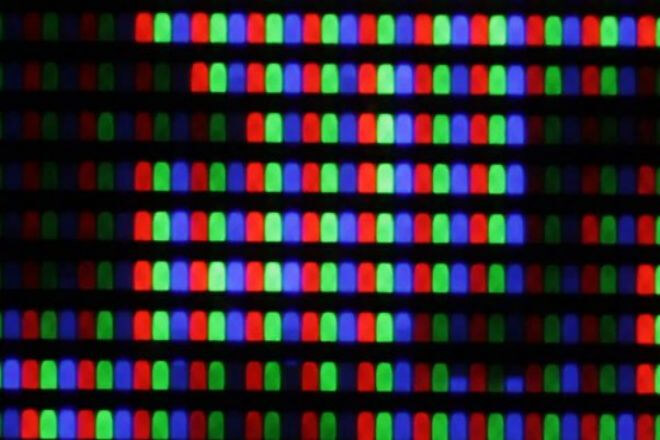
The color reproduction capability of an LED display refers to the screen’s ability to “paint” colors realistically, which greatly affects the clarity of the image.
It’s like painting a picture; if you use the colors accurately, the resulting image looks incredibly realistic and clear; if you use the colors inaccurately, the image looks awkward, and the details are unclear.
For example, a screen with a wide color gamut is like having a huge palette, capable of producing a wide variety of colors.
For instance, when you look at a photo of the sea, a screen with a wide color gamut can reproduce the deep blues, light blues, and the shimmering effect of the water, making it look incredibly comfortable and the details exceptionally clear.
However, if the color gamut is narrow, the screen can only display a few simple colors. The sea might become a monotonous blue, all the details are lost, and the image looks blurry.
Another example is color accuracy. If the screen can reproduce colors very accurately, the image looks incredibly realistic.
For example, when you watch a movie, if the skin tone of the characters is reproduced accurately, they look like real people, and their expressions and details are clearly visible.
But if the color reproduction is inaccurate, the characters’ skin tone might be yellowish or greenish, making them look very fake, and even their expressions are unclear. This kind of image is definitely uncomfortable to look at.
To give a simple example, you buy something online and see a picture of clothes with very vibrant colors, but when you receive them, the colors are completely different.
This is because the screen’s color reproduction ability is poor, and it “painted” the colors incorrectly.
If the screen could reproduce the colors very accurately, the clothes you see would be exactly the same color as the actual clothes, and the shopping experience would be much better.
Therefore, a screen with good color reproduction capabilities makes the image look more realistic, more comfortable, and the details clearer.
If the color reproduction is poor, the image looks “fake,” and details are easily lost. This is actually part of the definition of clarity, because a comfortable and realistic image is what true “clarity” means.
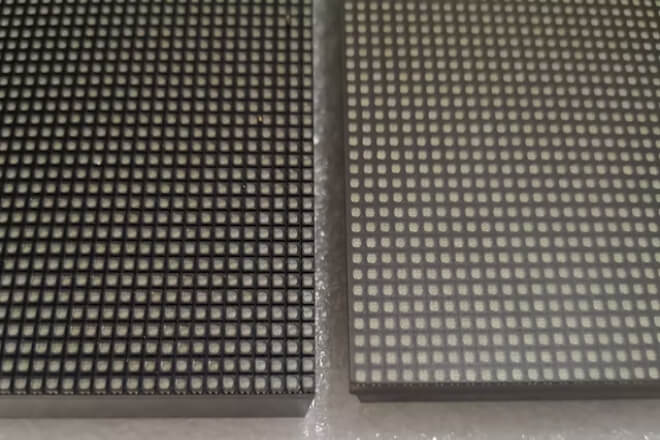
The packaging method mainly affects the clarity of the LED display, which is reflected in two aspects: first, the flatness and pixel density of the screen, and second, the protection performance and stability of the screen.
1). SMD Packaging
SMD packaging involves soldering small LED beads onto a circuit board. The advantages of this packaging method are low cost and easy maintenance.
However, if the LED beads are not soldered evenly, there will be uneven areas on the screen surface, affecting the uniformity of the image.
Moreover, SMD-packaged LED chips are independent and easily affected by external factors such as dust, moisture, or impact, which may lead to damage or detachment of the LED chips.
This can result in black spots or bright spots on the screen, affecting image clarity.
2). 옥수수 속 Packaging
COB packaging involves directly encapsulating LED chips onto a circuit board, and then covering them with a layer of material.
The advantages of this packaging method are that the screen surface is very flat, the pixel density is higher, and the image looks more delicate.
Furthermore, COB-packaged screens have strong protection against dust, moisture, and impact, and the LED chips are less likely to be damaged. This means better screen stability and longer-lasting image clarity.
3). Impact on Clarity
3.1). Image Uniformity:
Due to its flat surface, COB-packaged screens have better image uniformity and more natural color transitions.
In SMD-packaged screens, if the LED chips are uneven, the image may show color differences or uneven brightness.
3.2). Detail Representation:
COB-packaged screens have higher pixel density, allowing for the display of finer image details, suitable for close-range viewing.
SMD-packaged screens may appear grainy when viewed at close range, affecting detail representation.
3.3). Stability:
COB-packaged screens have better protection, and the LED chips are less likely to be damaged, resulting in higher image stability.
If SMD-packaged screens encounter harsh environments, the LED chips may be damaged, leading to black spots or bright spots on the screen and affecting clarity.
In short, COB-packaged screens perform better in terms of clarity, with more uniform and delicate images, and higher stability.
While SMD-packaged screens are less expensive, they may be slightly inferior in terms of clarity and stability.
 English
  Español
  简体中文
简体中文  Français
  日本語
日本語  한국어
한국어  العربية