

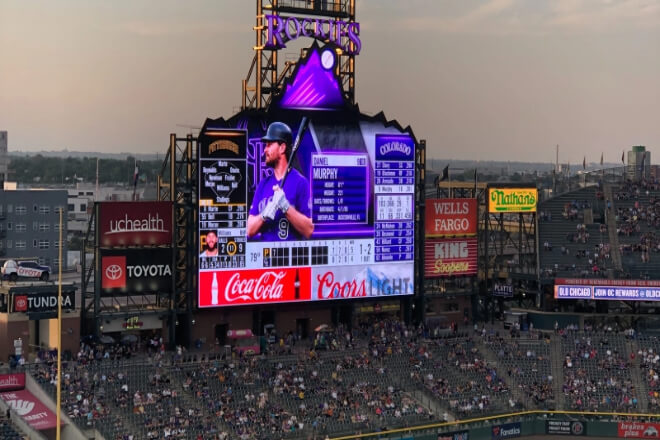
At world-class sporting events, the biggest concern isn’t that the screens aren’t big enough, but rather that the images are disjointed.
One of the core values of an LED display system is to “unify” the visual experience across the entire venue.
Firstly, the coordinated display of the main screen, secondary screens, and perimeter screens allows information to be layered without being fragmented.
The main screen handles core content (match footage, replays, key data), secondary screens supplement information (scores, times, player status), and perimeter screens provide atmosphere and brand display.
This way, no matter where the audience looks, they are all within the same information system.
To give a very intuitive example: the moment a goal is scored, the main screen plays the replay, the perimeter screens simultaneously display team-themed animations, and the secondary screens update the score—all information is unified within a single second.
Secondly, maintaining a consistent overall visual style significantly enhances immersion. If each screen has a different style, it will feel like “multiple programs pieced together”;
But when colors, animations, and fonts are unified, the entire stadium feels more like a unified visual space, rather than a collection of multiple screens.
More interestingly, this sense of unity directly influences the audience’s “professional judgment”—the more consistent, the more likely they are to perceive it as a high-profile event.
For another example: in a live setting where the lighting, main screen, and perimeter screens simultaneously switch to the same visual theme, the audience will naturally feel that “this is a stage designed holistically.”
Finally, it also significantly enhances the professionalism of the event. A unified visual system not only makes information easier for the audience to understand.
But also makes the event appear more “international” and standardized, which is one of the reasons why world-class events are increasingly emphasizing LED system design.
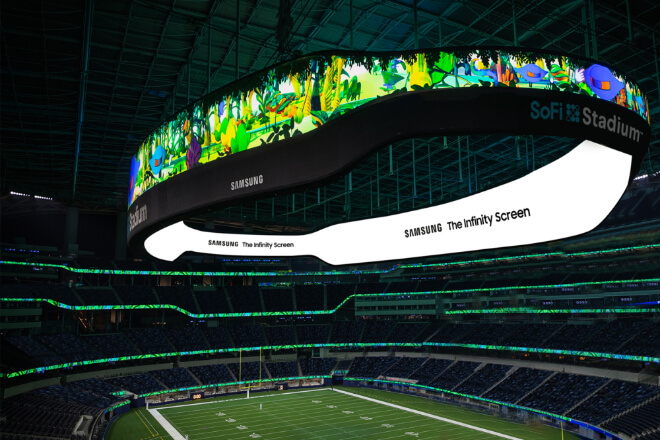
In the live broadcasting systems of world-class sporting events, LED displays are no longer just “screens in the stadium,” but rather the unified visual foundation for the entire broadcast.
First, ensuring the consistency and harmony of images from different camera positions is the core value of a holistic design.
Whether it’s the main camera, aerial cameras, or slow-motion replay cameras, they all ultimately enter the same visual system.
If the LED display content is inconsistent, it will create a disconnect between “one set of images on-site and another set of styles in the live broadcast.”
For a very intuitive example: the on-site screen has a high-brightness, cool-toned style, but the live broadcast is warm-toned.
Without consistent processing, viewers will clearly feel that “it’s not the same competition venue.”
Second, avoiding inconsistencies in color and 명도 is crucial for professional events. Large venues often have multiple LED screens (main screen, surround screens, advertising screens, etc.).
If color calibration is inconsistent, problems such as “reddish or bluish tints, and inconsistent brightness” will appear on the screen, which will be magnified on camera.
Even more interestingly, this difference is particularly noticeable in live broadcasts—because cameras are “eyes that don’t adapt to their environment,” recording all inconsistencies exactly as they are.
For example, a typical scenario: for the same goal replay, the main screen displays a clear and consistent image, but the side screens are brighter, causing the image to appear “jumpy” when the camera pans across it.
Simultaneously, it significantly improves the quality of global live broadcasts. Viewers of world-class events are not only at the venue but also watching on various devices around the world.
With a unified LED display system, broadcasting teams can more stably acquire, switch, and output images, ensuring that the content seen in different countries is as consistent and professional as possible.
Finally, it directly meets the needs of professional event broadcasting. Modern broadcasting is now a “systems engineering” project.
Encompassing not only camera work but also data, replays, and virtual content overlay, with the LED display system serving as the visual carrier layer for this content.
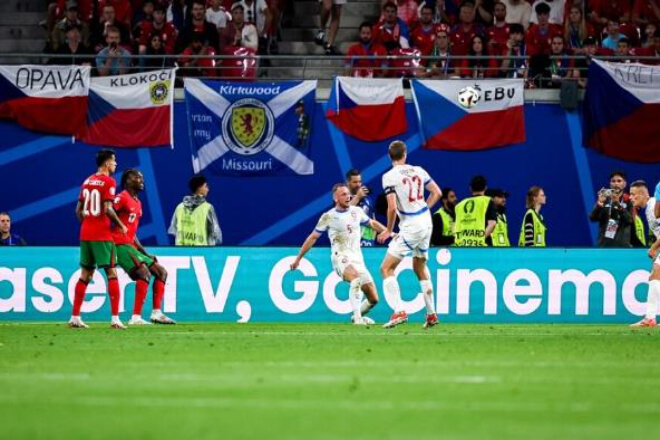
At world-class events, LED screens are no longer “each playing its own content,” but rather a well-defined information collaboration system.
First, the main screen is responsible for the match footage and is the core of the entire visual experience.
The audience’s attention is primarily focused on this area, used to present live matches, slow-motion replays, and key moments, making “what happened” most intuitive.
For a very intuitive example: the moment a shot is taken, everyone’s first reaction is to look at the main screen—because that’s where “the story is unfolding.”
둘째로, perimeter LED screens mainly display brand advertisements and event partnership content.
Their characteristic is that they don’t overshadow the main screen, but remain continuously present, reinforcing commercial information through high-frequency exposure without interfering with the match viewing.
More interestingly, this design is actually “continuous exposure with minimal interference,” meaning that while the audience watches the game, the brand information is repeatedly received in the background.
Another example is a live scenario: when a player is attacking, you’re looking at the main screen.
But out of the corner of your eye, you see the perimeter screens dynamically switching brand visuals—the information is “seen incidentally.”
Meanwhile, the circular screens are typically used to display scores, times, and key data.
Their advantage is that the view covers the entire field, allowing viewers to quickly obtain core information regardless of their seating position, without needing to deliberately search for it.
For example, with five minutes remaining in the match, the ring screen simultaneously displays a countdown and score changes.
Allowing the entire audience to simultaneously perceive that “the match is entering a crucial stage.”
Finally, the core value of this multi-screen collaboration is achieving efficient information transmission.
Different screens play different roles, but together they constitute a unified information system:
Main LED screen: What’s happening
Auxiliary LED screen: Current status
Perimeter LED screen: Commercial and supplementary information
In short, multi-screen collaboration is not “multi-screen playback,” but rather “telling a story simultaneously by layering information.”
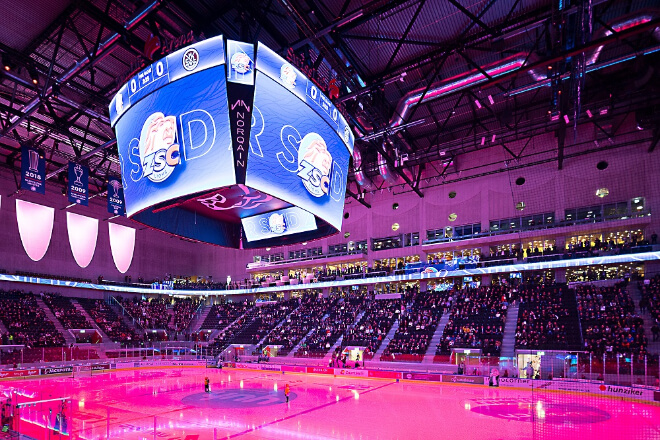
In world-class sporting events, opening and closing ceremonies are often more than just “performances.”
They are the first impression and final memorable moment of the entire event, and LED display systems are the key tool for amplifying these “memorable moments.”
Firstly, the coordinated visual presentation of multiple screens can transform the entire 단계 into a “transforming space.”
The main screen handles the narrative visuals, the side screens extend the sense of space, and the ground screens supplement environmental effects, so the entire stage is no longer flat, but a three-dimensional scene enveloped in visuals.
To give a very intuitive example: Waves appear on the screen, with synchronized flowing ripples on the ground screen and the side screens extending into deep-sea light and shadow, creating the illusion that the stage is transforming into an ocean.
Secondly, the synchronized presentation of lighting and special effects further amplifies the visual impact.
LEDs handle the visuals, lighting conveys emotion, and special effects deliver the instantaneous climax.
When all three are in sync, the entire event presents a very strong sense of “ritual progression.”
More interestingly, this synchronization isn’t a simple addition, but rather a “rhythmic design.” Knowing when to tighten and when to release guides the audience’s emotions step by step towards a climax.
For example, a typical scenario: the music gradually fades, the visuals slowly darken, the lights gradually focus on the center of the stage.
And then explode in a split second—the emotions of the entire audience are instantly ignited.
Simultaneously, it significantly enhances the sense of ritual. The opening ceremony is no longer just “the start of the program,” but a designed “entrance moment”;
The closing ceremony is not just an end, but a process of emotional condensation and recollection.
Finally, this visual system also directly enhances the event’s brand image. A unified and visually stunning opening and closing ceremony will leave a stronger impression of the event as meeting “international standards” in the minds of the audience.
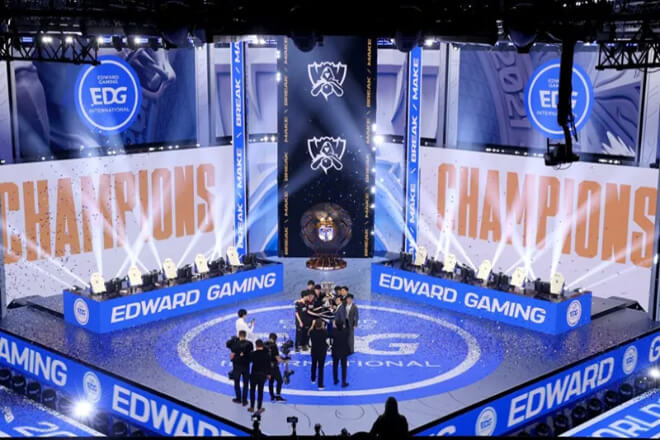
At world-class sporting events, the ones under the most pressure are often not the audience, but the back-end operations team, because all visuals, information, advertisements, and broadcast content must be switched precisely in a very short time.
The value of an integrated LED display system lies in transforming this complex operation into a “controllable, unified system.”
First, centralized control of multiple display screens transforms previously fragmented operations into unified scheduling.
The main screen, surrounding screens, perimeter screens, 단계 screens, etc., no longer operate independently, but are distributed and managed synchronously through a single control system.
For a very intuitive example: previously, multiple devices might have needed to switch images separately;
Now, a single command can put all screens into “goal replay mode” simultaneously.
Second, the ability to quickly switch between event and activity visuals is crucial for managing the pace of large-scale sporting events.
During different stages of a match—including pauses, halftime performances, and advertising displays—screen transitions need to be completed within seconds.
An integrated system ensures a stable, delay-free, and error-free transition process.
More interestingly, this transition actually “controls the rhythm of the event.” A change in the screen redirects the audience’s attention, and their emotions shift accordingly.
For example, in one scenario, as soon as the final whistle blows, the system immediately switches to replay + sponsor visuals + event information, allowing the audience’s emotions to transition from a tense moment to a summary and extension.
Simultaneously, it significantly reduces the difficulty of on-site management. Previously, multiple positions needed to coordinate different screens; now, a unified system reduces communication costs and the probability of errors, making execution more stable.
Finally, it directly improves the efficiency of large-scale event execution. Whether it’s content release, emergency adjustments, or impromptu insertions.
It allows for rapid response, making event operations “operate like a system,” rather than relying on manual, piecemeal processing.


 English
  Español
  简体中文
简体中文  Français
  日本語
日本語  한국어
한국어  العربية