
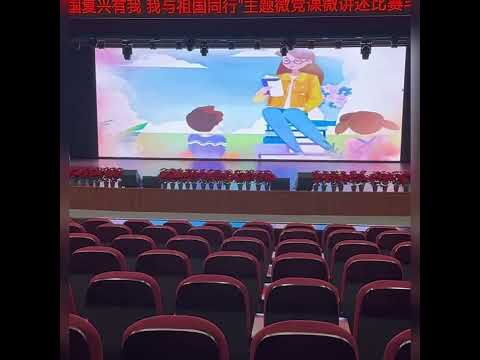
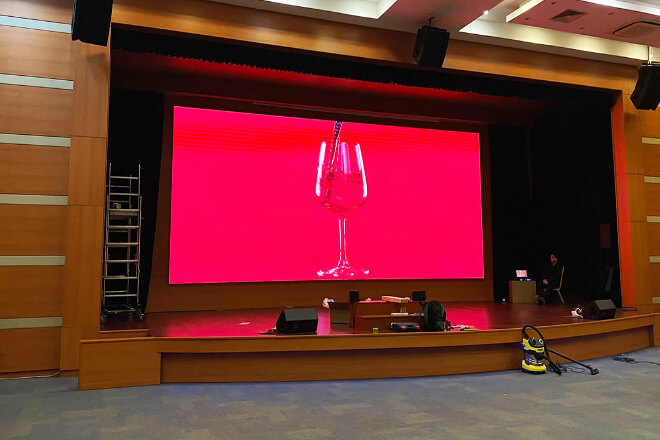
The biggest characteristics of auditoriums are their large space, numerous seats, and wide viewing distances.
The front rows may be only a few meters from the LED screen, while the back rows are quite far away.
만약 픽셀 피치 is not chosen appropriately, an interesting and awkward situation can easily arise: the front rows see pixelation, while the back rows try to guess the image.
If the pixel pitch is too large, the front rows will experience noticeable pixelation, and the details of the speech subtitles and figures will not be fine enough;
However, blindly choosing an ultra-small pitch in pursuit of “ultra-high definition” can significantly increase the budget.
Therefore, the pixel pitch should be selected based on the screen size, the closest viewing distance, the furthest viewing distance, and the main content being displayed.
For example, during a graduation ceremony in a school auditorium, students in the front rows may need to clearly see the subtitles of the principal’s speech and the images of the guests, while those in the back rows are more focused on the overall stage effect.
At variety shows, dance performances, videos, and other content need to be shown. In these situations, the pixel pitch needs to consider the viewing experience in different areas.
Simply put, a smaller pixel pitch doesn’t necessarily mean a more “curved” or unbalanced display; it needs to be just right for the viewing distance.
Ensuring that those in the front can see clearly and those in the back can see clearly is the true way to cater to every seat in the auditorium.
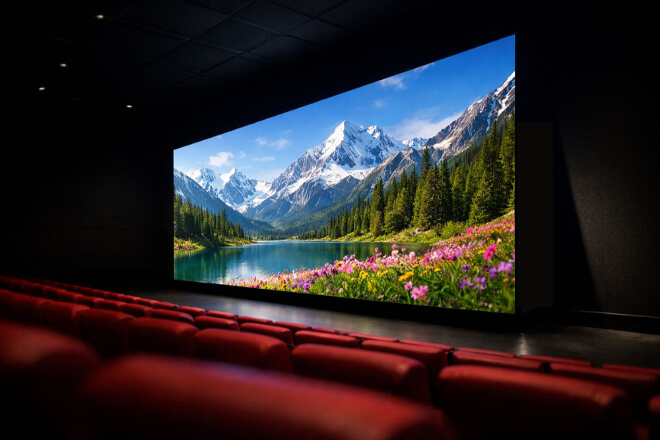
Many auditorium LED 스크린 fail not because the screen itself is bad, but because they haven’t been properly integrated with the ambient lighting.
During the day, natural light streams in through windows, while at night there are stage lights, overhead lights, and various performance lights.
The same screen may face several different lighting challenges throughout the day.
만약 명도 is insufficient, the image will appear washed out under strong daylight, and subtitles and details will be difficult to see;
However, if the brightness is too high, it may be glaring at night, even overshadowing the stage lights.
Therefore, when selecting an auditorium LED screen, it’s crucial to focus on brightness, contrast, and brightness adjustment capabilities.
The screen brightness should be able to adjust according to environmental changes, while the contrast should ensure sufficient tonal gradation to make people, 단계 backgrounds, and video content appear clearer.
For example, during daytime campus lectures or graduation ceremonies, screen brightness can be increased to ensure that audiences in the back rows can clearly see the subtitles;
While for evening performances, brightness can be appropriately reduced to allow the LED screen to coordinate with stage lighting, rather than both vying for the center stage.
Simply put, a brighter auditorium LED screen isn’t necessarily better; it needs to be adaptable.
It should withstand sunlight during the day and not be glaring at night, ensuring clear visibility during meetings and comfortable viewing during performances—that’s true proper use of brightness.
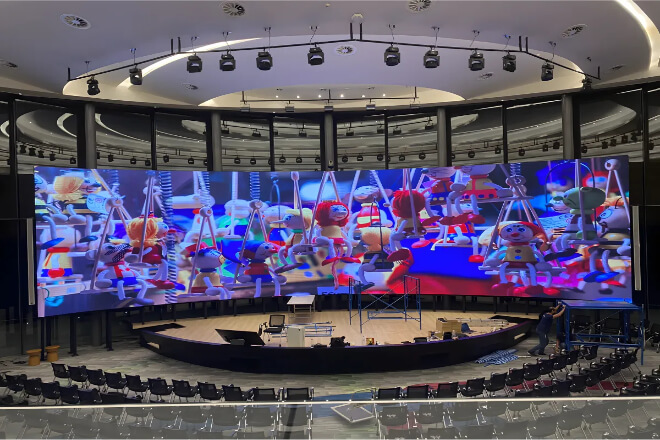
Large-scale university events often involve photography, videography, and online live streaming.
In these situations, 재생률 is an easily overlooked but potentially problematic parameter.
LED screens may appear fine to the naked eye, but once a phone or camera is pointed at them, they may suddenly display ripples, black lines, flickering.
Or even image shakiness—looking normal on-site, but appearing as if the screen is “acting up” in the video.
Therefore, auditorium LED screens need to focus on high refresh rate performance to ensure smoother and more stable images during rapid transitions, 단계 movement.
And camera shots, while reducing flickering issues caused by asynchronous refresh rates between the camera equipment and the LED screen.
For example, during graduation parties, campus singing competitions, or large-scale lectures, the audience sees a smooth image, but the live stream camera will also capture the screen.
If the refresh rate is poor, the live stream may show noticeable stripes, directly affecting the professionalism of the entire event.
Simply put, a high refresh rate ensures that the LED screen is not only “comfortable to watch on-site,” but also withstands the scrutiny of cameras.
After all, after an event, highlights need to be shared on social media, edited into videos, and used for live streams; the LED screen cannot perform well on-site but “fail” on camera.
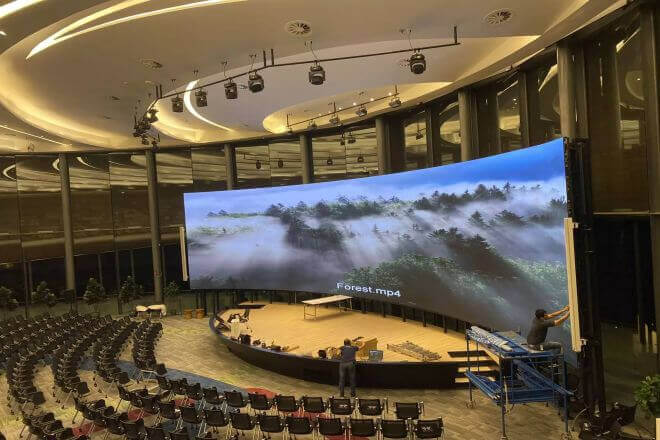
University auditoriums are not “easy retirement zones” for LED screens. Lectures, graduation ceremonies, cultural performances, campus competitions…
One event after another, the screen might finish one event and be back in operation the next day.
Therefore, high-frequency use and long-term operation place higher demands on the durability of LED screens.
When purchasing, in addition to focusing on image quality, it’s crucial to consider dustproof, moisture-proof.
And anti-static capabilities, as well as the 전원, driver, and heat dissipation configurations.
Stable basic hardware is essential to reduce problems such as blackouts, lag, crashes, and flickering during long-term operation.
For example, during a school graduation party, the LED 스크린 might run from afternoon rehearsals until the event concludes in the evening.
If the equipment is not stable enough, the screen might suddenly go black during a highlight of the performance, leaving the audience searching for repair personnel while the performers are still singing.
Especially in high-frequency usage scenarios like auditoriums, screen stability also means fewer repairs and downtime, reducing long-term maintenance costs.
Not having to worry about the equipment suddenly “breaking down” every now and then makes operation much easier.
In short, LED screens in university auditoriums not only need to “light up,” but also need to “withstand the test.”
No matter how many events are held or how long they run, LED screens should remain firmly on 단계—leaving the spotlight to students and performers, while quietly serving as background.
Racing events are never short of speed, but if LED screens are only used to display rankings and lap times, it’s somewhat of a waste of their potential.
For clubs, these screens can also become a continuously operating commercial display space, allowing the event’s popularity and commercial value to run in tandem.
Firstly, sponsor advertisements and brand content can be played during breaks in the race, pre-race promotions, and post-race activities.
For example, during a race pause, LED screens can display promotional content for car brands, tires, lubricants, or racing equipment brands;
When the race resumes, they can quickly switch back to real-time rankings and race data, without the advertisements completely disrupting the viewing experience.
Secondly, LED screens can also be used to promote the event brand and member activities. For example, an announcement of the next race can be displayed in advance;
Clubs can also use the screens to promote member days, test drive events, or racing experience activities, allowing the audience to easily learn about the next event.
In major sporting events, sponsor exposure can be enhanced by combining driver rankings, highlight reels, and brand content.
For example, if a sponsor’s brand content appears next to the fastest lap data, the brand isn’t just “showing its logo,” but is associated with a key moment of the race.
Meanwhile, the LED screen itself is part of the club’s image.
A unified visual design, team elements, and race theme can make the entire track look more professional and more easily create a unique visual identity for the club.
Therefore, a racetrack LED screen can serve as a window to race information, an advertising space, a brand display wall, and an entry point for member activities.
Used well, it not only helps viewers understand the race but also accelerates the club’s commercial value along with the race.


 English
  Español
  简体中文
简体中文  Français
  日本語
日本語  한국어
한국어  العربية