

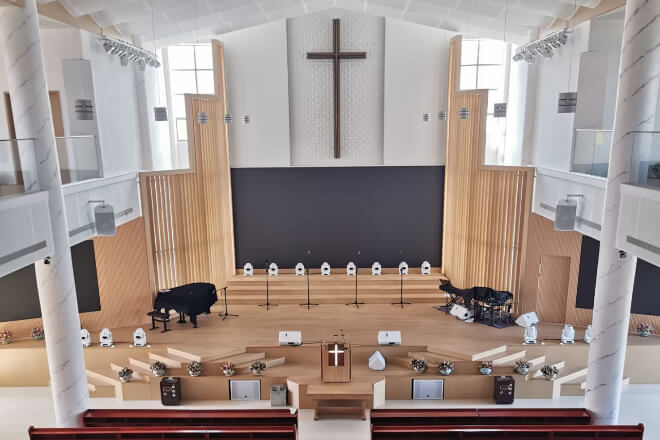
In an interior space like a church, the suitability of a small pixel pitch LED display is not primarily about “whether it can be used,” but rather “whether it will disrupt the atmosphere.”
After all, the emphasis here is on quiet, solemnity, and the natural flow of emotions.
Firstly, the biggest advantage of fine-pitch LEDs is that they are “clear even up close.” In such an indoor environment, the audience is usually not far from the screen.
If the image is not delicate enough, it can create an awkward feeling of “enlarging pixel blocks.”
But fine-pitch screens are different. Text, images, and information can be presented with great detail, as if the content is gently placed in front of you, rather than being shoved in your face.
More importantly, its visual impact is usually quite restrained. While clear, it avoids an overly exaggerated visual impact, preventing it from suddenly stealing the emotional control of the space.
With proper 명도 and content design, it can even blend naturally into the environment, like a “quiet information screen”—appearing when appropriate and remaining quietly when not intrusive.
From a spatial experience perspective, the impact of small pixel pitch LED displays on the atmosphere largely depends on how they are used.
If properly controlled, it won’t disrupt solemnity; instead, it will make information delivery softer and more orderly.
Simply put, in a church, a 작은 픽셀 피치 LED 디스플레이 display is more like a “well-mannered narrator”—clearly explaining the information.
But with just the right volume, neither overshadowing the main focus nor breaking the quiet atmosphere.
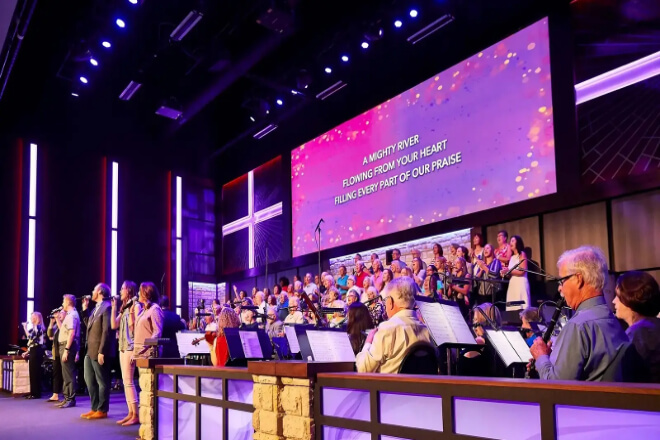
Whether a 작은 픽셀 피치 LED 디스플레이 is suitable for displaying content in 교회 services depends not on “whether content can be displayed,” but on “whether the content is appropriately integrated into the process.”
After all, the core here is a sense of order and ritual, not a piling up of information.
From a practical application perspective, displaying hymns, scriptures, and prompts is a common and highly adaptable use.
Clear fonts and stable images help participants follow the worship rhythm more smoothly, eliminating the need to frequently flip through printed materials and allowing them to focus more on the overall experience.
In some scenarios, small pixel pitch LED displays can also be used for live streaming or supplementary content presentation.
Such as guiding the ritual process or displaying remote participation footage, making information delivery more intuitive.
However, this must be done with restraint and not overshadow the main content.
More importantly, its use must align with the worship process itself.
If content changes too frequently or the visuals are too “commercial,” it can easily disrupt the overall rhythm and affect immersion.
Therefore, it is more suitable as a “supplementary expression” rather than a “visual protagonist.”
Simply put, during worship, a small pixel pitch LED display acts more like a “quiet guide”—clearly presenting hymns, scriptures, and procedural information.
But always leaving the 단계 to the overall ritual itself, allowing the sense of order to flow naturally.
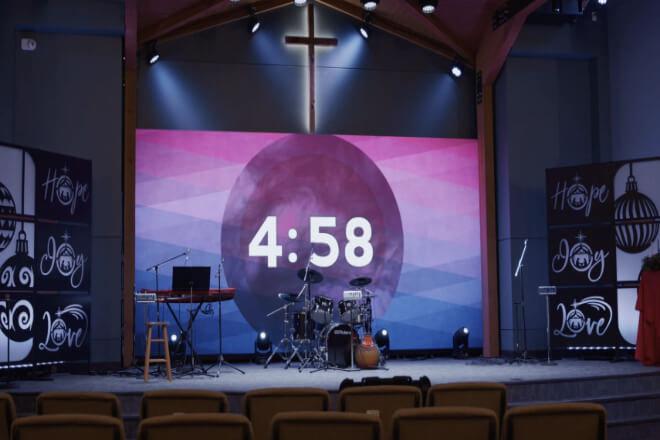
In indoor environments like churches, the stability and reliability of small pixel pitch LED displays hinge on a simple core standard: the ability to remain quietly online for extended periods.
They don’t need to be eye-catching or overly expressive; stability is the highest priority.
First, there’s the stability over long periods. Services or events often last for extended periods, sometimes even multiple sessions consecutively.
If the screen goes offline or becomes unstable, it significantly disrupts the overall flow.
Therefore, it acts like a patient background participant, always present but never disruptive.
Second, there’s the ability to adapt to changes in indoor lighting. While church lighting doesn’t fluctuate as drastically as outdoors,
The screen must remain stable and clear when switching between natural and artificial light. It shouldn’t be flickering or overly bright, maintaining a consistently clear but gentle display.
Another easily overlooked point is low noise and minimal interference. It can’t be too noticeable.
Any noise from the equipment or slight flickering of the image is like an inappropriate background disturbance, easily disrupting the tranquil atmosphere.
Simply put, in a 교회, a small pixel pitch LED display is like a “quiet assistant who knows how to behave”—its presence is almost forgotten most of the time.
But it always presents the necessary information steadily, without disrupting the atmosphere or causing any lapses in attention.
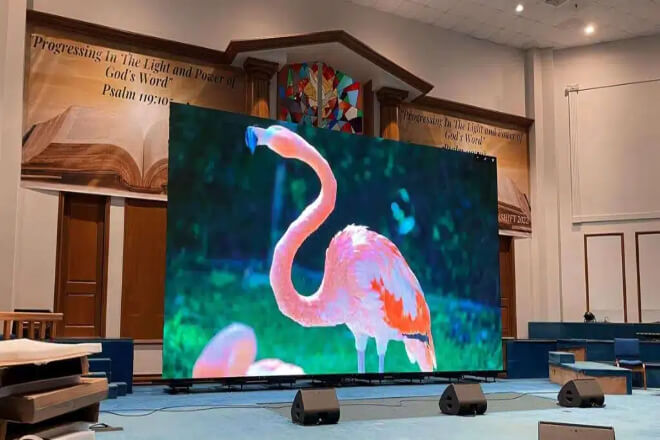
In a space like a church, the ease of installing a 작은 픽셀 피치 LED 디스플레이 isn’t primarily about technical difficulty, but rather whether it will look out of place.
After all, the space itself emphasizes a sense of unity and order.
From an installation perspective, there are generally three common methods: front wall, side wall, and background area.
The front wall is more like the “main expression area,” suitable for displaying the main content.
The side wall is like a “supporting information area,” discreetly supplementing information.
The background area leans towards a more integrated design, allowing the screen to “grow” into the space rather than being added later.
In terms of spatial adaptability, the advantage of small pixel pitch LED displays lies in their versatility; they can be flexibly adjusted according to the shape of the wall.
However, this requires careful planning in advance. Otherwise, even the most flexible equipment might become a “technological element crammed into the space,” looking somewhat out of place.
More importantly, it shouldn’t overshadow the building’s inherent character. Church spaces are inherently stylish.
If the screen is too eye-catching, it’s like a modern poster pasted into a classical painting—the function is there, but the overall ambiance is off.
Simply put, the installation of a small pixel pitch LED display in a church isn’t about “finding a place to put it.”
But rather “making it look like it was meant to be there”—its presence is just right, not overshadowing, but not absent either.
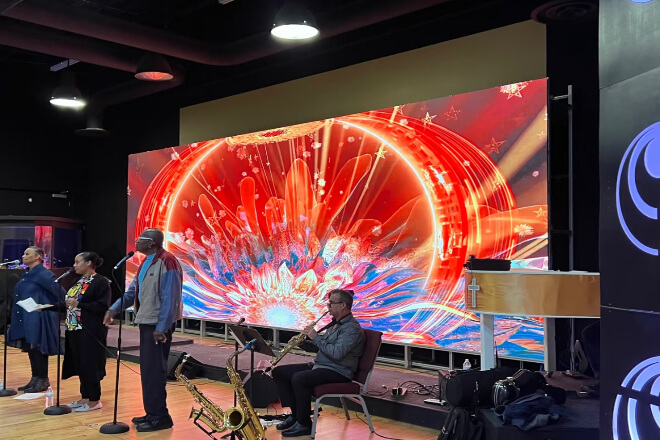
In a space like a 교회, whether a 작은 픽셀 피치 LED 디스플레이 will affect the overall atmosphere doesn’t depend on “whether there’s a screen,” but on “whether the screen is used correctly.”
After all, the most important thing here is the natural continuation of solemnity and tranquility.
If used improperly—for example, with excessive 명도, too frequent content switching, or an overly “commercial” visual style.
It can indeed disrupt the original atmosphere and rhythm, like suddenly adding a strong beat to a quiet piece of music, easily pulling the listener out of the mood.
Conversely, if the content is designed properly, it won’t ruin the atmosphere; instead, it can serve as a gentle, supporting expression.
For example, presenting poetry, scriptures, or process prompts in a softer visual style can help people focus more on the overall experience rather than being distracted by searching for information.
The key lies in achieving a sense of “immersion.” The screen doesn’t need to be the main focus of the space, but rather like part of the background—present.
But not stealing the show; clear, but not intrusive; conveying information, but not interrupting the flow of emotions.
Simply put, in a church, a small pixel pitch LED display is more like a “supporting actor who understands the atmosphere”—its task isn’t to attract all attention.
Rather, it allows the entire atmosphere to flow more smoothly, making its presence almost imperceptible, yet indispensable for the information it provides.


 English
  Español
  简体中文
简体中文  Français
  日本語
日本語  한국어
한국어  العربية