
Purchasing an LED 스크린 is just the beginning; the real headaches lie in the subsequent electricity, repair, and labor costs. Improper selection and haphazard maintenance can turn small problems into huge bills.
This article shares five practical methods, from intelligent energy saving and daily maintenance to remote operation and maintenance and partial repair.
To help you reduce 전력 소비, minimize malfunctions, and avoid unnecessary expenses for your LED screen.
Frequent problems with LED screens later on are sometimes not due to “poor screen quality,” but rather to incorrect initial selection.
It’s like making a pair of ordinary running shoes run a marathon; they might hold up at first, but over time, wear and tear and cracking will inevitably occur.
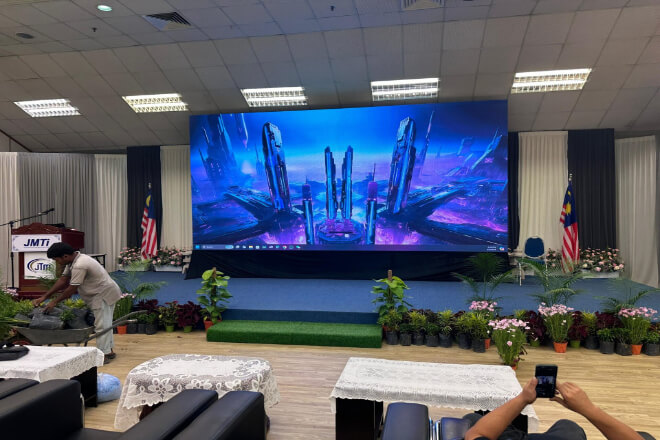
The same applies to LED 스크린. Indoor conference rooms, outdoor billboards, high-frequency commercial venues, and 정부 전시회 have completely different equipment requirements.
If you blindly choose low-priced products to save on procurement costs, or if the parameters don’t match the site environment.
Problems such as dust accumulation, water ingress, dead lights, and screen flickering may occur later. In the end, the money saved during procurement might all go to the repair technicians.
Therefore, when selecting a model, the first step isn’t asking “which one is the cheapest,” but rather “where will this screen be used?”
Outdoor projects should focus on waterproofing, dustproofing, wind resistance, and 명도;
High-frequency commercial scenarios should focus on heat dissipation, stability, and durability;
Indoor projects should prioritize image quality, comfortable brightness, and long-term performance.
예를 들어, 옥외 LED 스크린 in coastal areas, if the effects of rain, humidity, and salt spray aren’t considered, will quickly face a “survival challenge at the beach.”
In such cases, even the cheapest equipment is unlikely to truly save money.
Therefore, the core of reasonable selection is matching the product with the application scenario.
Spending more time matching parameters upfront will reduce the “surprises” of sudden screen blackouts and frequent repairs later.
After all, the real low cost of an LED screen isn’t buying the cheapest one, but buying the right one and minimizing problems.
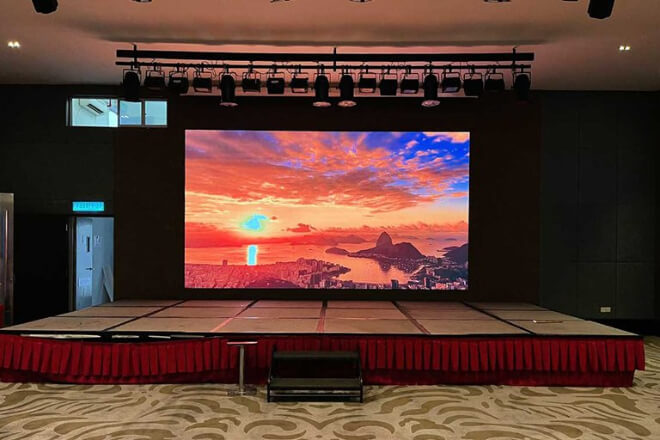
The LED screen is lit up every day, seemingly just quietly “emitting light,” but the electricity meter is anything but calm.
Especially for large LED screens that operate continuously, if they maintain full brightness from morning till night.
Even if no one is watching and the environment doesn’t require such brightness, the electricity bill will still rise hour by hour.
사실은, LED 스크린 don’t need to be “at full power” every day. They can intelligently adjust based on business hours, office hours, and changes in day and night lighting.
Increase 명도 during strong sunlight to ensure clear visibility; automatically decrease brightness at night when the environment darkens for a more comfortable viewing experience;
And automatically go into sleep mode when the store closes or the office is empty, preventing the screen from continuing to “work overtime alone.”
For example, if a nightclub hasn’t opened in the afternoon, but the LED screen is on from afternoon until night.
It’s like having the lights on at the workstations all afternoon before the employees even start work.
Setting a timer for on/off allows the screen to operate according to business hours, reducing unnecessary power consumption without affecting the visual effect during the evening’s official opening.
Furthermore, the screen can be zoned for different areas of use. Areas that need to display content operate normally.
While areas that don’t need to be used have their brightness reduced or turned off, ensuring that every kilowatt-hour of electricity is used where it’s truly valuable.
Therefore, the key to energy saving for LED screens is not to make them “work less,” but to make them work intelligently—bright when needed, dim when needed, and rest when no one is watching.
In the long run, this results in lower electricity bills, less equipment stress, and easier operation.
Many people have a habit when maintaining LED screens: ignore them until they break down. This sounds convenient, but LED screens don’t always cooperate.
A small wiring problem or heat dissipation issue, if left unnoticed for a long time, can slowly develop into a flickering or black screen, eventually escalating repair bills.
A more cost-effective approach is to establish simple routine maintenance habits.
Regularly perform dust removal and moisture control, check power cords, signal cables, and interfaces for proper functioning, and monitor the control system’s operation.
If you notice abnormal 명도 in certain modules, localized flickering, or a significant increase in equipment temperature, troubleshoot promptly instead of waiting for it to completely fail.
For example, if an LED 스크린 only flickers occasionally, it might simply be due to a loose connection or a wiring problem.
Timely intervention can resolve issues in minutes; neglecting it can lead to escalating problems, potentially requiring module replacement or even further power system inspection.
Routine maintenance takes little time but can proactively identify many small issues.
Spending a small amount of money and time on routine maintenance is far more convenient than incurring large sums for emergency repairs.
Therefore, the ideal state of LED screen maintenance is not “quick repairs when it breaks,” but rather preventing it from ever reaching the point of needing major repairs.
Ensuring stable screen operation also keeps maintenance budgets low.
If a project has only one LED screen, sending someone to check it out is relatively simple.
However, for multiple locations, remote outdoor areas, or clusters of LED 스크린 in an industrial park, sending someone to inspect each time quickly becomes a significant expense in terms of time and travel costs.
Even more troublesome is that sometimes staff travel dozens of kilometers only to find it’s just a minor signal problem.
Remote maintenance can reduce these wasted trips. The intelligent management system allows for real-time monitoring of equipment operation status, including anomalies in temperature, 명도, signal strength, and power supply.
In case of a problem, the system can issue an early warning, preventing staff from waiting for the screen to go completely black.
For common issues, remote debugging, parameter adjustments, and troubleshooting can be performed online.
For example, if a display anomaly suddenly occurs at a certain location, technicians can first check the signal and equipment status through the backend system.
Problems that can be resolved online can be addressed directly, eliminating the need for immediate on-site personnel.
The advantages of remote management are particularly evident when dozens or even hundreds of screens are distributed across different areas. Previously, this might have required a team traveling extensively;
Now, problems can be identified through the backend system before assigning personnel to handle faults requiring on-site intervention.
In short, remote maintenance allows staff to avoid unnecessary travel and focus on resolving real issues.
This reduces long-term labor and travel costs and also significantly speeds up the response time to LED screen malfunctions.

After a few years of use, LED screens may experience individual LED failures, 전원 aging, or 기준 치수 malfunctions. This doesn’t necessarily mean the screen is beyond repair.
However, some users, upon noticing a problem, immediately consider replacing the entire screen. This is akin to throwing away a phone case when only the battery is failing—a waste.
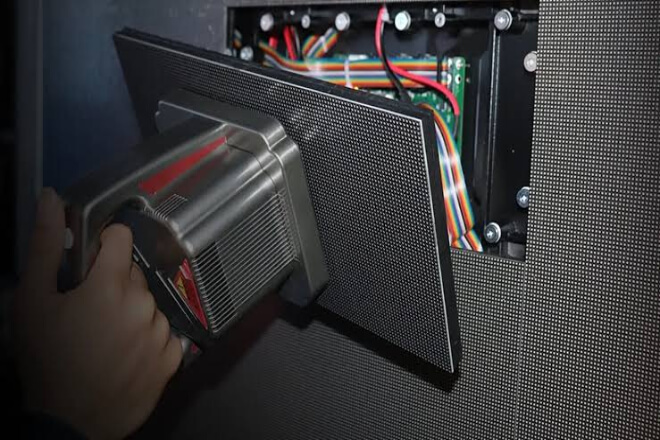
This is where modular LED screens excel. When a problem occurs, the specific fault location can be pinpointed first.
Then, damaged modules, power supplies, and control components can be replaced individually, while the normally functioning parts continue to be used, avoiding the need for the entire screen to be “retired.”
For example, if only a few modules on a large 옥외 LED 광고 스크린 malfunction, and the overall display quality and other hardware are normal, replacing only the faulty modules is usually more reasonable.
After repair, 명도 and color calibration can be performed to ensure consistency between the old and new modules.
This approach not only reduces one-time replacement costs but also extends the lifespan of the entire LED screen.
The long-term savings are particularly significant for large commercial advertising screens, park screens, or multi-location projects.
Therefore, when an LED screen experiences a partial malfunction, don’t rush to retire the entire screen.
Repair only the faulty part; replace modules whenever possible instead of the whole screen. This reduces waste and significantly eases maintenance costs.


 English
  Español
  简体中文
简体中文  Français
  日本語
日本語  한국어
한국어  العربية