

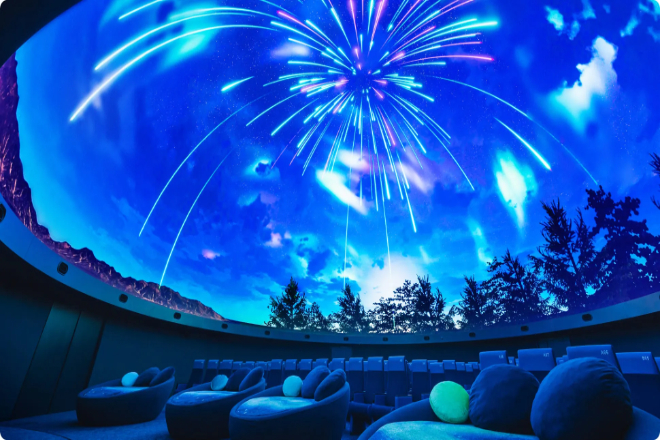
There are many ways to showcase the universe in a planetarium, and the screen shape doesn’t have to be limited to the traditional rectangle.
Different shapes affect the visitor’s viewing range, spatial experience, and content presentation.
Therefore, the primary purpose of the 전시회 hall should be considered when selecting a shape.
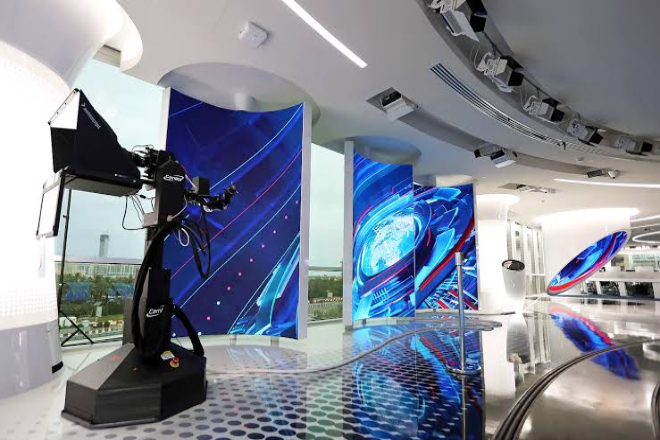
- Flat LED 디스플레이: Suitable for science popularization and thematic explanations
If a planetarium needs to display models of the solar system, planetary motion patterns, spacecraft introductions, or astronomical observation data, flat LED displays are generally more practical.
They facilitate the arrangement of text, images, videos, and dynamic charts, and are also suitable for use with information desks and interactive devices.
For example, in a solar system-themed exhibition area, the screen can display planetary alignments, orbital changes.
And the surface environments of different planets, allowing visitors to understand astronomical knowledge more intuitively.
- Curved LED displays: Suitable for creating a sense of spatial immersion
Compared to flat screens, curved LED displays can cover a wider field of view. When images of nebulae, galaxies, or planets unfold along the curved screen, visitors feel closer to the universe.
This form is suitable for immersive science exhibition halls, space exploration experience areas, and themed exhibition spaces.
However, the curvature needs to be determined in conjunction with the exhibition hall size, viewing position, and content design.
If the curvature is too large or the viewing position is unsuitable, it may affect the image proportions and viewing comfort.
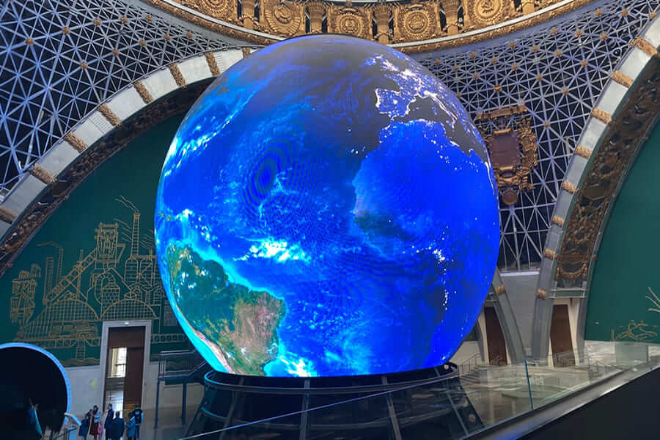
- Dome LED displays: Suitable for creating an immersive universe experience
If a project aims to allow visitors to experience being surrounded by stars, traveling through planets, or exploring deep space, the dome shape is worth considering.
The image can extend from directly in front to overhead, making visitors feel as if they are in space.
However, dome-shaped LED displays typically have higher requirements for structural design, installation precision, content adaptation, and maintenance.
Projects also need to assess building load-bearing capacity, visual obstruction, seating capacity, and overall budget.
It’s important to note that traditional projection domes used in planetariums and LED domes are not the same technology.
The choice should be based on the display objectives, screen 명도, budget, and maintenance capabilities.
Choosing the right screen type is crucial to making the universe appear more expansive, rather than having visitors searching for the screen’s boundaries.
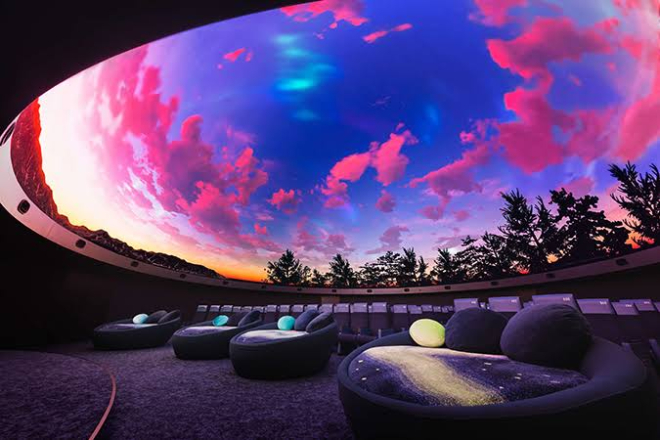
In a planetarium, a star might be just a tiny dot, and the edge of a nebula might contain very subtle variations in brightness.
If the LED display cannot reproduce these details, the otherwise beautiful cosmic image can easily lose its depth.
그러므로, 픽셀 피치 is a critical parameter to consider when selecting a planetarium LED display.
Pixel pitch refers to the distance between the centers of adjacent pixels, usually expressed in millimeters.
All other things being equal, a smaller pixel pitch generally means more pixels per unit area, making it easier to display details when viewed up close.
For science 전시회 halls where visitors are close to the screen, small-pitch LED displays should be prioritized for evaluation.
Specifications such as P1.2, P1.5, and P1.8 can be used as initial comparisons, but the final selection should be based on viewing distance, screen size, and the actual content to be displayed.
For large curved or dome-shaped screens, pixel pitch alone is insufficient; overall 해결, viewing range, and screen coverage must also be considered.
For example, when displaying the overall structure of the Milky Way, the screen needs to represent a wide range of spatial relationships;
When zooming in to the surface of the moon or planetary terrain, detail becomes even more crucial.
Furthermore, the resolution of the content source is equally critical. If the video itself lacks sufficient resolution, even a higher-spec LED display cannot magically generate details that were not originally present.
During procurement, it is recommended to test with real astronomical content to observe whether stars are clear, whether dark areas retain depth, and whether noticeable graininess appears at the edges of nebulae and planets.
For curved and dome-shaped projects, it is also necessary to check for issues such as stretching, distortion, or unnatural splicing of the image.
The more complex the screen shape, the more critical the coordination between content production and the display system becomes.
For planetarium displays, brighter and more vibrant isn’t always better.
Imagine a mysterious and profound starry sky; if the background is as bright as day, the tonal gradations between stars might disappear. While the image might be striking, it lacks the depth and grandeur expected of the universe.
First, focus on 명도 control.
Planetariums typically display different types of content, such as the bright surface of the Sun, colorful nebulae, and deep-sky scenes against near-black backgrounds.
LED displays should be able to adjust brightness according to different content, ensuring a clear image without overly stimulating the viewer’s vision.
Second, focus on shadow detail and contrast.
Cosmic scenes contain numerous dark areas. If the screen’s black levels are insufficient, the deep starry sky may appear hazy, and the distinction between stars and background will become indistinct.
Therefore, during procurement, testing should focus on black backgrounds, faint stars, and low-brightness nebulae to observe whether the screen can retain the necessary tonal gradations.
Third, color reproduction.
The colors of different celestial bodies help visitors understand their appearance and scientific characteristics. LED displays need stable color performance to avoid noticeable color shifts in different areas.
For large screens composed of multiple modules, brightness uniformity and color consistency are also crucial.
If one part of the dome appears bluish and another reddish, even the most exquisite content will easily ruin the overall visual experience.
Furthermore, planetariums often need to play videos and provide live explanations for extended periods.
So the stability of the screen under different brightness settings and the display effect of dynamic images should also be considered.
A good planetarium LED display doesn’t simply illuminate the universe in a riot of colors, but rather allows starlight, nebulae, and planets in the dark to have clear layers.
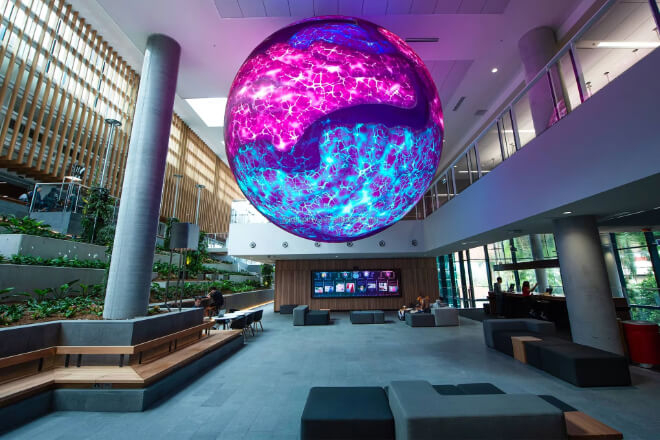
The more creative the planetarium screen shape, the more critical the content design must be.
Ordinary rectangular videos can be played directly on a flat LED display, but if the same video is placed directly on a curved or dome screen.
The image may suffer from proportional distortion, subject misalignment, or edge deformation.
Therefore, planetarium projects should plan content production methods concurrently with determining the screen’s form.
For flat screens, clear screen partitioning can be used to rationally arrange celestial models, explanatory information, and animated demonstrations within the same frame.
For curved screens, the composition needs to be adjusted according to the screen’s curvature.
For example, important subjects such as planets and spaceships should be placed in suitable viewing areas, avoiding locations with significant visual distortion.
For dome-shaped screens, content production is typically more complex. The image needs to consider the viewer’s upward viewing angle, field of vision, and spatial orientation.
Simply stretching ordinary video onto a dome may distort the shapes of celestial bodies or even cause discomfort to visitors.
Therefore, the screen’s size, curvature, 해결, and content format should be clearly defined at the beginning of the project, followed by joint testing by the display system and content production teams.
Furthermore, planetarium content doesn’t necessarily have to be limited to continuously playing videos.
Real-time astronomical data, interactive science education, star map displays, and themed films can be combined.
For example, guides can switch to the surface of a specific planet based on viewer questions, or demonstrate the changing position of a constellation in different seasons.
For projects requiring real-time content updates, it’s also essential to confirm that the control system supports the corresponding video formats, signal inputs, and playback management functions.
In this way, the LED display screen becomes more than just a playback device; it transforms into a platform that complements explanations, explorations, and interactive experiences.
The design of a planetarium’s LED display screen ultimately must consider the visitor experience and project operation.
First, the viewing location must be considered.
Whether it’s a flat screen, a curved screen, or a dome screen, the design should be tailored to the audience’s seating arrangement and viewing distance.
If the screen is too high, the field of vision is poorly covered, or important content is located in a difficult-to-observe position, the immersive experience may be compromised.
Second, viewing comfort must be considered.
While rapidly rotating starscapes, suddenly zoomed-in cosmic views, and significant changes in perspective can create a visual impact, overuse can cause discomfort for some visitors.
Therefore, the planetarium should control the speed of image changes based on the content type and design different display rhythms for science explanations, static star charts, and immersive films.
Third, installation and maintenance must be prioritized.
Large LED displays require consideration of structural support, heat dissipation, power supply, and maintenance space.
Curved and dome-shaped screens also require additional attention to installation accuracy, module replacement methods, and overall calibration complexity.
Before purchasing, it’s essential to understand the product’s warranty coverage, spare parts supply, repair response time, and after-sales calibration services to avoid complex and costly repairs after partial screen malfunctions.
Fourth, calculate long-term operating costs.
Besides the LED display itself, the control system, installation structure, content production, energy consumption, and ongoing maintenance costs should also be considered.
Content updates are particularly crucial for planetariums.
If the screen plays the same film repeatedly, even with high-end hardware, visitors may gradually lose interest.
Content can be updated regularly based on exhibition themes, festival activities, and science education courses, allowing the same display equipment to handle more display tasks.
Finally, system scalability should be considered.
Whether the existing LED display system can support upgrades if interactive devices, real-time data, or new themed exhibition areas are planned for the future will also affect long-term investment.
For project decision-makers, a worthwhile investment should not only offer an amazing initial experience but also balance scientific presentation, viewing comfort, and long-term operational needs.


 English
 Español
 简体中文
 Français
 日本語
 한국어
 العربية