

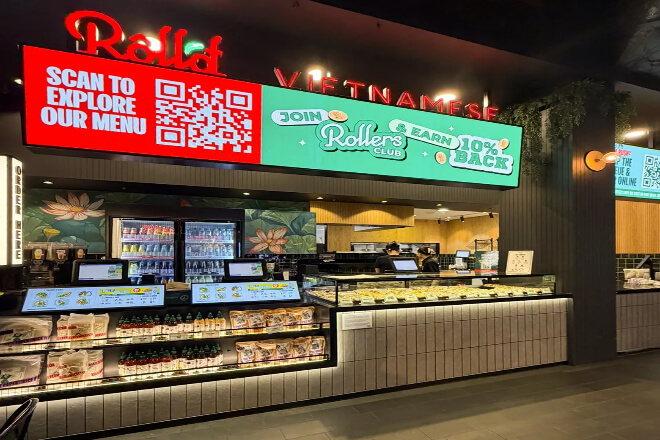
Choosing an LED screen for a Western-style restaurant shouldn’t be simply interpreted as “the bigger the screen, the more upscale the restaurant.”
If the space is limited, cramming in a huge screen may not create a sophisticated effect; instead, it might make customers feel that “this screen is taking up too much space.”
Therefore, screen size, 픽셀 피치, and installation location need to be considered together.
In areas like the ordering area, walls, and bar counter, where customers are usually closer to the screen, image sharpness is even more crucial.
When viewed up close, 작은 피치 LED 스크린 are preferable, as they ensure menus, dish images, prices, and brand visuals are clearer and avoid noticeable pixelation.
Additionally, the installation method should be chosen based on the store’s space.
Wall mounting is suitable for wall-mounted spaces, while hanging is preferable in areas with higher ceilings.
If the space layout is flexible, freestanding installation is also an option, allowing the LED screen to display content without obstructing customer flow.
For example, a small Western restaurant could install a small-pitch LED screen behind the bar, proportionally matching the wall size, to display images of signature steaks, pasta, desserts, and other dishes.
Customers can see the visual appeal of “What’s for dinner today” while ordering, which is more attractive than simply displaying a few menu posters.
In short, choosing an LED screen is like choosing plates for a restaurant—bigger isn’t always better; it must be appropriate for the space, viewing distance, and content.
Suitable size, sufficient image detail, and seamless installation are essential for an LED screen to truly enhance a Western restaurant’s appeal, rather than overshadowing the decor.
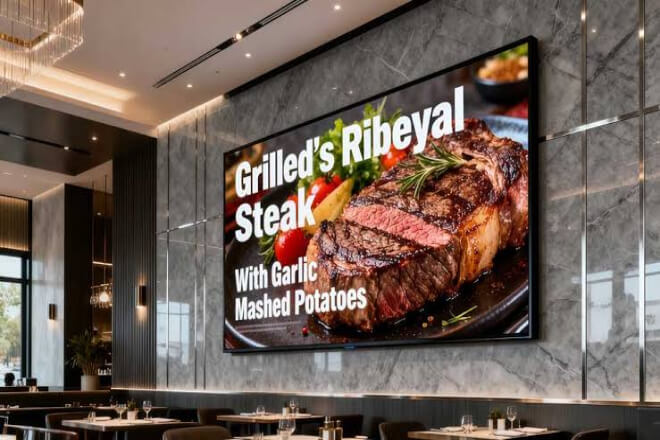
When choosing LED 스크린 for Western restaurants, image quality is paramount.
After all, for products like steak, pasta, desserts, and coffee, “how delicious they look” is a marketing tool, in addition to their taste.
If the screen image is blurry and the colors are washed out, even the most beautiful food photos can instantly lose their appeal.
Furthermore, the lighting in Western restaurants is often complex, with natural light, warm-toned chandeliers, and decorative lighting all potentially present simultaneously.
Ordinary screens are prone to glare, whitening, or color inaccuracies under such conditions.
For example, a juicy steak might appear dull and lifeless on the screen; the strawberries in a strawberry cake might have distorted colors.
Customers might not feel tempted to eat it, but rather question, “What happened to those strawberries?”
Therefore, when selecting LED screens, it is recommended to focus on contrast ratio, color gamut coverage, and adjustable brightness.
A high color gamut allows for richer and more accurate colors in dishes; high contrast ratio highlights the details of meats, sauces, and desserts;
And adjustable 명도 adapts to different lighting conditions, including daytime and nighttime.
If the LED screen is installed in a location frequently seen by customers, such as the ordering area or bar, anti-glare design is crucial to reduce light reflection and make the menu and food images more comfortable to view.
For example, if the screen clearly displays the crispy surface, texture, and glossy sauce of a signature steak, customers might even be tempted to order before they even pick up the menu.
Simply put, Western restaurant LED screens aren’t just about enlarging the dishes; they’re about perfecting the visual appeal first.
The more realistic the image, the more appetizing it is—make customers hungry first, then let the menu guide the purchase.
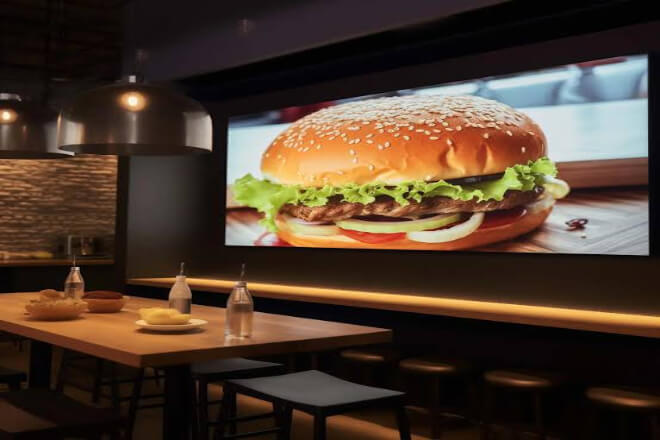
Restaurant LED screens face more than just customers and lighting; they also encounter fumes, humidity, temperature fluctuations, and prolonged operation.
Especially near the bar and kitchen, screens undergo various environmental tests daily. Inadequate protection can lead to dust accumulation, moisture buildup, and even aging wiring over time.
Therefore, when choosing a restaurant LED 스크린, it’s not enough to just consider the image quality; its durability is also essential.
When purchasing LED screens, focus on IP protection ratings, panel materials, and circuit sealing technology.
Choose appropriate dustproof, moisture-proof, oil-fume-proof, and temperature-resistant solutions based on the specific installation location.
For example, areas near 바 are often exposed to water vapor and beverage splashes, while screens near kitchens may be affected by oil fumes.
If ordinary LED screens are exposed to such environments for extended periods, it’s like putting electronic devices in a sauna every day.
Initially, there might be no noticeable problems, but over time, issues will easily arise.
LED screens with better protection can reduce the corrosion of internal components by dust, moisture, and oil fumes, lowering the risk of malfunctions such as blackouts.
Screen distortion, flickering, and lag, and making the screen more suitable for long-term operation.
Of course, don’t blindly buy just because it has a high protection rating; the actual installation environment must be considered.
The environments in the lobby, ordering area, bar, and near the kitchen are completely different, and the configuration should also differ.
In short, restaurant LED screens not only need to “show off their appearance,” but also need to be resilient.
After all, LED screens deal with oil fumes and moisture every day. If they’re too delicate, the owner might be burdened with repair bills before the customers even finish their meal.
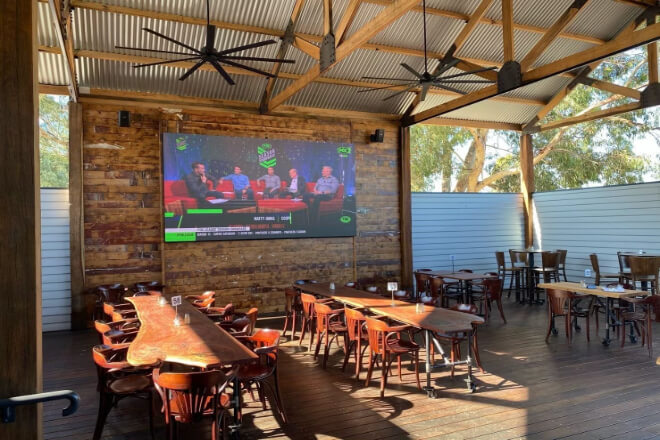
Restaurant menus aren’t “written down and never changed.” New items, set menu adjustments, price changes, holiday promotions… today it might be a steak set menu, tomorrow it’s a Christmas limited edition.
If every time the LED 스크린 needs updating, technicians have to operate it, it will become a real headache in the long run.
Therefore, the control system is equally important when choosing an LED screen.
A good control system should be easy to operate and highly compatible, allowing store staff to quickly update the content.
For example, it should support remote control, one-click screen replacement, batch menu updates, and timed on/off functions.
Play coffee and sandwiches during breakfast, switch to lunch set menus at noon, and then switch to signature steak and dessert recommendations in the evening.
The screen can automatically change according to the business hours without repeatedly messing with the equipment.
If the store has multiple LED screens, content management can also be done through a unified system.
For example, adjusting new product prices only requires a single update to simultaneously modify menus in multiple areas, avoiding the awkward situation of “the front desk displays 29 yuan, but the bar screen still shows 25 yuan.”
Meanwhile, the compatibility of the control system is also crucial. If screens are added later, playback devices are adjusted, or content management methods are upgraded.
There shouldn’t be any need to redo everything because the system “doesn’t recognize the new devices.”
Simply put, the restaurant LED screen control system should ideally be like a mobile app—easy for staff to use.
After all, what restaurants really need to focus on is serving food and providing service, not figuring out “how to update the menu on this screen.”
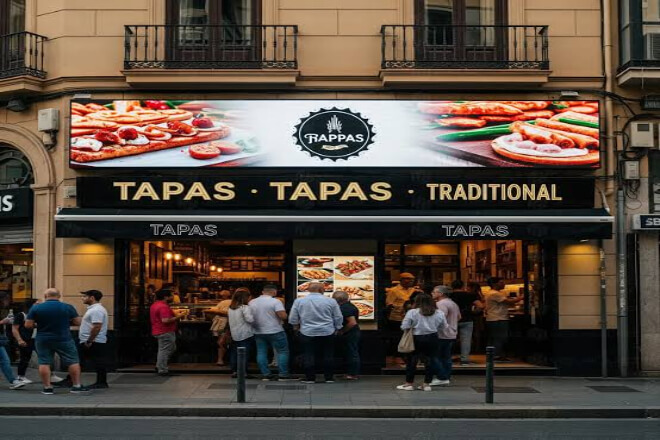
Western-style restaurant LED screens are often not just “on for a few hours and then off.”
From lunch to dinner, and then to nighttime operations, the screens may need to run continuously for extended periods.
Therefore, the real test for an LED 스크린 isn’t how beautiful it looks when it’s first installed, but whether it can still work reliably after six months or a year.
If the hardware quality is inadequate, problems such as damaged LEDs, system crashes, 명도 decay, severe overheating, and even excessive power consumption may occur after prolonged operation.
Frequent malfunctions of LED screens not only affect menu and brand displays but also increase repair, replacement, and downtime costs.
Therefore, when purchasing, priority should be given to high-quality LED chips, stable 전원 solutions, heat dissipation design, and overall energy consumption.
낮은 전력 소비, low heat generation, and good resistance to degradation allow LED screens to maintain a more stable display effect during long-term operation.
For example, in a Western restaurant operating for more than ten hours a day, if the LED screen is constantly under high load, insufficient heat dissipation will easily cause the equipment to “get hotter and hotter with each use.”
Over time, this not only affects stability but may also increase energy consumption.
Conversely, LED screens with well-designed hardware and heat dissipation are more suitable for long-term use in the restaurant.
At the same time, energy efficiency cannot be ignored. The longer the LED screen operates each day, the more significant the cumulative difference in power consumption becomes.
While the electricity savings may not seem significant each month, they accumulate over a year or two and represent a substantial operating cost.
In short, restaurants should not only consider how impressive the LED screen looks on the first day of operation but also whether it can withstand the test of long hours of daily operation.
Stable display, reasonable power consumption, and minimal malfunctions are the hallmarks of suitable hardware for long-term operation.


 English
  Español
  简体中文
简体中文  Français
  日本語
日本語  한국어
한국어  العربية