

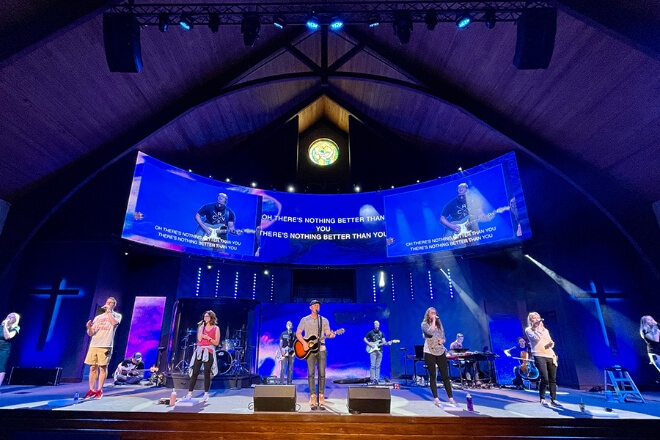
Religious venues differ from 쇼핑몰 and nightclubs; the spaces here typically emphasize solemnity, tranquility, and the aesthetic appeal of the architecture itself.
While LED displays can certainly improve information display efficiency, if designed to be too eye-catching.
They can easily disrupt the overall atmosphere by suddenly adding a particularly striking electronic screen to a harmonious space.
Therefore, when planning LED displays, it’s necessary to consider screen size, 명도, installation location, and the building structure in advance.
The screen shouldn’t just be large and bright; it must harmonize with the surrounding environment.
For example, LED screens in entrance areas can display welcome messages, event schedules, and important notices, allowing visitors to quickly access relevant information upon entering.
In public areas, the display size can be designed according to viewing distance to avoid text being too small to read.
For religious sites with unique dome, wall, or column structures, installation locations require careful planning.
Utilizing the building structure effectively allows LED screens to blend naturally into the space, rather than appearing jarring like a “temporarily placed television.”
Meanwhile, content design must be carefully considered. A solemn space doesn’t preclude the use of dynamic visuals;
Rather, brightness, animation rhythm, and content style need to be controlled to ensure the LED screen effectively conveys information and provides supplementary display.
Ultimately, LED screens in religious sites are not meant to “steal the spotlight,” but to better serve the space.
A well-planned design achieves just the right amount of screen presence, clear visibility, and a comfortable atmosphere.

For first-time visitors to a religious site, the entrance is often the first “navigation checkpoint.”
If information is unclear, visitors might start searching frantically upon entering, even asking staff for directions.
If they don’t know where the events are, what the opening hours are, and how to navigate different areas.
안 LED 스크린 at the entrance can centrally display this information, allowing visitors to quickly understand the space upon entering.
For example, it can display venue introductions, the day’s event schedule, opening hours, and important notices.
It can also incorporate simple maps or arrows to show visitors the location of different areas and directions.
If there are lectures, services, or other events on the day, the LED screen can update its content in real time.
For example, it can remind visitors of the time and location when an event is about to begin;
If an entrance is temporarily changed, a notification can be posted promptly.
Compared to fixed posters on the wall, LED screens don’t require repeated printing and replacements, making information adjustments more flexible.
For larger religious venues, wayfinding is even more crucial. Visitors don’t need to use their phones to check maps and figure out “where I am”; a glance at the entrance screen is enough to get basic directions.
Therefore, entrance LED screens can act as “quiet digital receptionists”: they don’t disturb visitors, yet they can inform them when needed.
“Where is this place? What activities are happening today? Where should we go next?”, making the entire visitor experience more natural and seamless.
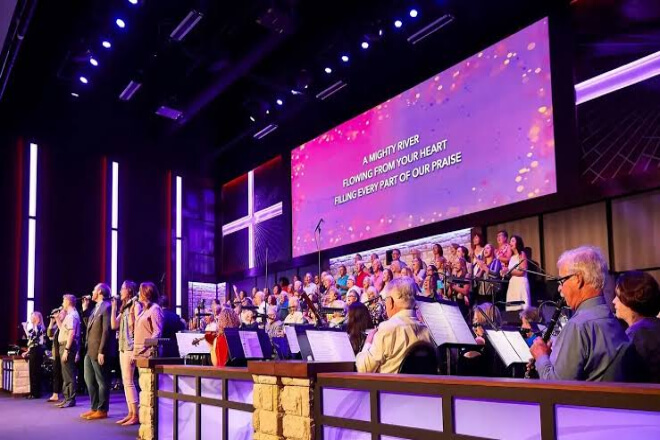
LED screens in activity areas must first address a very practical problem: ensuring everyone can see the screen clearly, but without making it the “noisiest presence in the room.”
Especially in religious venues, the display screen needs to serve the explanations, ceremonies, and activities, not steal the atmosphere of the space itself.
Screen size should be determined based on 시거리 and seating distribution.
For example, small activity areas don’t need a huge LED 스크린; it’s enough for the last row of viewers to be able to see the text and images clearly.
In larger auditoriums or activity spaces, the display area needs to be appropriately increased to avoid situations where those in the front rows can see clearly while those in the back can only “guess the content.”
명도 control is equally important. During the day, when ambient light is strong, brightness can be increased appropriately to ensure clear content;
After the event ends or the environment darkens, brightness can be reduced to avoid the screen being too bright and disrupting the solemn and comfortable atmosphere.
In terms of content, the focus can be on displaying explanations, ceremony procedures, event information, presentation slides, or important notices.
For example, in large event venues, audience members in the back rows can see the presentation slides and key information through the LED screen without having to constantly crane their necks to see what’s in front.
Therefore, the design of LED screens in event areas needs to find a balance: sufficient size, comfortable brightness, clear content, and visibility from different positions.
Good display effects are not about keeping the audience constantly focused on the screen, but about making it easier for them to participate in the event.
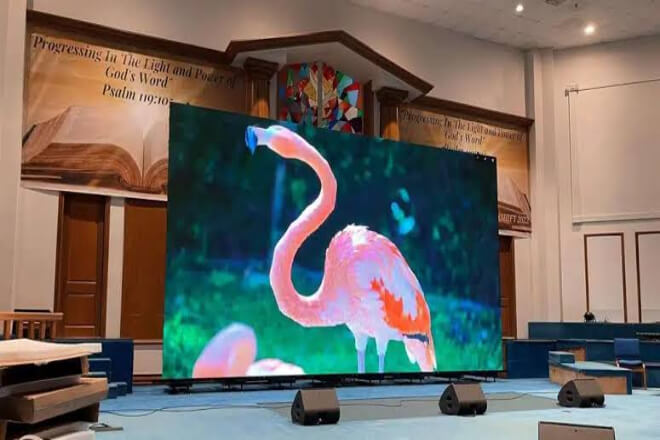
Cultural dissemination sometimes needs a “younger perspective.” If the walls only have long text descriptions, visitors may lose attention before even reaching the key points.
LED display technology can transform historical stories, cultural backgrounds, and architectural features into more intuitive and visual content, making knowledge more than just “reading text.”
예를 들어, LED 스크린 can play historical documentaries, architectural evolution animations, or cultural stories, allowing visitors to see the changes a religious site has undergone from the past to the present.
When introducing architectural features, dynamic visuals can explain the cultural meanings behind elements such as domes, murals.
And sculptures, ensuring visitors not only find them aesthetically pleasing but also understand the reasons behind their design.
For younger visitors, this visual expression is more likely to generate interest. For instance, a seemingly ordinary architectural detail.
When displayed on an LED screen with its historical background and accompanied by a short video, can transform what would otherwise be easily forgotten into a story worth stopping to learn.
Therefore, LED screens not only play content but can also serve as more engaging “digital guides.”
They make traditional culture less distant and more visually appealing, encouraging young people to stop and observe, and making it easier for them to remember and share cultural stories.
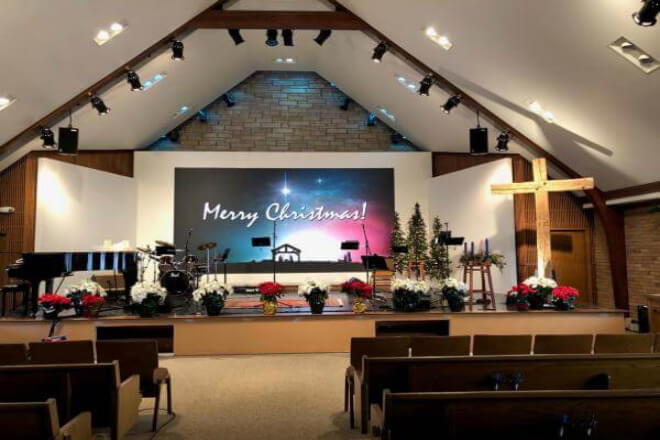
When choosing an LED display for a religious site, it’s not enough to simply ask “Is it clear?”
More importantly, it must be comfortable to view, operate stably, and not disrupt the solemn atmosphere of the space.
After all, this isn’t a 쇼핑몰 advertising space; the screen doesn’t need to “steal the show” the moment it lights up.
First, choose a display effect suitable for the indoor environment, paying particular attention to low brightness and high grayscale performance.
Indoor lighting is relatively stable, so there’s no need to pursue ultra-high 명도 like outdoor advertising screens; otherwise, prolonged viewing can be glaring.
High grayscale allows for more natural tonal gradations in people, images, and videos, especially when playing historical footage or cultural documentaries, resulting in more comfortable detail.
Second, consider long-term operational stability. If the screen is mainly used for daily activities, presentations, and information dissemination.
It needs to be able to operate stably for extended periods, reducing the trouble caused by sudden blackouts, color discrepancies, or malfunctions.
Post-construction maintenance is equally important. Content may change constantly with festivals, cultural exhibitions.
Or daily announcements, so it’s best to choose a solution that allows for easy remote updates and management.
For example, if event schedules are temporarily adjusted, staff can directly modify the content in the backend, eliminating the need to temporarily move ladders to change posters.
Therefore, a good LED solution isn’t simply about pursuing “impressive parameters,” but rather about achieving appropriate brightness, natural images, stable operation, and easy updates.
Allowing the screens to quietly perform their function is more in line with the atmosphere of religious venues.


 English
  Español
  简体中文
简体中文  Français
  日本語
日本語  한국어
한국어  العربية