

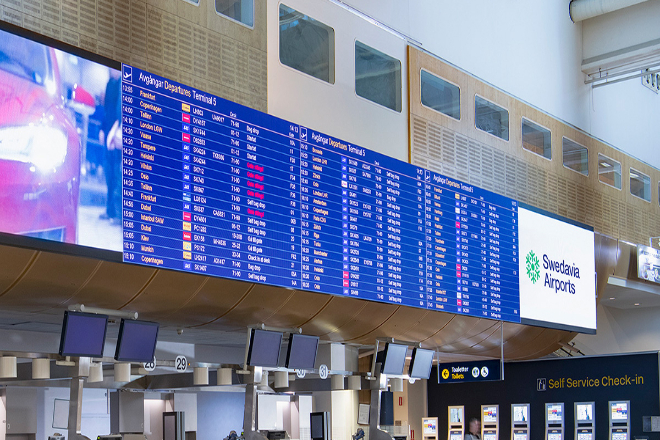
공항 are vast, and what passengers fear most isn’t walking far, but rather walking for ten minutes only to suddenly realize they’re going the wrong way.
Especially in departure, arrival, transfer, security, and boarding gate areas, the wayfinding needs are different in each area, so a single LED 스크린 can’t cover everything.
Based on passenger flow direction, spatial layout, and viewing distance, flexible installation methods such as hanging, wall-mounted, and freestanding can be chosen, placing the screens where passengers truly need them.
For example, in the departure hall, prominently display check-in counters, flight status, and security entrances;
In the transfer area, highlight transfer routes, boarding gate directions, and remaining time.
In densely populated areas, multiple screens can work together to help passengers quickly find their way without having to look around.
For example, after passing through security, passengers can look up and see a clear sign saying “Gate B12 →,” as if someone has already told them, “Don’t panic, this is the way.”
Simply put, airport LED signage isn’t about having more screens, but about being readily available when passengers need it.
Less getting lost, more ease, and a smoother airport experience.
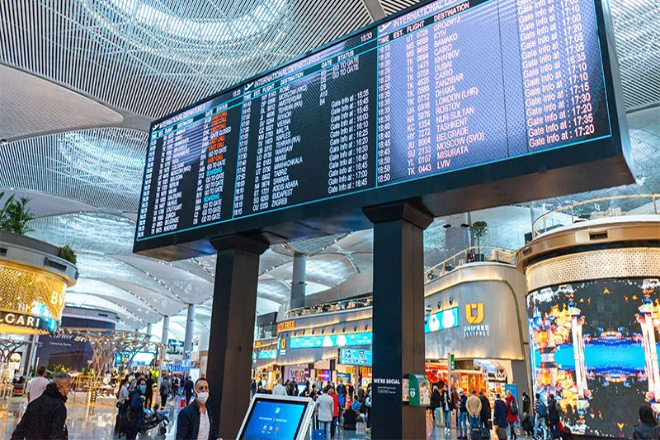
공항 flight information can sometimes be more unpredictable than weather forecasts. Delays, gate changes, cancellations, and baggage carousel adjustments can all happen suddenly.
If manual updates are used, a few minutes’ delay could mean hundreds of meters more for passengers, or even an airport treasure hunt.
A high-quality LED screens intelligent signage system can directly connect to the airport’s backend data.
Automatically updating flight status, gates, departure times, baggage carousels, and other information.
When flight schedules change, the screens can update their content instantly, eliminating the need for staff to repeatedly make on-site corrections.
For example, a passenger might see their flight at gate A15 and be leisurely walking over, only to find the gate has suddenly changed to B08.
With the LED 스크린 updated promptly, passengers can immediately see the new information and directions.
Otherwise, they might arrive at A15 only to find “why is no one here?” and then have to run.
Simultaneously, real-time information reduces the burden on information desks.
Passengers can find the latest answers on the screens themselves, and staff don’t have to repeat “Your gate has changed” dozens of times a day.
In short, the airport LED screens wayfinding system is like a tireless “information broadcaster”: it updates immediately when flights change.
Passengers avoid unnecessary detours, staff make fewer trips, and the airport experiences less “rush-to-flight anxiety.”
The lighting in airport halls is anything but “low-key.” During the day, sunlight streams through the glass curtain wall, and various indoor lights further exacerbate the problem.
만약 LED 스크린‘s 명도 and image quality are insufficient, glare, a washed-out appearance, and blurry text can easily occur.
Passengers, dragging their luggage, standing in front of the screen, have to squint to confirm: “Is it A12 or A13?”
Therefore, airport LED wayfinding screens need to be matched with appropriate brightness, pixel pitch, contrast, and viewing angle based on the environment.
Even if passengers are standing far away or passing by from the side, they should be able to quickly see the flight number, gate, time, and directional arrows.
For example, passengers entering the departure hall can see “Flight AB123 → Gate A12” on the LED screen from afar, without having to walk closer to confirm.
In high-traffic areas like airports, the ability to “grasp” information at a glance directly impacts passenger navigation efficiency.
Furthermore, to accommodate passengers from different countries, the screens can also incorporate bilingual (Chinese and English).
Multilingual information, icons, and dynamic arrows to reduce comprehension barriers caused by language differences.
In short, airport LED screens aren’t about being “brighter the better,” but rather about being visible from a distance, clear up close, and understandable from the side.
After all, catching a flight is stressful enough; there’s no need to play a game of “spot the difference” with a screen.
Modern airport signage is no longer just about telling passengers “which way to go.” Facing the complex floors and areas of large airports,
if everyone had to ask staff, the information desk would easily become a “high-traffic checkpoint.” This is where interactive LED 스크린 come in handy.
Touchscreen queries, route navigation, flight information, 공항 announcements, and multilingual support can be added to intelligent LED signage systems, allowing passengers to complete information searches themselves.
Looking for your gate? Look it up yourself. Looking for a restroom, restaurant, or lounge?
Search for it yourself. Need to confirm your transfer route? The screen provides directions directly.
For example, a passenger visiting a large international airport for the first time, dragging their suitcase, suddenly realizes they don’t know where their gate is.
Instead of searching for staff, passengers can simply type or click on the target location on the interactive LED screen.
The system will then provide route, floor, and directional prompts, and even guide them step-by-step.
For international airports, multilingual functionality is also extremely useful.
Passengers can switch to their preferred language, reducing the awkwardness of “understanding every word but not knowing where to go.”
Airports don’t have “off-hours.” Flights take off in the early morning, and passengers arrive in the early morning; the LED signage can’t be saying, “Take a break today.”
24/7 continuous operation means the screens not only need to look good but also withstand prolonged, high-frequency use.
Durable, low-failure-rate LED screens hardware should be prioritized during configuration.
Along with a stable backend management system that supports remote monitoring, content updates, scheduled management, and fault alerts.
LED screens also need good heat dissipation, dustproofing, and heat resistance to minimize performance degradation from prolonged operation.
For example, at 2:00 AM, a passenger arriving at the 공항 needs to find the baggage carousel.
If an LED wayfinding screen suddenly goes black and there are no staff on-site to assist, a passenger’s first reaction is likely not “the equipment needs maintenance,” but rather, “Where am I?”
However, with a remote maintenance system, staff can monitor the screen’s operational status in real time.
Quickly address any anomalies, reduce the duration of malfunctions, and alleviate the burden of manual inspections.
Simply put, the ideal state for airport LED screens wayfinding is “24/7 online, but avoid being overly visible.”
Stable display during the day, continued operation at night, and always readily available in critical moments are essential to truly become a reliable digital infrastructure for the airport.


 English
  Español
  简体中文
简体中文  Français
  日本語
日本語  한국어
한국어  العربية