
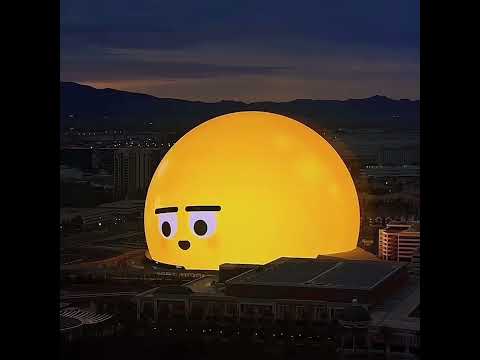
Cities are never short of “large screens,” but what’s truly scarce are visual symbols that allow people to recognize the location from afar.
Even the largest ordinary giant LED display might just be a display surface on a building; a giant spherical LED display, however, inherently possesses recognizability.
Combined with its enormous size and 360° visibility, it’s much easier to spot whether vehicles are passing by, pedestrians are walking by, or it’s viewed from nearby buildings.
For example, a giant spherical LED display at the entrance of a commercial complex can play brand content during the day and transform into a giant Earth, Moon, or a flowing sphere of light at night.
From a distance, people might see this “glowing sphere” before even seeing the building.
More importantly, the sphere easily becomes content for photos and social media.
It might naturally appear in photos taken by tourists of the city at night, and during large events, the visual content can be quickly changed according to the theme.
Over time, people may remember not just the building’s name, but rather—”That’s the place with the giant spherical LED display.”
Therefore, the true landmark value of a giant spherical LED display is not simply about size, but about combining architecture, the LED 디스플레이, content, and urban memory.
A landmark doesn’t have to be outrageously large, but it must be unique enough to be unforgettable.
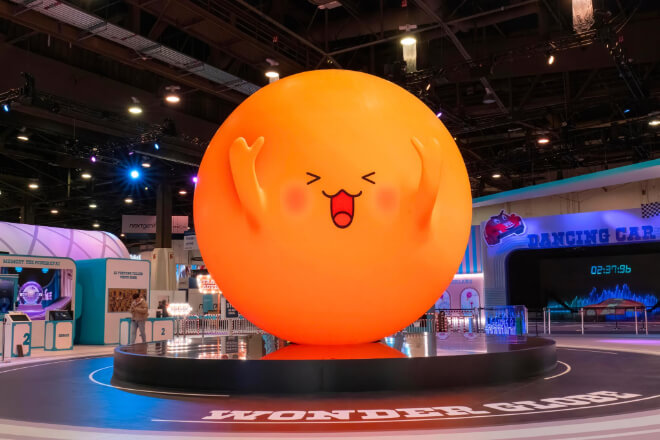
The appearance of ordinary buildings is basically fixed; it looks the same during the day and the same at night.
But a spherical LED display is different—as long as the content changes, the entire building is like a new “skin.”
The spherical surface can continuously display city themes, artistic visuals, and brand content, and can also quickly switch themes according to holidays, events, and large-scale activities.
For example, it can become a giant colorful sphere for Christmas, a football or team visual during the World Cup, and directly switch to brand-specific content for brand events.
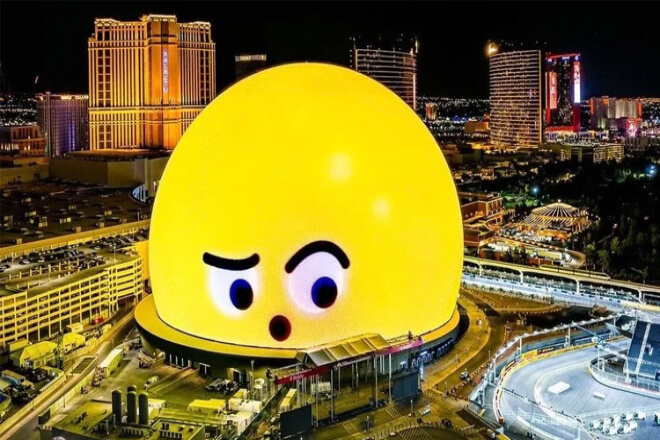
The Sphere in Las Vegas is a prime example. Its external LED display has showcased various visuals, including giant eyeballs, emojis, basketballs, and the moon, constantly generating new visual buzz around the same building.
The biggest advantage of the sphere is that this content doesn’t just appear on “one wall,” but can unfold continuously across the entire surface.
An animation starts on one side, wraps around the top, and extends to the other side, transforming the building into a giant 360° digital canvas.
This also gives the building the ability to continuously generate buzz. Today it’s art content, tomorrow it’s a sporting event, and the day after it’s a brand collaboration.
The building doesn’t move, but its appearance can change daily.
Therefore, the truly interesting aspect of spherical LED displays is that they transform buildings from fixed “objects” into continuously updated digital city content carriers.
Previously, buildings relied on designers to decide “what they should look like.” Now, spherical LED displays allow them to decide—what they want to look like today.
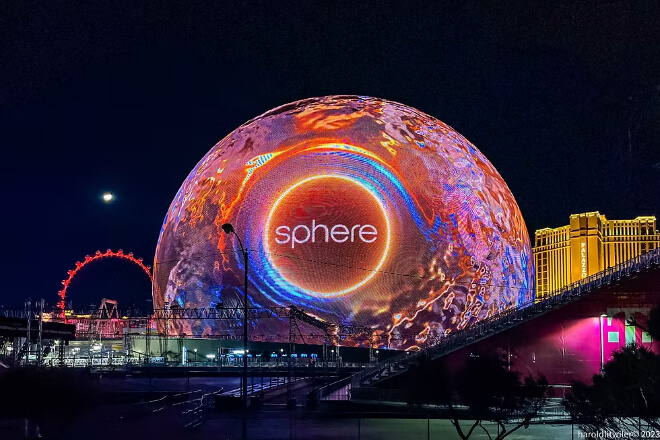
Giant spherical LED displays aren’t necessarily “the bigger the better.” The key is placement in areas with high foot traffic, frequent events, and a strong urban presence.
With the right location, it can transform from a large screen into a true urban visual focal point.
Urban commercial complexes can use them to attract long-distance foot traffic, giving their commercial areas an instantly recognizable visual symbol.
Entertainment complexes can combine them with performances, sporting events, and immersive content, allowing the sphere to constantly change its “expression” in response to events.
Cultural and tourism projects are well-suited to using their unique shapes to create photo opportunities, making “taking pictures and posting on social media” part of landmark promotion.
Large convention centers can leverage the sphere to enhance project recognition, becoming a natural visual backdrop during 전시회 and press conferences.
Sports venues can update their displays around events, teams, and brand content, making the sphere a second visual focal point outside the stadium.
In short, giant spherical LED displays are best suited for locations with high foot traffic, frequent events, and a continuous demand for content.
Moreover, these screens have an advantage that ordinary billboards struggle to achieve: today it’s a commercial advertisement, tomorrow it’s a sporting event, and the day after it can become an urban art installation.
Interactive Question: If you were to create a new visual landmark for a city, would you place it in the city center, the commercial district, or the sports and entertainment area?
Where do you think it’s most likely to truly “become a hit”?
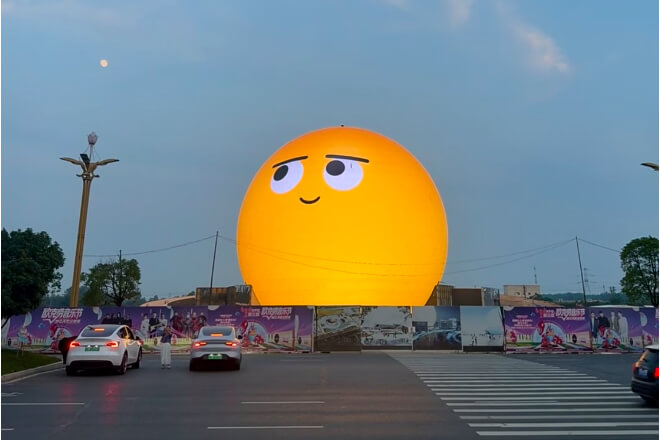
If a giant spherical LED display only elicits “Wow, it’s huge!”, it might quickly become just a backdrop for tourists.
Its true commercial value lies in ensuring it’s consistently viewed, photographed, and even monetized.
Brands can turn it into a super advertising space. For example, when a car brand launches a new model, the entire sphere can be transformed into a car “rushing” out;
During sporting events, it can be replaced with team visuals, game content, or sponsor advertisements.
After the event, it can continue to play brand promotions, artistic content, and city themes, ensuring the giant sphere isn’t just a “daylighting” display.
It can also turn tourists into free promoters. A sufficiently interesting image appearing on the sphere might prompt passersby to take a picture and share it on social media platforms like Instagram and TikTok.
What was originally a simple screen display can become a natural wave of viral marketing.
For commercial complexes and cultural tourism projects, a few extra minutes of visitor lingering or a casual photo can generate additional spending and exposure.
More importantly, the commercial value of a spherical LED display comes from continuous updates.
Today it’s brand advertising, tomorrow a holiday theme, next week a sporting event visual, and the next time it could be a “giant moon.”
The screen remains the same, but the content keeps changing, ensuring the topic doesn’t easily become outdated.
Therefore, a truly successful giant spherical LED display isn’t the most popular on the day it’s built, but rather one that people are still willing to see, photograph, and share years later.
After all, the worst thing for a landmark isn’t a lack of viewers, but rather that people only see it once and then forget about it.
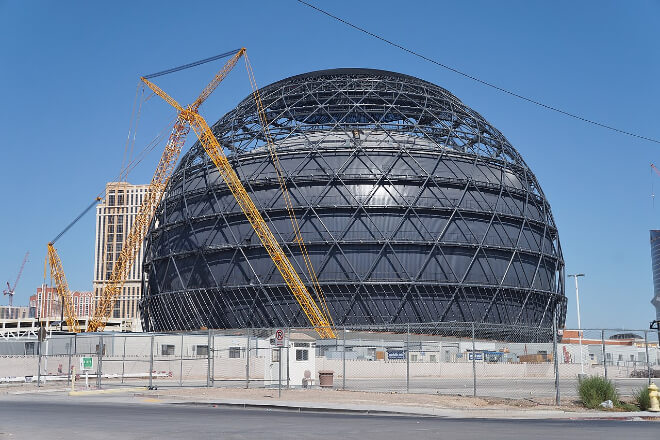
A giant spherical LED display may seem like simply “bending” an LED screen, but in reality, it’s far more complex.
Ordinary LED 스크린 primarily face flat surfaces, while a sphere must simultaneously address issues of curvature, structure, weight, heat dissipation, power supply, and maintenance.
LED 모듈 must be precisely fitted to complex curved surfaces; even slight installation deviations can result in an awkward “something’s off-center” appearance.
The larger the screen, the less room there is for improvisation in maintenance and repair.
The external LED system of the Las Vegas Sphere is a prime example.
It uses an independent steel grid structure to support a large number of LED display components.
Involving multiple systems including building structure, steel structure, LED displays, 전원, heat dissipation, and maintenance.
In other words, the engineering team wasn’t just installing a large screen, but ensuring an entire gigantic system remained stable on a spherical surface.
Of course, engineering success isn’t enough; the content must also be up to par. Simply overlaying ordinary videos onto a sphere might just be “enlarging a square image.”
Truly engaging content needs to consider the visual characteristics of a sphere, allowing the image to move around the sphere and fully utilize the 360° space.
Therefore, the competition for giant spherical LED displays isn’t just about “who has the biggest screen.”
But about the seamless collaboration between design, architecture, engineering, display technology, and creative content.
A regular large screen is simply “installing a screen,” while a giant spherical LED display is about “successfully lighting up a sphere and keeping it brightly lit.”


 English
  Español
  简体中文
简体中文  Français
  日本語
日本語  한국어
한국어  العربية