

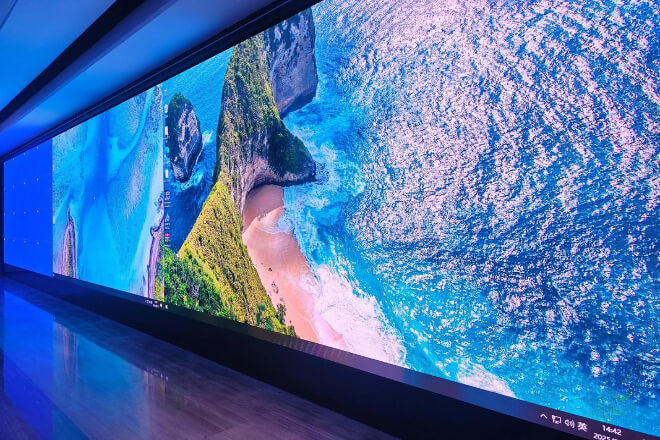
Traditional LED screens are often just “tools for playing advertisements,” with limited content and fixed functions.
However, in the digital upgrades of shopping malls, venues, and parks, it is becoming a more important role—a unified information dissemination center.
First, it enables unified information dissemination across 쇼핑몰, venues, and parks, breaking down information fragmentation.
In the past, notices might be posted on bulletin boards, broadcast on the public address system, or delivered manually, resulting in multiple and decentralized information sources.
LED screens can serve as a unified entry point, centrally displaying all key content on a single visual platform.
For example, a large screen at the mall entrance simultaneously displays floor guides, event previews, and brand promotions, allowing customers to grasp the core information at a glance.
Secondly, it supports real-time updates of notifications and event content, improving information response speed.
Whether it’s temporary event adjustments, emergency notifications, or brand pop-up events, everything can be instantly updated on the screen through the backend system.
Compared to traditional methods, information dissemination time has been shortened from “hours or even days” to “seconds.”
Simply put: Previously, it was “information finding people”; now, “information proactively appears.”
At the same time, it significantly improves information reach efficiency, allowing more people to access key content immediately.
LED screens are typically located in high-traffic areas, such as entrances, atriums, and elevator lobbies, inherently possessing high exposure.
Combined with dynamic visuals, they attract attention more easily, making information delivery far more effective than static posters or paper announcements.
To put it more interestingly: Previously, information was like “small notes stuck in corners”; now, information becomes “large screen reminders that automatically jump to your face.”
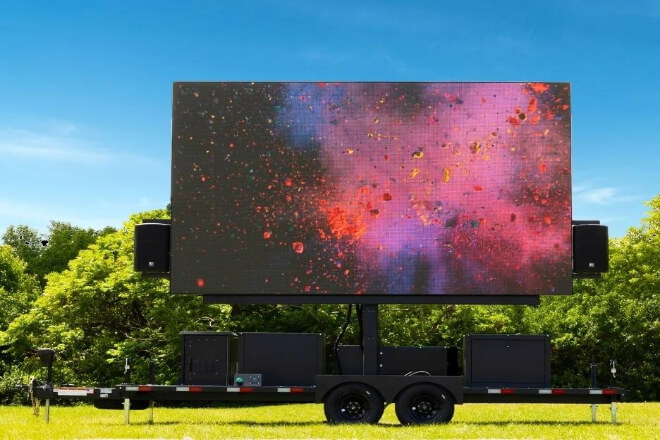
Past LED 스크린 were more like “windows that only played content,” with viewers leaving after watching, offering little interaction.
Now, it’s evolving into a more engaging role—an interactive experience portal, transforming viewers from passive “spectators” into active “participants.”
First, interactive features like QR code scanning, prize draws, and on-screen voting turn the screen into a channel for participation. Viewers are no longer just receiving information.
They can participate in activities via QR code scanning with their phones, such as voting for an MVP, participating in prize draws, and sending blessings. Results are displayed in real-time on the large screen.
예를 들어, 쇼핑몰 event, viewers can scan a QR code to participate in a “Today’s Most Popular Brand Voting” session, with the results updating in real-time on the large screen—the whole process resembles a public interactive game.
Second, it enables two-way communication with the audience, rather than a one-way broadcast. Traditional screens are “I play, you watch”; interactive LEDs are “you participate, I respond.”
This instant feedback mechanism allows the screen to respond to viewer behavior in real-time, creating a sense of “dialogue.”
Simply put, the LED screen is no longer just a “speaker,” but a “responsive live host.”
Simultaneously, it significantly enhances engagement and dwell time, making the space more attractive.
When viewers see their choices, comments, or participation displayed on the large screen, they are more likely to stay and continue participating.
This feeling of being “seen” naturally prolongs dwell time and enhances the memorable experience.
To put it more interestingly: before, it was “passing by and glancing at the screen”; now it’s “participating, maybe you’ll get on the big screen.”
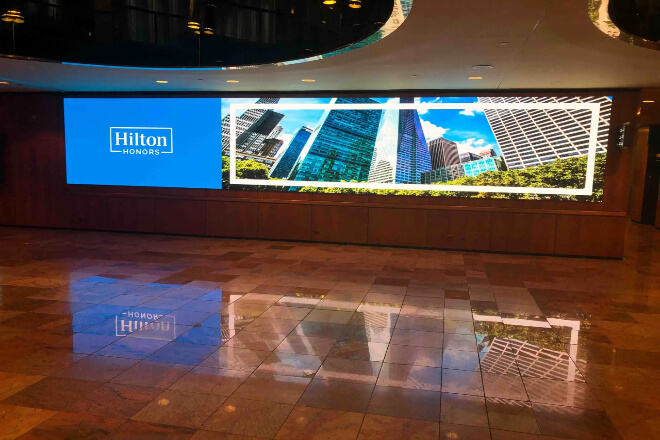
Previously, LED screens were very “straightforward”: playing ads, displaying information, and completing tasks.
Now, their role is becoming more “adaptable”—not just displaying content, but directly participating in the design of the spatial atmosphere.
First, dynamic visuals turn the space into a “단계 that changes scenes.” LEDs are no longer just a backdrop, but can “skin” the entire environment. The feeling of the space changes with the content.
For example, a 쇼핑몰 atrium normally plays brand advertisements, a “business model.”
During holidays, it switches to falling snowflakes and warm light animation, instantly becoming a “Christmas square”; then it switches to waves and blue light and shadow, like stepping into a seaside resort.
The same place can “change cities, change seasons, change moods” just by using the screen.
Second, the linkage of lighting, music, and LEDs gives the space a “rhythm.” It’s not just about watching a screen; the entire space comes alive.
A flash of light, and the screen flashes in sync; a climax in the music, and the visuals explode.
To give a more intuitive example: in a nightclub setting, as the drumbeat intensifies, the LED backdrop instantly transforms into pulsating waves of light.
The crowd is unconsciously drawn into the rhythm, feeling as if the entire space is “breathing with the DJ.”
Simply put: before, “the screen was playing content”; now, “the space is performing content.”
Simultaneously, it enhances the spatial experience, encouraging people to linger, take photos, and share. When the space itself is visually appealing, people will automatically stop and check it out.
Sometimes, it’s not even for consumption, but to take a photo that “feels like stepping into a movie scene.”
To put it more interestingly: before, LED screens were responsible for “advertising”; now, LED screens are responsible for “making people feel like they’re on a movie set.”
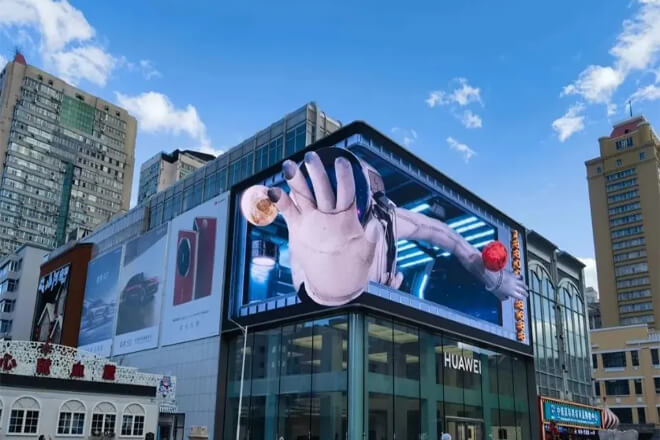
Previously, LED screens were mostly just “devices for displaying content,” playing advertisements and announcements, their task finished once completed.
But in commercial spaces, it’s upgrading to a more crucial role—an operational tool directly involved in business operations.
First, tenant advertising, event promotions, and brand collaborations transform content into an “operable resource.”
LED 스크린 are no longer just for uniformly displaying content; they offer “time-segmented display opportunities” for different merchants, brands, and events. The screen itself becomes a shared commercial traffic entry point.
For example, a 쇼핑몰 might promote lunch sets for restaurants during the day, switch to clothing brand promotions in the afternoon.
And then use it for overall mall event promotions in the evening. The same screen “serves different businesses” at different times.
Second, it improves commercial conversion rates, making “seeing” closer to “consumption.”
Compared to static posters, dynamic videos, limited-time offers, and countdown events are more likely to stimulate consumer decisions. LED screens are not just about “exposure,” but about “driving action.”
Simply put: it’s not about letting people “know there’s an event,” but about making them “want to go check it out now.”
Simultaneously, it enhances the ability to guide consumption within the scene, making customer flow more directional.
LED screens can combine wayfinding information, promotional tips, and event recommendations to guide customers to specific floors or stores.
For example, displaying “New product launch on the 3rd floor atrium” directly directs foot traffic to the target area.
To put it more interestingly: Previously, LED screens were simply “shopping mall billboards”; now, they’re more like “talking sales assistants,” subtly suggesting, “Would you like to go up and take a look?” when you hesitate.
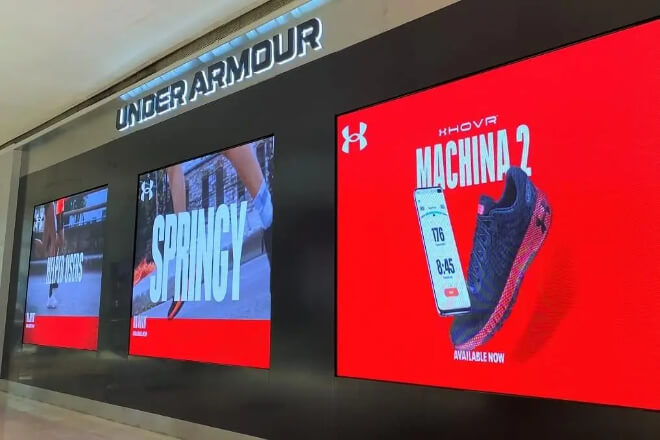
Previously, LED screens were more like “individually operating devices,” each screen responsible for its own content, each operating independently.
But in the digital space system, it’s upgrading to a more crucial role—a “node” within the entire system, rather than an isolated “display.”
First, connecting to data systems and intelligent control platforms allows the screens to “work online.”
LED 스크린 are no longer just receivers of playback signals; they can connect to data platforms, such as customer flow systems, event systems, and security systems.
The content displayed on the LED screens can also be adjusted in real time based on data changes.
For example, during peak 쇼핑몰 hours, the screen automatically highlights promotional information.
When foot traffic is low, it switches to event previews or brand exposure content. LED screens are beginning to “create content based on data.”
Second, supporting multi-screen linkage and remote management enables unified scheduling.
Multiple LED screens no longer operate independently but can be controlled uniformly through a platform.
The main screen displays event footage, side screens synchronize data analysis, and entry screens display guidance information—all can be linked with a single click.
Simply put: previously it was “one screen, one image”; now it’s “many screens telling the same story together.”
Simultaneously, it drives the digital upgrade of spaces, transforming buildings into manageable media systems.
When LED screens become system nodes, the entire space is no longer just a “building,” but a digital environment that can be scheduled, managed, and optimized.
Operators can manage the space like management software: adjusting content, switching modes, and analyzing effects.
To put it more interestingly: previously, LED screens were like “standalone television sets”; now, they’re more like “intelligent screen cells within a city system.”


 English
  Español
  简体中文
简体中文  Français
  日本語
日本語  한국어
한국어  العربية