

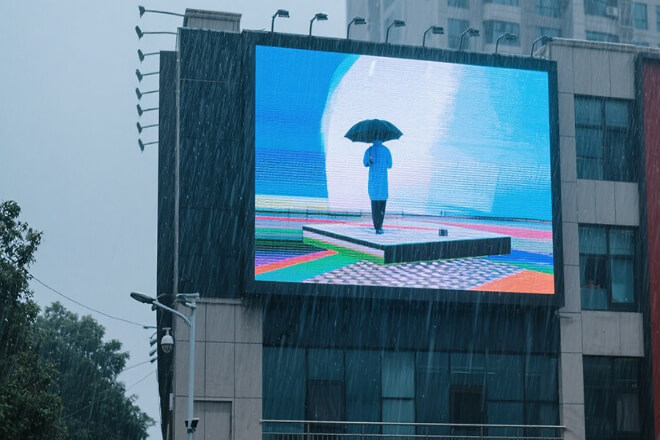
There’s a very real dividing line in advertising: static ads are “seen and forgotten,” while dynamic ads are “remembered after watching.” LED 디스플레이 have significantly widened this gap.
First, dynamic videos are more eye-catching than static images, making it easier to “grab” attention. For example, a static poster might be glanced at and then forgotten.
But if the image is moving—the product is rotating, the scene is changing, the lighting is shifting—people will naturally linger for a second or two longer.
For example, you might be just passing by, but if the screen suddenly changes images rhythmically, you’ll subconsciously “take another look.”
Second, it increases the brand’s first-glance exposure, ensuring the ad is “seen first.”
The advantage of dynamic content lies in its ability to stand out more easily within its environment, such as shopping malls, pedestrian walkways, and sporting events.
Simply put, static ads are the “background,” while dynamic ads are more like “moving reminders,” more likely to grab attention at first glance.
Furthermore, dynamic content strengthens the memorable aspects of an ad, ensuring that viewers remember not just the visuals, but the process of change.
For example, a brand might use a short video to showcase a product’s usage scenarios.
This is more memorable than a single image because viewers may not remember a single frame, but the entire “process of change.”
For instance, it’s not the picture of a cup of coffee that’s memorable, but the scene of “the coffee being poured and steaming.”
Finally, dynamic content enhances visual impact, elevating advertising from simply “seeing” to “being felt.”
Dynamic visuals, combined with color changes and rhythmic transitions, more easily stimulate visual attention, especially on large screens where this impact is amplified.
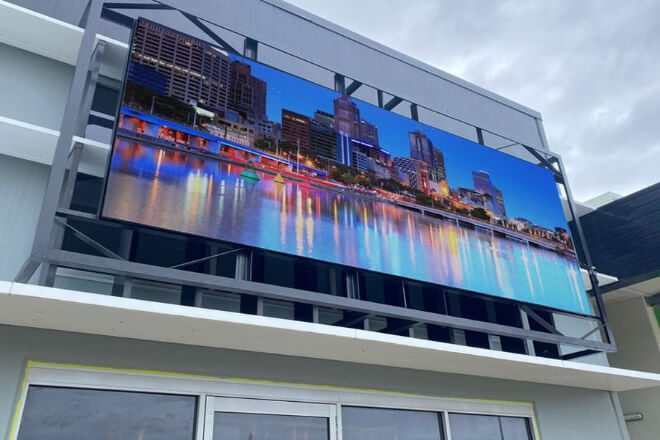
Traditional advertising has a significant problem: once on a wall, it’s difficult to “change the storyline.”
LED displays, on the other hand, offer the opposite advantage—they act more like a “digital 단계” where content can be changed at any time.
First, it supports real-time updates and remote management, eliminating the need for on-site modifications to advertising.
For example, if a brand wants to change promotional information, there’s no need to reprint posters or go to the site to disassemble them; the screen updates immediately upon backend modification.
For instance, a discount event decided in the morning can appear on the mall’s large screen in the afternoon.
Second, it allows for switching different advertising content based on time of day, enabling the same screen to play different roles at different times.
For example, the morning focuses on brand exposure, lunchtime on restaurant discounts, and the evening on entertainment or event information.
Simply put, a single screen can adapt to the needs of different time periods, almost like it can “change personalities.”
Simultaneously, it meets the needs of multi-brand rotation, maximizing ad space utilization.
For example, a single screen can serve multiple brands simultaneously, rotating by time or by the second.
For example, in the 30 seconds you stand in front of the screen waiting for the elevator, you might see three different ads—coffee, sports, and movie—appear in rotation.
Finally, it improves advertising efficiency, transforming content from a “fixed schedule” to “flexible scheduling.”
Advertising no longer needs to have its content locked in advance; instead, it can be quickly adjusted based on events, weather, holidays.
And even pedestrian traffic, making the campaign more closely aligned with actual results.
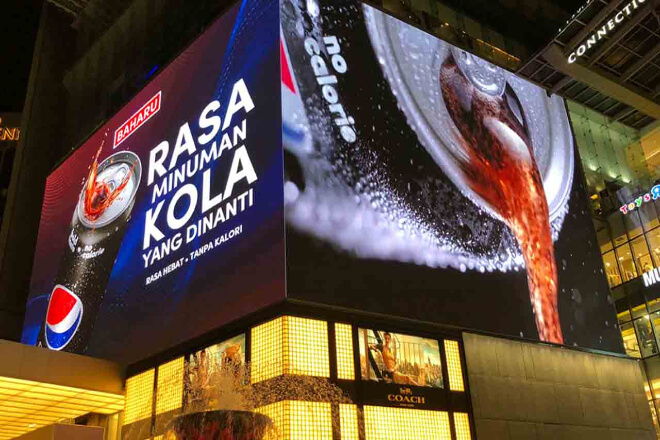
For advertising to be seen by more people, the core is one thing: from appearing in one place to appearing everywhere. LED displays perfectly achieve this “spatial diffusion.”
First, they cover multiple scenarios such as 쇼핑몰, streets, and transportation hubs, placing brands in the “must-see” paths of pedestrian traffic.
For example, you see it once in a shopping mall, again at the subway entrance, and again on large screens in the street.
For example, you see a brand in the subway station in the morning, the same brand in the shopping mall at noon, and again on a street screen when you pass by in the evening—you become “familiar” without even realizing it.
Second, simultaneous indoor and outdoor advertising deployment allows for “seamless coverage” of the brand.
Indoor advertising is responsible for the precise targeting of consumers, while outdoor advertising is responsible for the wide-ranging exposure.
The combination of the two is like “close-range persuasion + long-range face recognition.” Simply put, one is responsible for making you remember, and the other is responsible for making you see it repeatedly.
Simultaneously, it breaks the spatial limitations of traditional media, freeing advertising from the constraints of “paper or fixed locations.”
Traditional advertisements are limited to their placement, while LED screens can be distributed across spaces of varying heights, angles, and sizes, covering everything from small shop window displays to large outdoor screens.
Finally, it enhances brand reach, transforming exposure from a “point-like” to a “network-like” approach.
It’s not about single-point exposure on a single screen, but rather multiple screens working together to create a continuous “visual path” for the brand throughout the urban space.
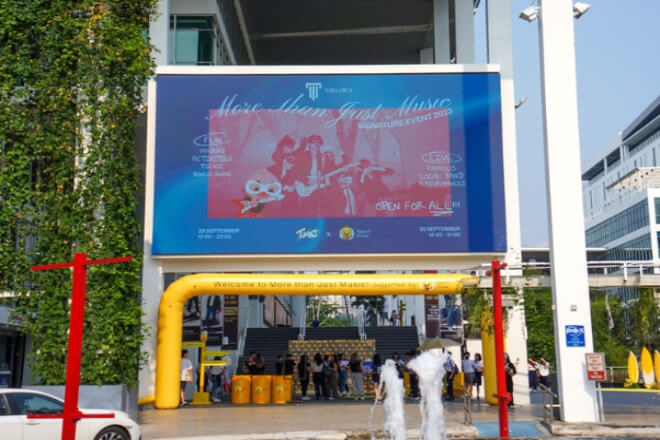
Advertisements that merely “look at me” are easily overlooked, but once they become “you can participate,” the situation changes completely.
The interactive design of LED displays essentially transforms viewers from “passersby” into “participants.”
Firstly, it supports QR code scanning and interactive activities, turning advertising from “looking at” to “playing.”
For example, the screen can display QR code entry points for prize draws, limited-time coupons, and interactive mini-games.
For instance, if you’re simply waiting for the elevator and the screen prompts “Scan the code to win a cup of coffee,” many people will likely give it a try.
Secondly, it enhances user engagement, making viewers feel like they’re not being “interrupted” by the advertisement, but rather “participating in an activity.”
For example, large screens can display real-time participant numbers, winning information, and even project user nicknames or avatars onto the screen.
Simply put, the psychological experience is completely different, shifting from “I’m watching an ad” to “I’m appearing in an ad.”
Simultaneously, it transforms “one-way communication” into “two-way interaction,” giving the advertisement a response.
Traditional advertising involves the brand speaking and the user listening; interactive LEDs allow users to vote, choose content, and participate in challenges.
Such as “Which new product do you prefer?” The voting results are displayed on the screen in real-time.
Finally, it increases marketing conversion opportunities, allowing interaction to directly lead to consumption.
For example, scanning a QR code to receive a coupon can be used directly in-store, or participating in an activity grants the right to purchase.
This “see-participate-act” chain is more likely to generate actual conversions than simple exposure.
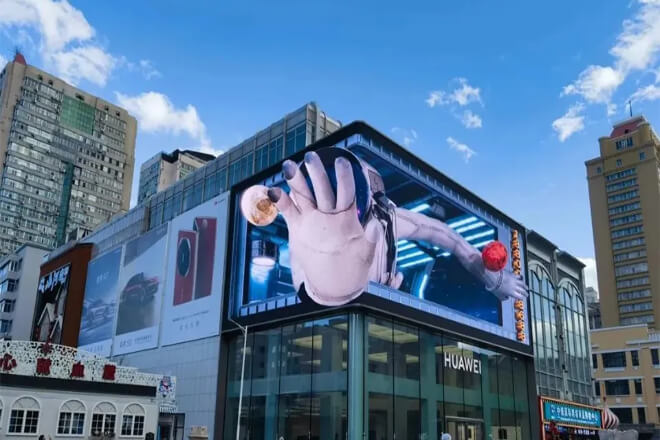
The most expensive aspect of advertising is never the “production” itself, but rather the one-time use.
The advantage of LED displays lies in transforming advertising from a “disposable consumer good” into a “sustainably used content asset.”
First, it supports long-term reuse, ensuring high-quality content isn’t wasted. For example, a classic brand video can be played repeatedly at different times and in different scenarios, without needing to be remade for each event.
For instance, a well-made new product advertisement can be reused in 쇼핑몰, events, and festivals, simply by changing the rhythm or combination.
Second, it reduces content update costs, making operations more lightweight. Traditional advertising requires re-production, installation, and setup every time it’s changed, while LED screens only require backend content updates to switch.
Simply put, the cost difference between “changing a billboard” and “changing content” is significant.
Simultaneously, it transforms from a one-time campaign to a continuous operation, allowing advertising to enter a “long-term rhythm.”
For example, brands can plan content weekly, monthly, or even by holiday, instead of ending after a single campaign.
This transforms advertising from an “event” into a continuously existing “brand exposure stream.”
Finally, it improves overall marketing ROI, making each exposure more valuable.
Repeated exposure + multi-scenario playback + flexible updates allow the same content to generate new reach at different times, thereby amortizing the cost per exposure and increasing overall return on investment.


 English
  Español
  简体中文
简体中文  Français
  日本語
日本語  한국어
한국어  العربية