

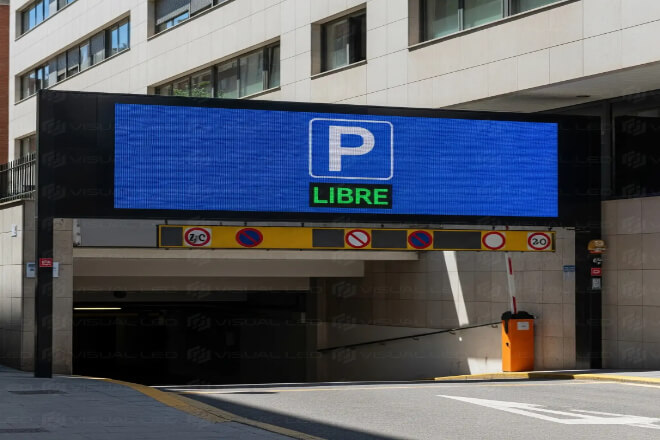
The most frustrating thing about parking lots isn’t actually “whether there are parking spaces,” but rather—how long it takes to find a parking space.
The role of LEDディスプレイ here is to directly transform “finding a parking space” into “following directions.”
First, it displays real-time information on available parking spaces. The large screen at the entrance can directly tell you:
How many spaces are available on each level, and which area is more available, eliminating the need to circle around trying your luck.
For example, upon entering the parking lot, the LED screen displays “There are many parking spaces remaining on level B2.”
Allowing drivers to go directly down without circling around level B1 only to find there are no spaces.
Second, it guides vehicles to quickly find parking spaces. Besides providing overall information, many parking lots also install LED guidance screens in designated areas to indicate “
There are still spaces available if you turn left ahead” or “This area is full, please go straight.”
For example, when approaching a fork in the road, the screen might display “Right side A area is full, we suggest going to C area,” essentially providing real-time directions.
More importantly, it reduces the time spent searching for parking spaces. What might have taken ten minutes or more can now be done by simply following the screen’s guidance—a shorter route and quicker decision-making.
Finally, it optimizes overall vehicle traffic efficiency. With cars no longer circling and entrances less congested.
The flow of traffic in the entire parking lot is smoother, reducing the situation of “getting stuck inside looking for a parking space.”
In short, this application transforms parking lots from a “luck-based” experience to a “direct access to a parking space” experience using LED displays.
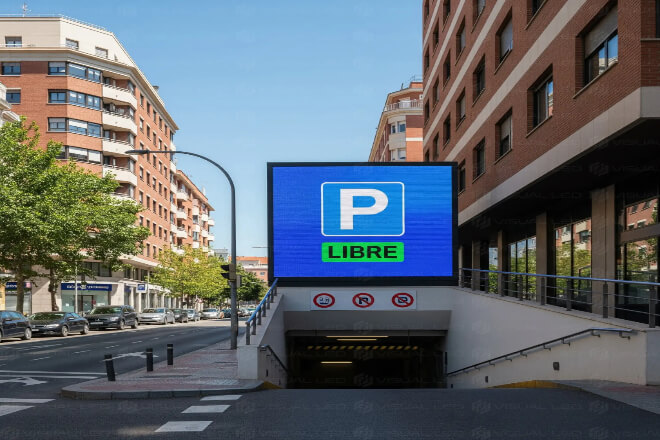
The quality of the parking lot experience largely depends on one small thing: whether you feel “a little panicked” upon entering.
Being disoriented, unable to distinguish floors, or unable to find your way out of the exit all negatively impact the experience. The role of LEDディスプレイ is to make the entire space “understandable.”
First, it clearly displays floor and area information. The entrance screen directly shows the layout of each floor, parking availability, and area divisions, so that people know “where to go” as soon as they enter.
For example, upon entering the parking lot, instead of circling, a quick glance shows “B2 is more vacant, C area is closer to the elevators,” making the choice very straightforward.
Second, it provides dynamic entrance and exit guidance. Parking lots don’t have fixed routes; entrance and exit directions may be adjusted due to construction.
Tidal traffic flow, or events. The LED screen can update route prompts in real time.
For example, if an exit is temporarily closed, the screen will immediately indicate “Please exit via the east exit,” so drivers don’t have to walk to the door only to find they’ve “gone the wrong way.”
More importantly, it significantly reduces parking anxiety. Many people become nervous upon entering a parking lot, worrying about not finding a parking space or getting lost.
Clear information provides much more peace of mind.
For example, a screen displaying “There are available spaces 100 meters ahead” or “The elevator exit leads directly to the mall” makes the entire process more controllable, preventing aimless driving.
Finally, it enhances the overall service experience. Parking is no longer a “wayfinding process,” but a “guided flow,” resulting in a smoother user experience.
Simply put, this application transforms parking lots from “easy-to-navigate spaces” into “spaces where you can navigate at a glance.”
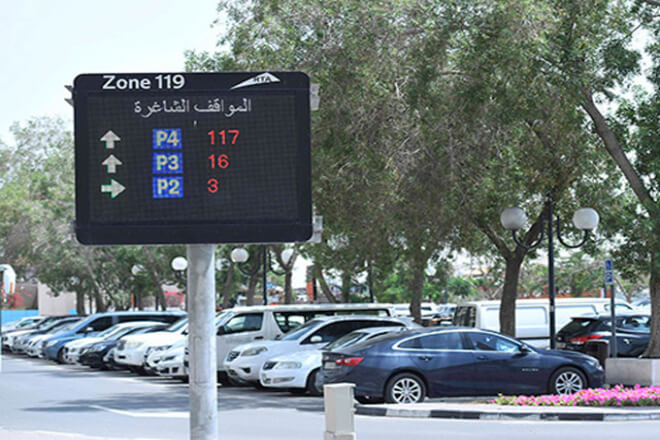
For a parking lot to truly be “smart,” the key isn’t just how many cars it can park, but rather that it needs to ensure data is visible, information is manageable, and adjustments are timely.
In this case, LED displays are like bringing the backend system “to the site.”
First, it synchronizes parking data in real time. The system can directly synchronize the parking space usage, entry and exit traffic.
And available spaces in each area to the LEDスクリーン, providing management and users with the same “real-time answer.”
For example, if there’s a sudden surge in traffic on a certain floor and available spaces decrease rapidly.
The screen will immediately update to “This area is nearly full,” guiding subsequent vehicles to divert and avoid congestion.
Second, it supports remote content management. Parking lots don’t need manual on-site information changes.
The backend can centrally adjust screen content, such as temporarily adjusting guidance, issuing notices, or switching operational information.
For example, during peak holiday periods, the management center can remotely update prompts such as “Prioritize using Entrance B.”
Eliminating the need for on-site equipment modifications and significantly improving efficiency.
More importantly, it enhances overall operational management efficiency. Managers can quickly identify problems through screen-based data system integration.
Such as which areas are consistently full or which exits are severely congested, allowing for timely strategy adjustments.
Finally, it drives the digital upgrade of parking lots. LED displays are not merely “display tools,” but rather a crucial link connecting with data systems, sensors.
And management platforms, transforming parking lot management from “manual experience-based management” to “data-driven management.”
In short, this application makes LED displays the “visual brain” of parking lots, enabling management to go from invisible to visible and manageable.
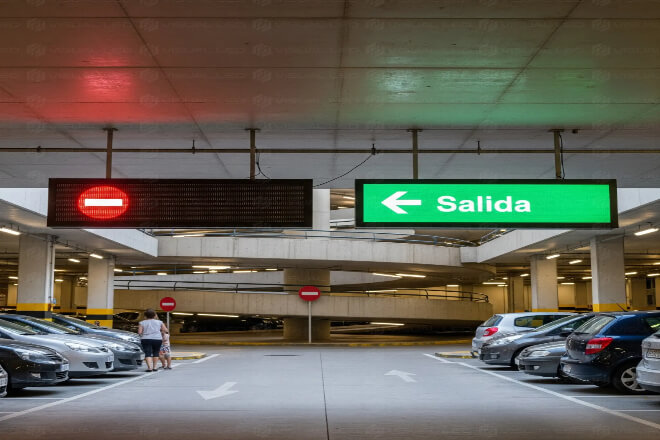
Parking lots have often been considered “pure expenditure space,” but a crucial aspect is often overlooked:
Drivers linger there, and this lingering is involuntary. LED displays effectively “turn” this waiting time into value.
Firstly, they can display advertising and brand promotion content. LEDスクリーン at entrances, payment areas.
And elevator entrances can continuously display advertisements for mall brands, car services, and nearby businesses, giving the space itself a means of dissemination.
For example, while waiting to pay or waiting for the elevator, drivers can look up and see information about nearby restaurant discounts or new car displays—information that naturally enters their field of vision.
Secondly, waiting time can be used to enhance advertising exposure.
Parking and retrieving a car involves waiting, and during this time, people are less busy, and their attention is more easily drawn to screens.
For example, while queuing to pay at the exit, if a large screen is playing short ads or brand content, drivers will generally glance at it, resulting in a longer dwell time compared to “passing-by” ads.
More importantly, it can generate additional operating revenue.
Originally just providing parking services, the space can now become a continuous source of income through screen advertising, time-slot playback, and brand partnerships.
For example, during peak hours, car insurance ads can be displayed, while at night, restaurant and entertainment information can be switched, selling different “attention resources” at different times.
Finally, parking lots can be transformed from “cost zones” into “value zones.” Not only does it cover operating costs, but it can also generate revenue through advertising and content operations.
In short, this application transforms the “waiting time” in parking lots into usable commercial time through LED displays.
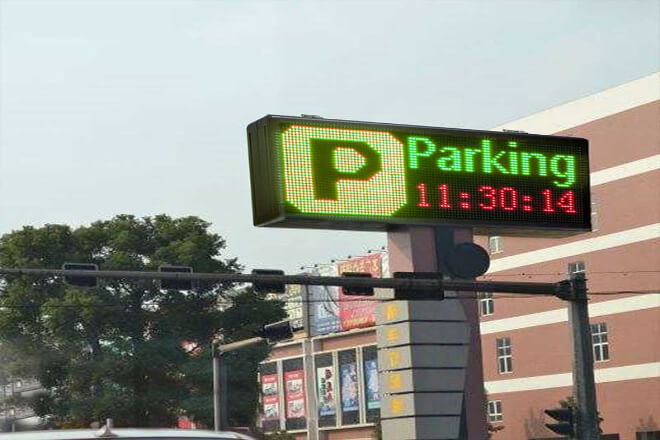
Parking lots may seem like a “transitional space,” but in the event of an emergency, such as a fire, equipment failure, or congestion.
The most crucial factor is whether information can reach everyone immediately. LEDディスプレイ play a role in “rapid notification + unified guidance.”
Firstly, they can issue emergency notices and safety alerts. For example, equipment malfunctions, traffic restriction adjustments.
And temporary area closures can all be simultaneously displayed on the LED screen, ensuring all vehicles and pedestrians entering and exiting see it at the same time.
For example, if an equipment malfunctions on a certain floor, the screen can immediately display “Entry to this area is suspended; please detour to Zone B,” preventing vehicles from mistakenly entering and causing congestion.
Secondly, they can guide evacuation routes in emergencies. In the event of an emergency, parking lot routes may need temporary adjustments.
And the LED screen can quickly switch to “evacuation mode,” guiding users to the nearest exit or safety passage.
For example, in the event of a fire alarm, the screen will directly display “Please exit in an orderly manner via the east exit.”
Which is more consistent, clearer, and less likely to cause confusion than manual broadcasts.
More importantly, it significantly improves the speed of information transmission. Parking lot environments are complex, and signals are scattered.
Relying solely on verbal notifications or small signs is prone to delays or omissions, while LED screens can provide “synchronous updates across the entire lot.”
For example, if a certain area needs to be temporarily closed, once the information is updated, all vehicles passing through that area will see it immediately, eliminating the need for individual notifications.
Finally, it enhances overall safety. When information is transmitted faster, routes are clearer, and guidance is more consistent, the probability of on-site chaos is significantly reduced.
In short, this application transforms LED displays in parking lots into “first-response safety command screens.”


 English
  Español
  简体中文
简体中文  Français
  日本語
日本語  한국어
한국어  العربية