

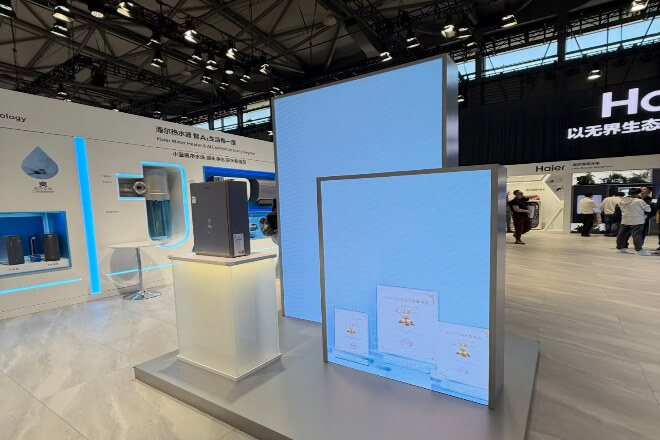
Many events experience an awkward moment: the lights come on, and the previously clear image suddenly fades;
Audience members in the back rows can only see a blurry outline when trying to see product details.
For product launches, 展示会, or brand events, a visual glitch can negatively affect the atmosphere.
The advantage of LED displays lies in their independence from ambient lighting conditions.
Because LED screens are self-illuminating, even under strong ステージ lighting and bright venue environments, the image maintains good brightness and clarity.
Whether playing promotional videos, showcasing product details, or presenting real-time data, LED displays make it easier for audiences to see the key points.
In contrast, projectors are more demanding in terms of environmental conditions. Too much ambient light can cause the image to appear grayish; at greater distances, text and details may become unclear.
Especially at large events, lighting, stage effects, and audience experience are integral to the overall design.
Sacrificing lighting performance to protect projection quality can actually negatively impact the atmosphere.
For example, a new car launch event needs to showcase the car’s lines, interior details, and a dynamic promotional video.
Using an LED display ensures that even as the ambient lighting changes with the music, the screen remains vibrant and stable, making it easier for the audience to highlight the product’s features.
This is why more and more corporate events are choosing LED displays as the core stage display equipment.
It offers more than just a brighter screen; it provides greater control over visual effects in complex environments, reducing the likelihood of “not being able to see clearly at crucial moments.”
For event organizers, stable image quality is an integral part of the event experience. After all, no one wants their carefully prepared video content to be ruined by an overly bright stage light.
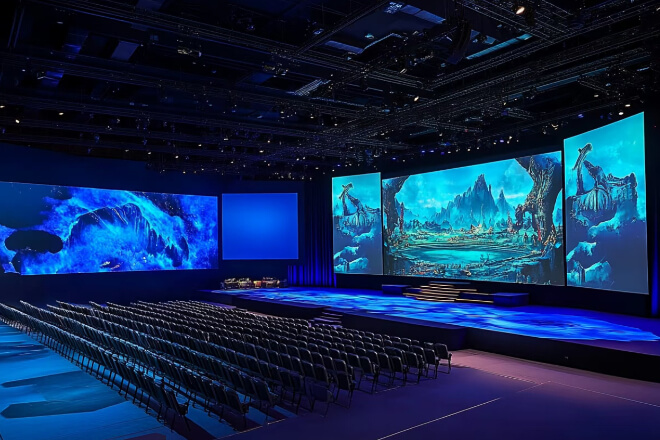
One of the biggest challenges of large events is ensuring that every audience member can see the content clearly.
While those in the front rows may see clearly, those in the back may have to guess the content.
Which undoubtedly impacts the overall experience for press conferences, meetings, or exhibitions.
The advantage of LED displays lies in their modular design, allowing for the creation of display screens of varying sizes.
From small backdrops of a few dozen square meters to large visual systems covering the entire ステージ, they can be adjusted to suit the event space.
Whether it’s a corporate annual meeting, a product launch, or a large exhibition, they can meet the display needs of different scales.
Compared to single-size projection equipment, LED displays are more likely to maintain a consistent viewing experience in large spaces.
Whether the audience is seated at the front of the stage or further away, they can see clear images, text, and video content, and the experience is less likely to be diminished by distance.
For example, at an international brand’s new product launch, there may be media, partners, and a large audience present simultaneously.
If a large LED screen is used for the stage backdrop, it can not only display product promotional videos.
But also switch between presentation content, data charts, and brand visuals in real time, making the entire event flow more smoothly.
Furthermore, the flexibility of LED displays opens up more possibilities for event design.
They can be customized to create curved, irregularly shaped, or multi-screen combinations to suit the stage structure, freeing the display space from being limited to a traditional backdrop.
For large-scale events, the value of LED displays goes beyond simply “enlarging the image.”
They act as the visual center of the event, allowing audiences in different positions to participate and ensuring every important moment is clearly presented.
After all, a meticulously planned event loses half its value if only those in the front rows can see it clearly.
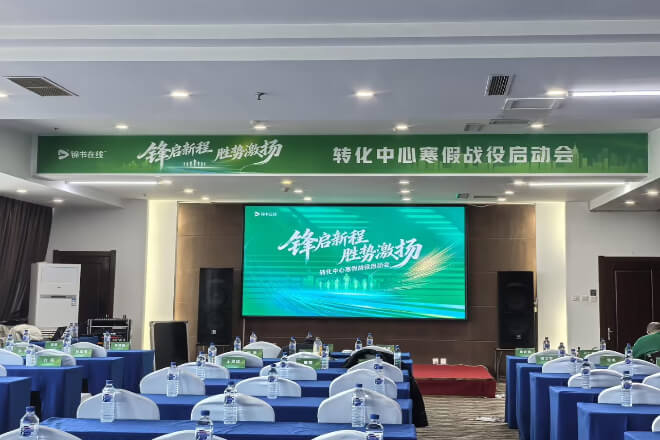
Besides the content itself, the atmosphere of an event also significantly impacts the audience’s experience.
Why do audiences continue to discuss the footage after some press conferences?
Why do some concerts and brand events always inspire people to take photos and share them? Often, the answer lies in the visual design behind the scenes.
LED displays offer more visual possibilities for events. Compared to traditional backdrops, they can play high-definition videos, dynamic images.
And creative visual content, transforming the stage backdrop from a fixed image into a “dynamic space” that changes continuously with the event’s flow.
For example, in corporate new product launches, LED screens can play brand videos at the beginning, showcase high-definition details.
When products are unveiled, and simultaneously present data and visual animations during presentations, making the entire launch process more rhythmic.
For the audience, the product is not just introduced, but leaves a deeper impression through visuals, lighting, and on-site effects.
In large-scale events, LEDディスプレイ can also be combined with lighting, music, and stage design to create a more immersive experience.
An ordinary ステージ can instantly switch between different scenes through dynamic background changes:
One moment it’s a futuristic space with a strong sense of technology, the next it might transform into a brand story scene full of atmosphere.
Some international brand events have already incorporated LED display systems as an important part of their stage design, rather than simply using them as a “backdrop.”
Through creative visuals, real-time interaction, and visual effects, LED screens help brands better express their concepts and make the on-site experience more memorable for the audience.
Of course, the value of LED displays is not about making the visuals as complex as possible, but about ensuring that the visual content better serves the theme of the event.
Good design should make the audience feel “impressed” and remember the message the brand wants to convey.
For press conferences, exhibitions, and large-scale events, LED displays are transforming from a mere display tool into a crucial element in creating on-site experiences.
They transform the stage from a space into a visual experience that can be viewed, felt, and shared.
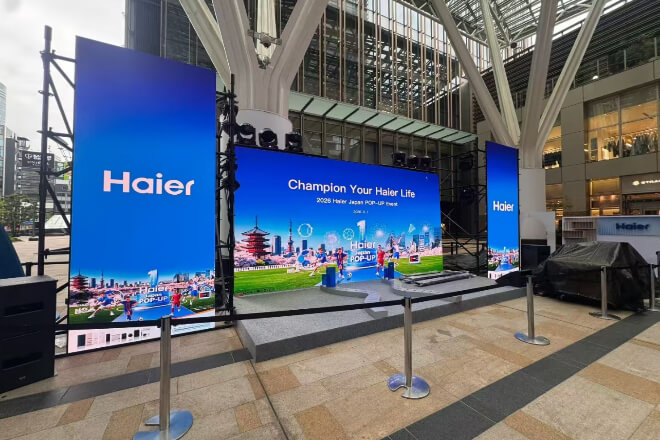
Anyone who has run an event knows that on-site plans rarely go exactly as initially planned.
Venue size changes, ステージ design is adjusted, and event flow may be supplemented with additional segments.
For event teams, a display solution that can quickly adapt to changes is often more important than simply pursuing a “large screen.”
One of the biggest advantages of LED displays is their flexibility. Composed of multiple modules, they can be freely assembled to suit the venue space.
Small meetings can feature simple backdrops, while large press conferences can be combined into giant stage visual walls.
Or even customized with curved or irregular shapes to better integrate the screen into the overall stage design.
This flexibility is particularly evident in exhibitions, brand roadshows, and corporate events. For example, a brand tour may require different venues in different cities.
Redesigning the display equipment each time would not only be time-consuming but also increase setup costs.
LEDディスプレイ can quickly adjust their size and layout according to on-site conditions, making them more suitable for mobile events.
Besides the change in appearance, content switching is also much easier. In an event, one second a brand promotional video might be playing.
The next a guest speaker’s presentation, and then a switch to interactive segments or live data.
If the display system isn’t responsive enough, the event’s rhythm can easily be disrupted.
For example, at a corporate product launch, the opening needs to create atmosphere, the middle needs to showcase product details, and the final segment needs to create a climax with interactive elements.
LED displays can quickly switch screens according to the flow, providing corresponding visual support for each segment.
For event organizers, the value of LED displays isn’t just “enlarging the image,” but more importantly, their ability to keep up with the event’s changes.
After all, today’s events increasingly emphasize the experience, and a flexible display system is essential for bringing creative ideas to life.
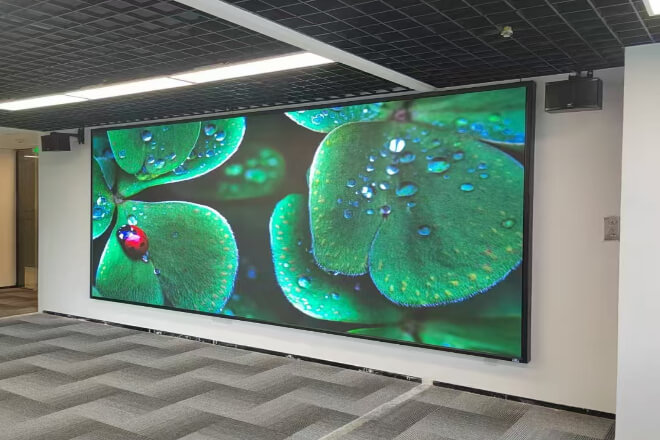
After a corporate event, the audience may not remember all the presentation content, but a compelling visual is often more likely to remain in their minds.
This is why more and more companies are using LED displays at product launches, exhibitions, and brand events.
Transforming the event into a true brand experience rather than just “someone speaking and content to watch.”
At the event, LEDディスプレイ can showcase company logos, brand stories, promotional videos, and product information, presenting brand content in a more intuitive way.
Compared to traditional backdrops or posters, dynamic visuals can change with the event’s flow, making the brand presentation more engaging and attracting more attention.
For example, at a new product launch, companies can use LED screens to show the product design process, application scenarios, or functional demonstrations.
Allowing the audience to quickly understand the product’s highlights without having to listen to lengthy introductions.
For complex technical products, a clear video presentation is often more persuasive than several pages of text.
Beyond content display, LED displays also influence the overall atmosphere of the event. A well-designed, high-definition screen can make the stage look more professional.
Allowing the company to project a stronger brand image to customers, partners, and the media.
Often, the visual impact of an event is one of the first impressions an audience forms of a company’s strength.
More importantly, a good visual presentation helps a brand become memorable. After the event, attendees may forget a particular introduction.
But a striking stage visual or a captivating brand video is more likely to become a memorable “iconic image.”
For businesses, LED displays are not merely backdrops for events; they are crucial tools for brand expression and reinforcing brand image.
They ensure that the message a company wants to convey is seen and easily remembered.


 English
  Español
  简体中文
简体中文  Français
  日本語
日本語  한국어
한국어  العربية