
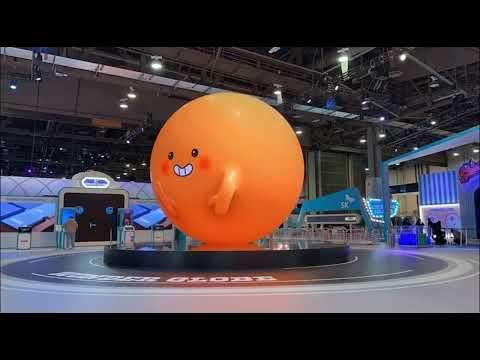
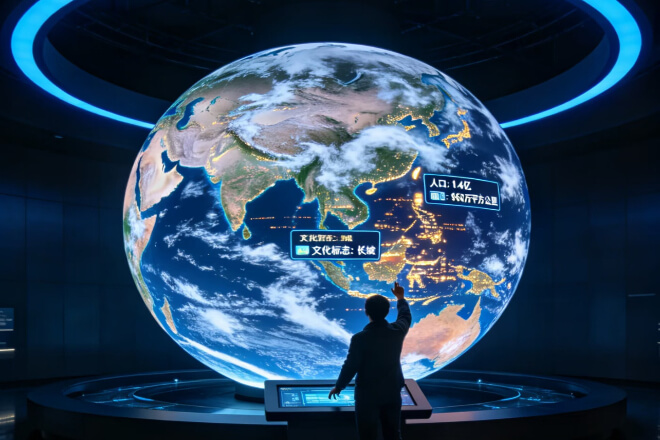
Previously, many visitors to science exhibition halls would look at models, read the descriptions, take a photo, and then move on.
However, for themes like the universe, Earth, and nature, it’s difficult to truly feel their impact through text and static exhibits alone.
The emergence of spherical and irregularly shaped LED screens has changed the way science is presented.
It’s not just about “displaying knowledge,” but about giving visitors the opportunity to “step into knowledge.”
Compared to traditional flat screens, a 360° surround display can cover more viewing angles, extending the image from your eyes to the entire space.
For example, in a planetarium, visitors might look up and see the Milky Way rotating and planets orbiting, as if they were traveling through space.
In a natural science museum, visitors can simulate entering the deep sea, watching whales swim by, or experiencing the feeling of traversing a rainforest.
This immersive experience is particularly suitable for children’s science education.
Instead of telling children “how big the Earth is” or “how volcanoes are formed,” letting them stand in an LED dome and witness firsthand the Earth’s rotation, volcanic eruptions, and climate change makes the learning process much more engaging.
ために 展示 operators, 360° LED screens also make content display more flexible.
The same space can be transformed into a space exploration 博物館 one day, an ocean world the next, or even quickly switch content according to different exhibition themes.
After all, a good science experience isn’t about how many words visitors memorize, but about leaving the exhibition hall and thinking, “That scene really felt like seeing another world with my own eyes.”
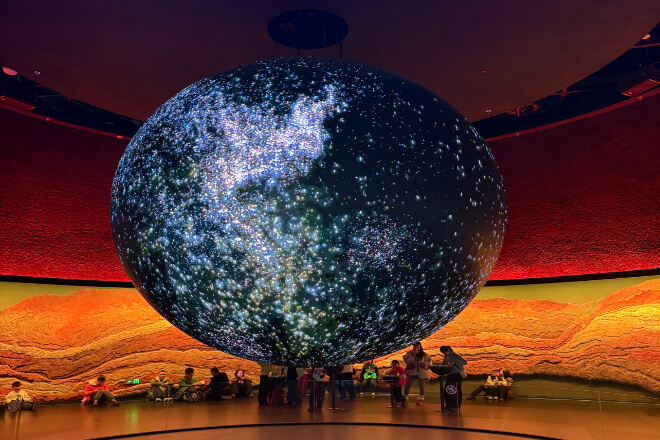
Many scientific facts aren’t “uninteresting,” but rather too difficult to imagine. For example, how planets move in the universe, how ecosystems change.
And how climate affects Earth are often difficult for visitors to truly understand through textual descriptions or static images.
The advantage of spherical or irregularly shaped LED screens lies in transforming these abstract concepts into dynamic scenes that can be directly viewed.
Through continuous visuals, animation effects, and data visualization, complex scientific principles become simpler and more understandable.
For instance, in an astronomy 博物館, an LED dome can simulate the movement of the solar system, allowing visitors to visually see the trajectories of planets orbiting the sun.
In Earth science exhibits, it can demonstrate crustal changes, ocean currents, and climate change processes, turning previously imaginary knowledge into real, tangible scenes.
This method of presentation is also more appealing for ecological science themes.
For example, when introducing rainforest ecosystems, visitors can see the connections between plant growth, animal activity.
And environmental changes, making it easier to understand natural laws than simply reading a description.
Furthermore, LED screens can transform vast amounts of data into visual content.
Complex information such as temperature changes, population growth, and interstellar distances, presented through dynamic models.
And images, allows viewers to quickly grasp the key points without needing to study extensive technical materials.
After all, the goal of science popularization isn’t to make visitors memorize a bunch of difficult data, but to give them that “ah, that’s how it is!” moment.
Spherical, irregularly shaped LED screens serve as a visual bridge, making complex science more intuitive and easier to understand.
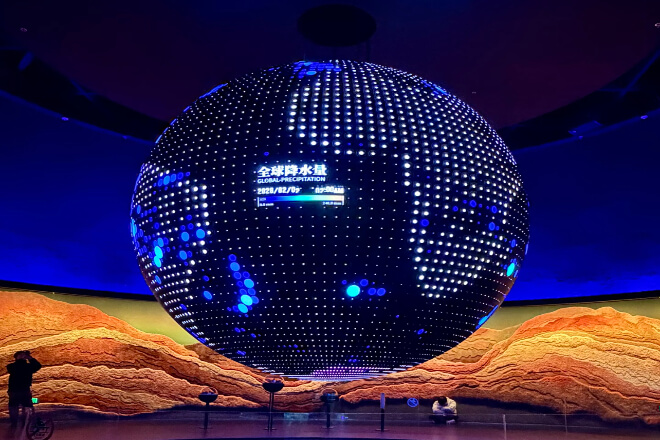
When entering an 展示 hall, what’s most likely to make visitors stop? It might not be a text description on the wall, but a giant spherical screen that “lights up, changes shape, and tells a story.”
The greatest charm of spherical, irregularly shaped LED screens is their inherent appeal.
Compared to traditional flat display equipment, they don’t have a fixed viewing direction.
Their unique spherical structure can become the visual center of the exhibition space, sparking visitors’ interest in exploration as soon as they enter the area.
For example, in a planetarium, a giant LED dome can instantly transform into a “mini universe.”
Allowing visitors to look up and see galaxies rotating and planets orbiting, as if observing the Milky Way from a space capsule;
In a nature exhibition hall, it can become a “digital earth,” showcasing different ecological scenes such as the ocean, forests, and polar regions.
Beyond displaying content, the spherical LED screen itself enhances the technological and futuristic feel of the exhibition hall.
For science 博物館, themed exhibition halls, and urban planning museums, a unique digital display area not only enriches the spatial layers but also becomes a popular spot for visitors to take photos and check in.
For example, many visitors to an exhibition hall always look for a place “worth taking a photo and sharing.”
A futuristic spherical LED display area might become the background for their social media photos, allowing the exhibition hall to gain more natural publicity.
Therefore, the spherical, irregularly shaped LED screen is not just a display device but also a “visual protagonist” in the exhibition hall.
It gives the space a memorable point and transforms visitors from simply passing by to actively approaching, exploring, and sharing.
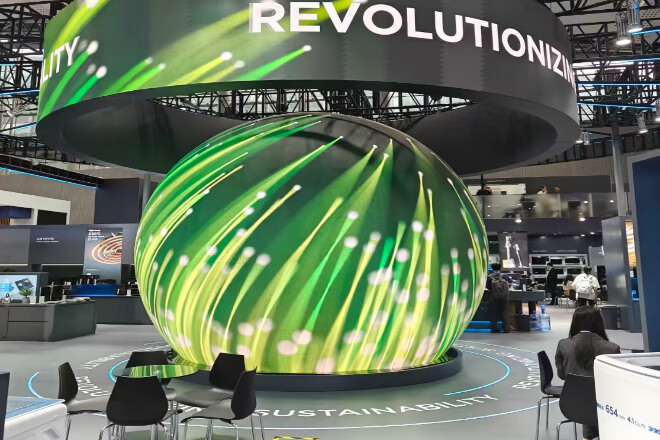
Previously, many visitors to science museums might have followed a similar process: look at the exhibits → read the descriptions → take a photo → move on.
But now, more and more 展示 halls want visitors to “play” rather than just “look.”
The advantage of the spherical, irregularly shaped LED screen lies in its ability to make the displayed content more flexible and engaging.
The same screen doesn’t need to display a fixed theme; it can quickly switch between different scenes according to the exhibition’s needs.
For example, in the morning, it can take children on a “space trip,” exploring the mysteries of the solar system and planets.
In the afternoon, it can transform into an “ocean world,” showcasing deep-sea creatures and coral ecology, making visitors feel as if they’ve traveled directly from space to the ocean floor.
Combining interactive technology can further enhance the experience. Visitors can participate in the content’s changes through touch and motion-sensing interactions.
For example, visitors can wave their arms to control the movement of planets or observe how their actions affect a virtual ecosystem.
Compared to simply watching animation, this participatory process is more memorable.
This method of presentation is particularly attractive to children and students. An abstract scientific concept can become much easier to understand through an immersive experience.
For example, when learning about Earth’s climate change, visitors no longer just look at data, but witness firsthand the processes of glacial and sea-level changes.
For exhibition halls, interactive experiences also increase visitor dwell time.
After all, an exhibition area that makes children want to “play for another five minutes” is often more valuable than an exhibit that is quickly viewed and then left.
Spherical and irregularly shaped LED screens transform science exhibits from simply “telling visitors the answers” to inviting them to explore the answers themselves.
Making the learning process more engaging and memorable.
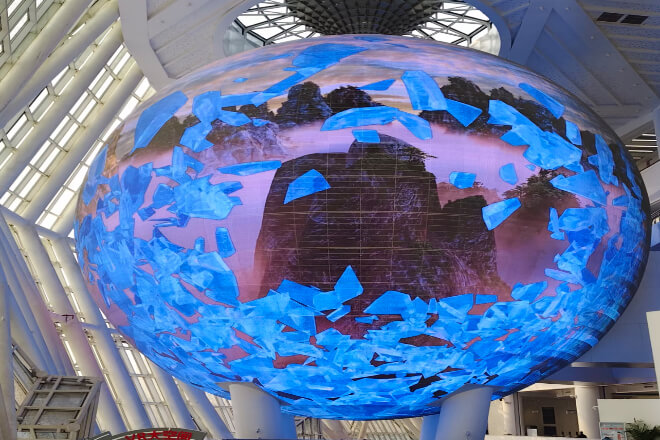
What’s the biggest fear for a science 博物館‘s exhibit? It’s not that it’s not attractive enough at the beginning, but that years later visitors still see “the same content.”
Loss of novelty diminishes the exhibit’s value.
One advantage of spherical and irregularly shaped LED screens is their ability to continuously update museum content.
The same screen can adapt to different themes and activities without frequent hardware replacements.
For example, a planetarium’s spherical LED screen can showcase “Exploring the Solar System” one day, and switch to “The Mysteries of Black Holes,” “Interstellar Travel,” or “Future Space Base” the next.
As new science themes are introduced, the content can be constantly refreshed.
This flexibility is even more important for comprehensive science museums. Different themes can be presented during different seasons and events.
For example, offering fun science experiences for children during the summer holidays and creating unique light and shadow 展示会 during festivals allows for more diverse operational methods for the same exhibition area.
Meanwhile, the ability to continuously update content extends the equipment’s inherent value.
A high-quality spherical LED screen is not just a one-time display device, but can become a core display platform for the long-term operation of an exhibition hall.
Furthermore, unique spherical LED display spaces can help exhibition halls build their own distinctive IP.
For example, creating a dedicated “digital universe space” or “future exploration center” can create unique memories for visitors, encouraging them to return and share.
After all, excellent science exhibition halls should not only attract visitors on their first visit, but also have the ability to make them want to return.
Spherical irregularly shaped LED screens offer more than just stunning visual effects; they provide a continuously growing display value.


 English
  Español
  简体中文
简体中文  Français
  日本語
日本語  한국어
한국어  العربية