
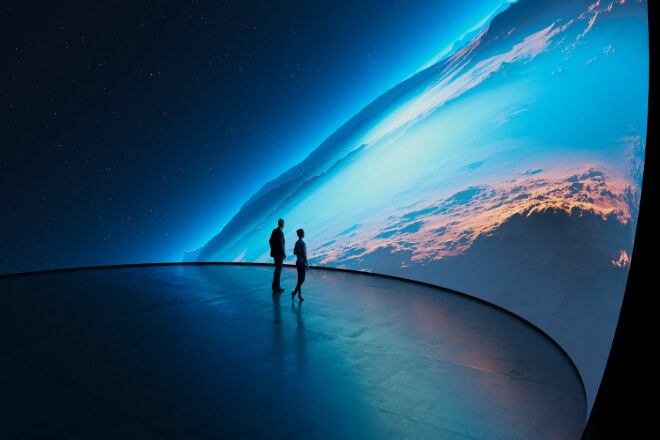
Traditional exhibition spaces typically use display boards, television screens, or large single-sided displays to convey information.
Visitors can see the content, but they may not be willing to stay for long.
Especially in 展示 halls, brand experience centers, and cultural tourism projects, if the display format lacks variation, even the richest information can become somewhat dull.
360-degree immersive exhibition spaces change this experience.
Through multi-faceted displays, surround visuals, and spatial content design, they allow visitors to experience visual information from different directions.
For example, in a car brand experience center, after visitors enter the exhibition area.
The surrounding LED screens can simultaneously display scenes of vehicles driving through mountains, cities, or coastlines.
Even when the vehicle is stationary in the center of the exhibition hall, visitors can have a visual experience as if they are participating in a driving journey.
For businesses, the value of this display method goes beyond just more visually impactful effects; it also includes:
Enhancing spatial appeal: Making exhibition halls, stores, and experience centers more visually memorable.
Extending visitor dwell time: Stimulating interest in exploration through dynamic content and interactive experiences.
Strengthening brand expression: Integrating the brand story into a complete spatial scenario, rather than simply playing promotional videos.
Creating business opportunities: Providing more possibilities for product experiences, brand collaborations, event displays, and commercial promotion.
When the exhibition space transforms from a mere information delivery location into an experiential destination, the commercial value of LED displays expands accordingly.
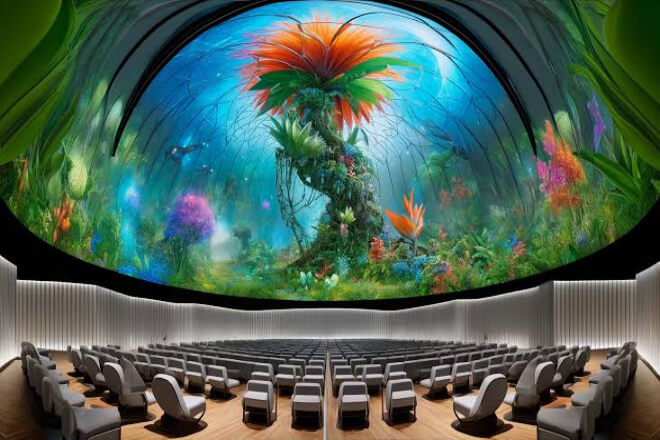
Creating a 360-degree immersive 展示 space is not simply about installing a few LED displays on four walls.
The real key is whether the screens can form a continuous and harmonious visual environment.
Based on the spatial structure and project budget, businesses can consider the following layout options:
1). Four-sided surround layout:
Install LED displays around the perimeter of the space, allowing visitors to view the images from different directions.
This approach is suitable for brand experience centers, digital showrooms, and themed exhibition spaces.
2). Curved surround layout:
Curved LED screens reduce the visual discontinuity caused by right-angled boundaries, allowing the images to unfold more naturally around the viewer.
For projects requiring continuous scenes, curved structures offer good design flexibility.
3). Top and wall integration layout:
Extend the LED display to the ceiling, creating a visual enclosure with the surrounding screens.
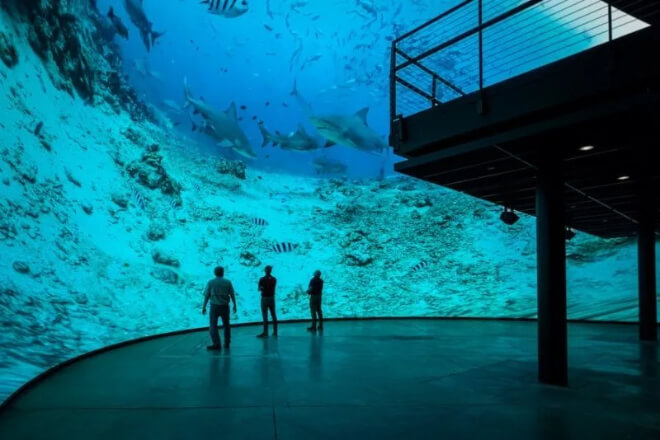
For example, in an ocean-themed exhibition hall, the ceiling displays swimming fish, while the walls showcase coral and underwater landscapes, immersing visitors in an underwater world.
4). Interactive floor and wall layout:
In some projects, LEDフロアスクリーン can be combined with wall displays.
For instance, in digital art 展示会, the floor displays light and shadow that change with footsteps, while the walls simultaneously display dynamic art content, making the space more engaging.
It’s important to note that screen layout should be planned in conjunction with space area, ceiling height, audience movement, and viewing distance.
More screens don’t necessarily mean a stronger sense of immersion.
Only by ensuring the display area complements the spatial structure can the image avoid appearing fragmented, or even causing visual fatigue.
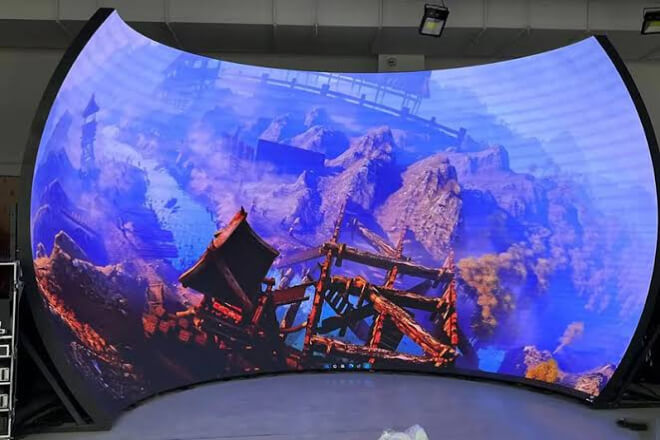
Screen layout determines how much of the image the audience can see, while display technology affects the smoothness and naturalness of that image.
When planning a 360-degree immersive display space, the following aspects deserve special attention:
Audiences may be in close proximity to the screen, so an appropriate pixel pitch needs to be selected based on the actual viewing distance.
For projects viewed at close range, 狭ピッチLEDディスプレイ typically require careful evaluation to avoid image graininess affecting the visual experience.
- 輝度 色彩性能:
The display brightness in different areas needs to be reasonably coordinated. If the walls are bright but the ceiling is noticeably dark, the overall image will easily lose its unity.
At the same time, color reproduction and white balance consistency are also crucial, especially when multiple screens are displaying the same scene.
- リフレッシュレート and dynamic display effects:
Immersive spaces often display fast-moving scenes, such as flight, racing, natural landscapes, and dynamic art content.
The display system needs a refresh rate and processing power that match the content playback requirements to ensure smooth dynamic visuals.
If the project involves camera shooting, additional shooting tests are required.
- Irregular and フレキシブルLEDディスプレイ solutions:
If a project wants to break through the limitations of traditional rectangular screens, curved, cylindrical.
Or other customized LED display solutions can be considered based on the building structure, allowing the screen to blend more naturally into the space.
For business decision-makers, choosing an LED display should not be based on just one parameter.
But should consider pixel pitch, brightness, color, refresh rate, and overall system performance in a combined evaluation.
This is an issue that many immersive display projects easily overlook.
Even with a large number of LED displays, if the content played is just ordinary promotional videos, viewers may still feel like they are in a room with many screens.
A truly engaging 360-degree immersive display space needs to connect the content with the space.
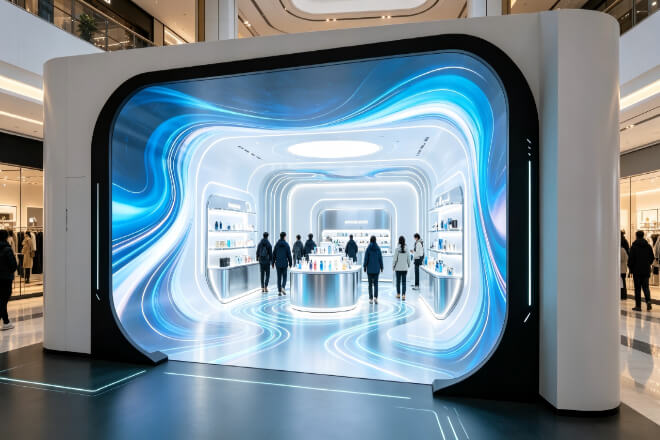
A successful 360-degree immersive display project requires both creativity and a reliable technical solution.
Insufficient planning in the early stages can lead to problems such as inconsistent visuals, difficulties in equipment maintenance, or budget overruns.
Before purchasing, businesses should focus on evaluating the following aspects:
- Define project positioning:
Is it for brand display, digital art, cultural tourism experiences, or product launches? Different objectives determine the spatial layout and display solution.
- Measure space in advance:
Confirm wall dimensions, ceiling height, load-bearing structure, installation conditions, and audience movement to avoid screen design mismatches with the actual building.
- Plan the overall display system:
Multi-faceted LED screens require consideration of control systems, signal distribution, image synchronization.
And content playback capabilities to ensure coordinated operation across different display areas.
- Prioritize installation and maintenance:
Wrap-around, top-mounted, or irregularly shaped LED screens may increase installation and maintenance difficulty;
Maintenance access and equipment access space should be reserved in advance.
- Calculate long-term operating costs:
In addition to the screen purchase cost, expenses such as content production, equipment power consumption, heat dissipation, maintenance, and future upgrades should also be considered.
- Choose suppliers with project experience:
Prioritize suppliers who possess capabilities in spatial design, system integration, installation, commissioning, and after-sales service, rather than simply providing display equipment.
It’s particularly important to note that 360-degree immersive display spaces often involve multiple aspects, including LED displays, content production, architectural design, and control systems.
Companies should ideally involve relevant teams in communication from the early stages of the project, rather than considering content presentation only after screen installation.


 English
 Español
 简体中文
 Français
 日本語
 한국어
 العربية