

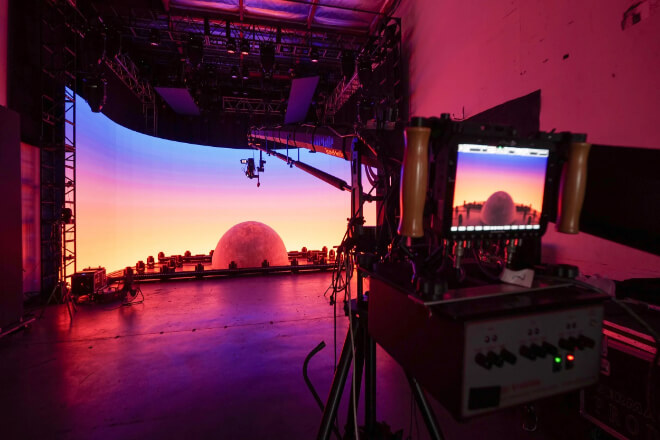
The LED screen in virtual production is not just an ordinary “background wall.”
It needs to be seen not only by people on set but also directly appear in the shots of movies, commercials, and live broadcasts.
Therefore, if there are color differences, flickering, or insufficient detail in the image, the camera won’t turn a blind eye.
Compared to traditional green screens, the biggest advantage of LED virtual production is that it allows virtual scenes to directly appear on set.
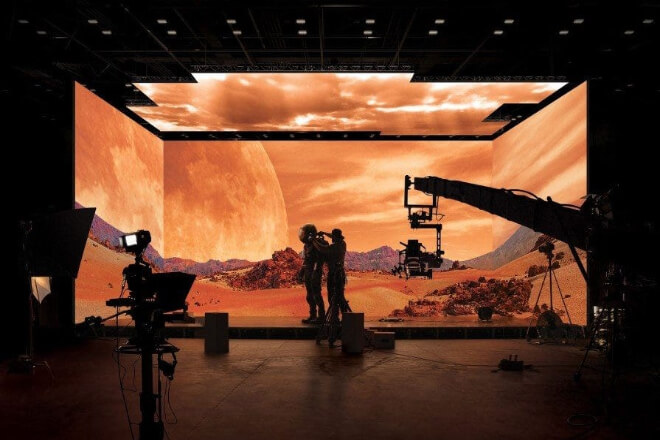
For example, when filming a space scene, actors don’t need to act out their imagination against a green screen;
の LEDスクリーン behind them can directly display the interior of the spaceship, the starry sky, or even a cosmic city.
Actors can see it, the director can see it, and the cinematographer can immediately see the visual effects.
This also makes filming more flexible. Need to switch from a “space capsule” to a “future city”?
No need to dismantle sets or rebuild them; simply change the content on the LED screen, and the scene changes accordingly
Directors can also adjust composition, lighting, and virtual backgrounds on-site, reducing the hassle of repeated post-production modifications.
Of course, this also means the LED screen must withstand the “magnifying inspection” of the camera.
高い refresh rates, low scan issues, excellent color reproduction, and stable image quality are all crucial;
Otherwise, what looks beautiful to the naked eye might immediately reveal its flaws on camera.
Therefore, choosing an LED screen for virtual production isn’t just about achieving “high definition.”
But about ensuring actors are comfortable viewing, cameras capture natural shots, and directors can easily make changes.
After all, at this point, the LED screen is no longer a supporting character, but an “actor” directly in the frame.
Choosing an LED screen for virtual production shouldn’t be based solely on whether it “looks clear to the naked eye.”
What an ordinary viewer sees on a screen is one thing; what a cameraman is doing, pressing their lens against the screen to examine details, is quite another.
Some issues that are not obvious in real life can become immediately apparent on camera.
First is ピクセルピッチ. Virtual production often requires close-up shooting. Excessive pixel pitch can result in graininess when viewed up close, making background details appear unnatural.
For example, if an actor is standing in front of a virtual city street, and distant buildings look like enlarged pixelated images, the immersive experience is significantly diminished.
リフレッシュレート is equally important. Insufficient refresh rate can cause scan lines and flickering when filming LED screens.
It’s undesirable to have strange horizontal lines appearing in the exported footage, even if they weren’t visible on set.
Next is grayscale performance. Films and commercials often shoot night scenes, dark rooms, or scenes with gradual changes in light.
Insufficient grayscale can easily turn dark areas completely black, while high grayscale preserves more shadows and details, making the transition between characters and background more natural.
Finally, there’s color reproduction. Virtual backgrounds need to blend seamlessly with characters and lighting.
If the LED screen’s colors are significantly off, it can create the impression that “the people are real, but the background looks fake.”
For example, a sunset scene should ideally have a soft orange-red hue. If the screen’s colors are oversaturated, the image will immediately appear unnatural.
Therefore, the parameters of a virtual LED screen aren’t simply a matter of who has the highest numbers;
They must withstand close-up viewing and repeated scrutiny from the camera. Visual appeal is only the first hurdle; the real judge is the camera.
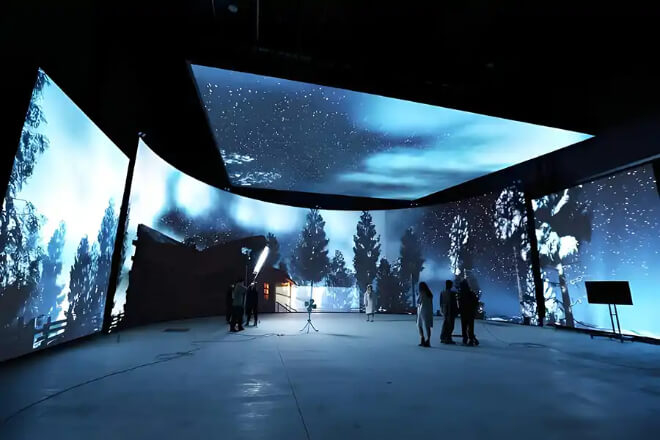
In a virtual production environment, the LEDスクリーン is more than just a “backdrop” for the actors. “
How the camera shoots, how the actors perform, and whether the final image looks realistic—it can all subtly influence the quality.”
If the screen’s performance is unstable, even the best camera can’t completely salvage the situation.
First, pay attention to moiré patterns, flicker, and scan lines. These might not be noticeable to the naked eye on set, but the camera is a “detail detective.”
Small problems that are missed by the naked eye can be magnified on camera.
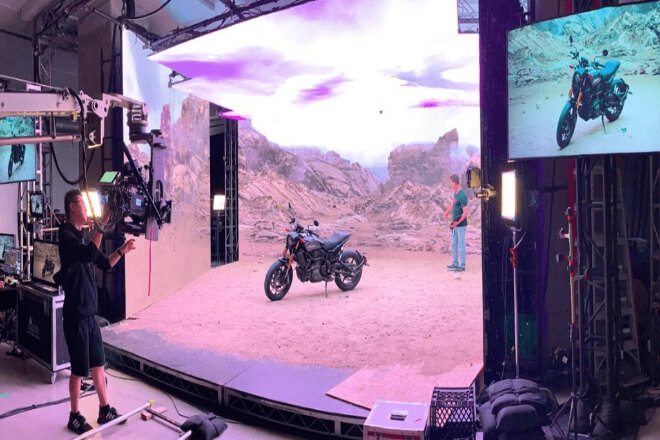
For example, when shooting a car advertisement, if both the car body and the LED background screen show obvious textures, the originally high-quality image instantly looks like an “electronic screen.”
Another advantage of LED screens is that they can directly provide more natural ambient light and light reflections.
For example, when filming a sports car driving through a neon-lit street, the lights on the screen can directly reflect onto the car body, glass.
And even the actors’ faces, making the lighting of the characters and the virtual background more unified.
Compared to adding lighting bit by bit in post-production, this on-set effect is usually more natural.
At the same time, actors no longer have to constantly “imagine the scene” in front of a green screen.
For example, when shooting science fiction movies, LED screens can directly display scenes such as futuristic cities and spaceships.
Allowing actors to see their environment, and cinematographers to adjust composition and lighting on-set.
Ultimately, the more harmonious the background, characters, reflections, and lighting, the more realistic the sense of space the image will have.
Viewers see a complete scene, not “actors standing in front of a screen filming.”
Therefore, the real power of a good virtual production LED screen is not simply “good-looking.”
But rather minimizing flaws detected by the camera and making it less obvious to the audience that it’s fake.
Although virtual production uses LED screens, different shooting scenarios have different “temperaments.”
Film, advertising, live streaming, and corporate studios cannot use the same set of solutions directly; otherwise, it’s easy to end up with a “luxurious setup that’s actually unusable.”
Film production prioritizes image quality and stability. Film shooting often requires close-ups, complex lighting.
And extended multi-camera shooting, so ピクセルピッチ、 リフレッシュレート, grayscale, and color consistency are crucial.
For example, when shooting close-ups of faces, graininess or flickering in the background can easily magnify small problems in the shot.
Advertising shooting prioritizes color reproduction and content transitions. Today it might be a car commercial, tomorrow a beverage commercial.
And the day after a tech product commercial; the LED screen should ideally be able to quickly switch between different visual scenes.
For example, within the same studio, changing the virtual background can instantly switch from a “futuristic city” to a “beach vacation,” reducing the hassle of repeatedly building sets.
Live streaming studios are more concerned with long-term operation. Live streams may run for hours or even longer, requiring the screen to remain stable and not suddenly “break” midway through.
Simultaneously, heat dissipation, energy consumption, and daily maintenance must be considered.
After all, the worst thing for a live broadcast isn’t an awkward silence, but a sudden blackout.
As for corporate studios, flexibility is more important. They can be used for product launches and online meetings, and can be switched to different scenarios for training or corporate promotion.
If post-production maintenance is simple and content updates are convenient, a single LEDスクリーン system can handle more tasks.
Therefore, when choosing a virtual production LED screen, don’t just ask “which one has the highest parameters.”
But rather, “What will this screen be used to film daily, how will it be filmed, and for how long?”
Choosing the right scenario is crucial for an LED screen to truly become a helpful tool in the studio, rather than an expensive “background decoration.”
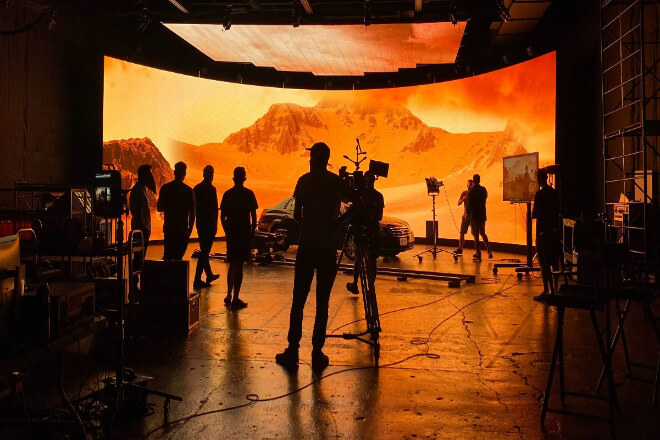
When choosing a virtual production LED screen, don’t just focus on parameters like pixel pitch and refresh rate.
After all, the screen isn’t just bought to “look good,” but to work daily with cameras, lighting, and content systems.
A truly effective solution should consider everything from the shooting space to post-production maintenance.
First, check if the screen size matches the shooting space. The size of the studio, the camera’s recline range, and the actors’ activity area all affect the screen size.
If the screen is too small, it’s easy to capture the edges when the camera zooms out; if it’s too large, it might waste space and budget.
For example, shooting a car commercial requires a larger background coverage area; if the main focus is on interviews, there’s no need to “enclose” the entire studio with LEDスクリーン.
Secondly, front-maintenance design is crucial. Virtual production sets use equipment frequently.
So it’s best to be able to quickly inspect and replace modules or power supplies if problems arise. This avoids having to rework the entire set just to fix one screen.
The control system is also critical. LED screens need to work with real-time rendering, virtual scenes.
And camera tracking systems, so the control system must support stable signal processing and content switching.
Otherwise, if the background has changed while the screen is still “loading,” it will be somewhat jarring.
Finally, don’t overlook the supplier’s experience and technical support. Virtual production is not simply an LED screen installation project;
It also involves the screen, control system, cameras, content, and on-site debugging.
A supplier’s experience with similar projects and their ability to handle on-site issues are often more important than the number of “9”s on the specifications sheet.
Therefore, when choosing a virtual LED screen, remember four key words: “space matching, easy maintenance, system stability, and a reliable supplier.”
If the screen brings peace of mind to the entire team after being installed in the studio, then you’ve made the right choice.


 English
  Español
  简体中文
简体中文  Français
  日本語
日本語  한국어
한국어  العربية