

For businesses, purchasing an Affichage LED is just the beginning. The real test of equipment’s value often lies in its repair efficiency when malfunctions occur after several years of use.
Especially for écrans LED à petit pas, a problem with a single LED can affect the entire display’s visual effect.
With the development of MIP packaging technology, new possibilities have emerged for LED display repair.
So, does MIP technology truly make repair simpler?
To understand the impact of MIP technology on repair, we first need to understand its packaging structure.
MIP is a micro-LED packaging technology. Simply put, it first packages micro-LED chips into independent micro-devices, and then mounts them onto the display module’s circuit board using surface-mount technology.
Compared to traditional packaging methods, a key feature of MIP technology is that the LED light-emitting unit exists as a relatively independent packaged device, rather than directly integrating the bare chip onto the circuit board.
This structure offers a significant advantage: when a packaged component fails, technicians can replace the faulty component.
Provided the product structure and repair conditions allow, instead of replacing the entire display module.
For businesses, this means more precise repairs. Previously, replacing a wide range of components might have been necessary; now, the repair scope can be narrowed down to a specific packaged unit.
However, MIP (Made in-Package) is not a technology that can automatically solve all repair problems.
The actual repair difficulty depends on the package size, circuit board design, surface protection structure, and the expertise of the repair personnel.
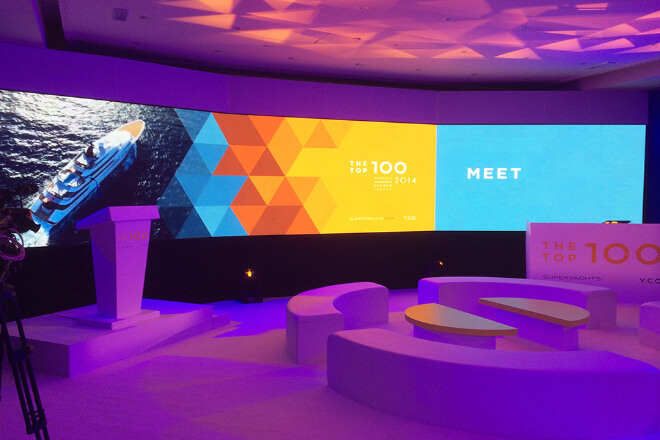
Imagine a grand écran LED showing important presentation content in a conference center, where one pixel malfunctions.
If troubleshooting requires replacing the entire module, it not only increases spare parts consumption but may also affect the normal operation of the entire display area.
MIP technology provides an alternative repair approach for this situation.
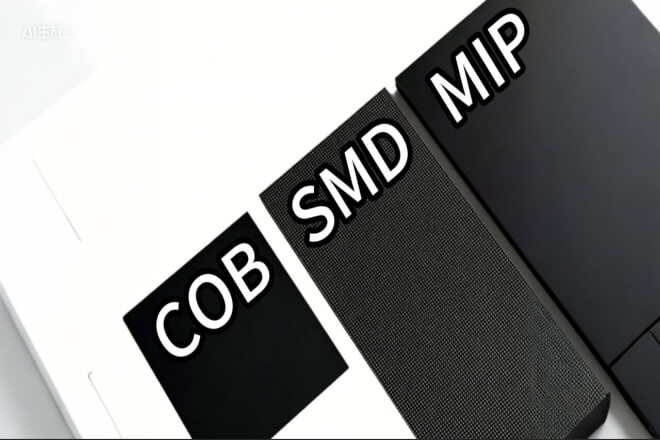
Different LED packaging technologies have different structures, and their repair methods will naturally differ as well.
- SMD technology: Mature repair methods
SMD uses individually packaged LED beads, mounted on the circuit board via surface mounting. When a single LED chip fails, it can usually be replaced locally.
This repair method is relatively mature, and technicians have easier access to the necessary tools and experience.
- COB technology: Emphasizes overall package protection
COB technology mounts the LED chip directly onto the circuit board and then uses a packaging process to form an overall protective structure.
This design improves the overall protection of the display surface, but if a local chip fails, repair may involve more complex rework operations, sometimes requiring the replacement of the entire module.
- MIP technology: Balances miniature packaging and partial replacement possibilities
MIP first packages the microchip into an independent device and then mounts it onto the circuit board.
Therefore, under the condition that the product design requirements are met, repair personnel can replace individual packaged devices.
In short:
CMS : Single LED chip replacement is relatively mature.
ÉPI: Overall package protection is better, but partial repair may be more complex.
MIP: The independent packaging structure provides the possibility of repairing individual devices.
However, it cannot be simply assumed that MIP is always easier to repair than SMD.
MIP packages are smaller, requiring more sophisticated rework equipment, operational precision, and experienced technicians.
True ease of repair needs to be assessed on a product-by-product basis.

This is a crucial question for businesses when purchasing MIP displays.
Theoretically, if a localized fault in an MIP display can be resolved by replacing a single packaged component.
It could reduce the number of modules that need replacing and lower spare parts consumption.
However, actual maintenance costs are not solely determined by the price of replacement parts.
First, the costs of repair equipment and labor cannot be ignored.
MIP packaged components are small, and repairs typically require specialized desoldering, positioning, and testing equipment.
Operators also need corresponding precision repair skills. If a company does not have its own repair team, it may need to rely on suppliers for after-sales service.
Second, post-repair display consistency needs to be rechecked.
After replacing the packaged component, it is also necessary to check whether the luminosité, color, and display effect are consistent with surrounding pixels.
Especially in close-view scenarios such as conference rooms, studios, and control centers, localized color differences can be very noticeable.
Third, spare parts availability affects long-term maintenance efficiency.
If a company purchases MIP displays using specially packaged components, and the supplier cannot reliably provide spare parts of the same specifications.
Even if the product itself supports partial repairs, downtime may be prolonged due to a lack of parts.
Therefore, companies should not only focus on whether the MIP supports single-component replacement.
But also comprehensively consider repair labor, spare parts prices, equipment investment, and after-sales response speed.

For commercial display projects requiring long-term operation, repair capabilities should be included in the evaluation during the procurement phase, not just after equipment failure.
First, understand which repair methods the product supports.
Confirm with the supplier whether partial replacement is possible when a single packaged component fails, or whether the entire module must be replaced.
It’s best to request a practical repair demonstration, rather than just a technical presentation.
Second, confirm the repair tools and technical requirements.
Understand whether repairs require specialized equipment, special processes, and trained technicians.
If the project deployment is large-scale, assess whether it’s necessary to establish internal repair capabilities.
Third, focus on spare parts supply and after-sales support.
Confirm the supplier’s ability to provide MIP-packaged devices, display modules, and related accessories of the same specifications long-term.
And understand the spare parts delivery cycle, warranty coverage, and repair response time.
Fourth, evaluate the display effect after repair.
Repair completion does not mean the problem is completely solved.
Companies should also require the supplier to check the luminosité, color consistency.
And grayscale performance of the replaced area to avoid new display discrepancies.
Fifth, calculate the total lifecycle maintenance cost of the equipment.
Incorporate daily inspections, fault repairs, spare parts inventory, labor costs, and downtime losses into the assessment.
For large display projects, even a slight improvement in repair efficiency can generate real value in long-term operation.
MIP technology provides more flexible repair possibilities for LED displays, but the true determinant of the maintenance experience remains product design, repair system, and supplier service capabilities.


 English
 Español
 简体中文
 Français
 日本語
 한국어
 العربية