

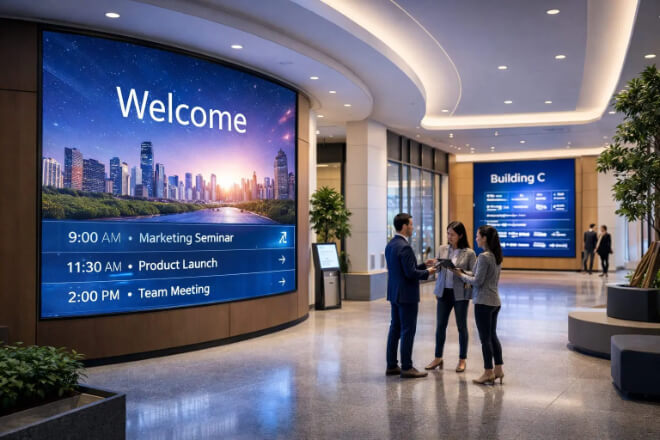
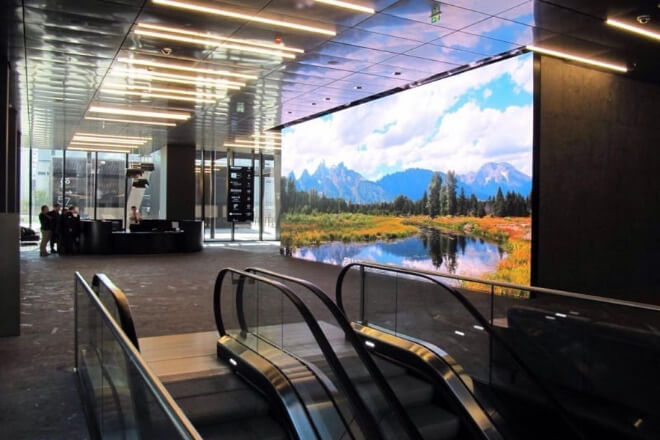
这 LED显示屏 in a company lobby often acts as the “first sentence”—the impression is formed before the customer even speaks. A well-done display is a plus; a powerful one directly builds trust.
Firstly, it showcases the company image and brand story in the lobby.
Traditional display boards are often “static brochures,” while LED screens can bring the company to life with videos, animations, and case studies.
For example, as a customer enters the lobby, the screen plays a video of the company’s development history, from a small office to a large project site.
This “dynamic storytelling” is more memorable and builds trust than simple text.
Secondly, it enhances the space’s technological and professional feel. High-definition large screens inherently possess a “modern filter.”
For example, a concise brand visual animation can be played in the meeting reception area.
Or, product application scenario videos can instantly transform the entire space from an “ordinary office building” into a “professional showroom,” allowing clients to experience the company’s strength even before formal negotiations begin.
Next is quickly attracting client attention. The lobby is the area where clients spend the least amount of time, but it is the most crucial.
LED screens, through dynamic images, rhythmic changes, and visual impact, can easily grab attention within seconds.
For example, a client might be looking down while waiting, but if the screen suddenly switches to a stunning project case, they will naturally look up, creating a crucial first impression.
Finally, it enhances the anticipation of the visit. If clients see core business, success stories, or partner information on the screens before entering the company, they are more likely to anticipate something interesting to see.
For example, a loop of footage of major project implementations on screens in the visitor corridor makes the entire visit feel like a pre-planned story.
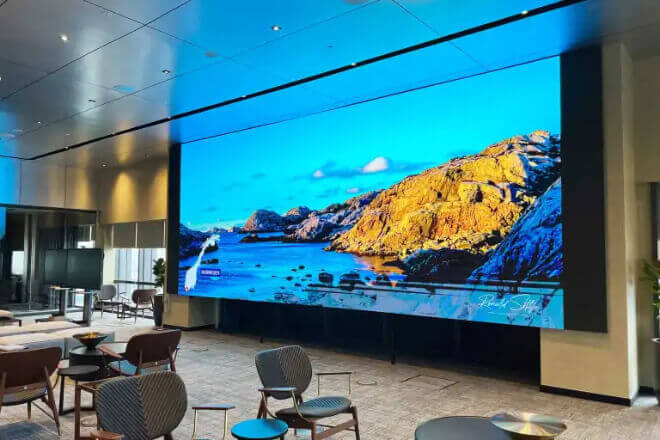
The biggest fear for a company introduction is that “the content is important, but no one reads it.”
The role of LED displays is to transform this “instruction manual-style presentation” into a more story-like and visually engaging way of displaying information.
Firstly, they replace traditional text and image explanations with video. Compared to flipping through PowerPoint slides or looking at brochures, videos bring company content to life.
For example, instead of stating “the company was founded in a certain year, and its business covers multiple fields,” a short video showcasing factory operations, project sites.
And client collaborations allows viewers to understand the company’s operations in seconds.
Secondly, they showcase development history and core strengths. LED screens can create dynamic visual stories.
Such as from the early stages of the business to expansion and the implementation of key projects, unfolding gradually through visuals.
For example, the screen can transition from a small office to a large project site; this “visualized growth trajectory” is more impactful and memorable than simple numbers and years.
Furthermore, they make complex information easier to understand. Much company information is highly technical.
Such as technical processes, product structures, or service systems, which can easily become abstract when explained in words.
LED screens can use animation to break down complex processes, such as breaking down a system workflow into dynamic visuals of “input—processing—output,” making it easy for viewers to understand without repeated explanations.
Finally, it improves information delivery efficiency. LED screens can quickly display key information, such as core business, competitive advantages, and success stories.
Allowing customers to gain an initial understanding within minutes, rather than spending tens of minutes reading materials.
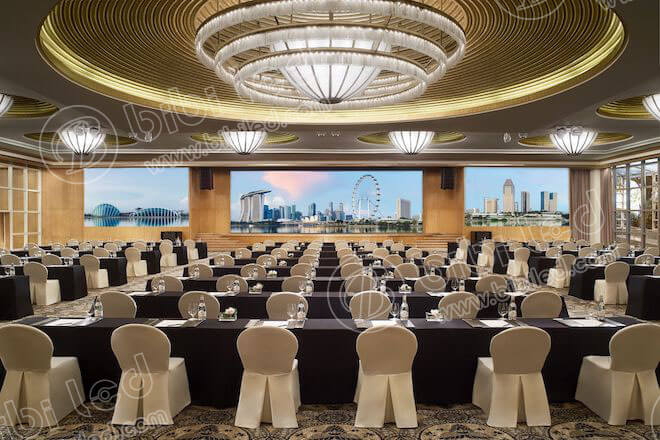
In a corporate showroom, an LED显示屏 acts like an “interactive guide”—not just a one-way presentation of content.
But a continuous engagement that draws visitors into the experience, transforming “viewing” into “participating.”
Firstly, it showcases dynamic case studies and project results. Compared to static display boards, LED screens can use videos and animations to “recreate” projects.
For example, when showcasing a city landmark project, the screen can gradually transition from design drawings to the construction process.
And finally to the final nighttime effect. Visitors don’t need much explanation to intuitively see “how this project was built.”
Secondly, it supports interactive content playback. Many showrooms utilize touch, sensors, or time-based content switching to make screens not just “play” but also “respond.”
For example, as a customer approaches a certain area, the screen automatically switches to the corresponding industry case studies.
This “content changes as you approach” experience makes the visit more engaging.
Next, it enhances customer engagement. Interactive content allows visitors to not only watch but also to choose.
For instance, when comparing solutions, customers can switch between different versions to visually see the differences.
This engagement leads to deeper information absorption, rather than passive reception.
Finally, it makes the visit more interesting. Showrooms are no longer just about “walking around and listening to explanations.”
But rather a rhythmic experiential route: sometimes video case studies, sometimes interactive transitions, sometimes immersive visual displays.
For example, when walking through a company’s technology exhibition area, the large screen suddenly transforms into product application animations, making the visit feel more like “exploration” than “reading.”
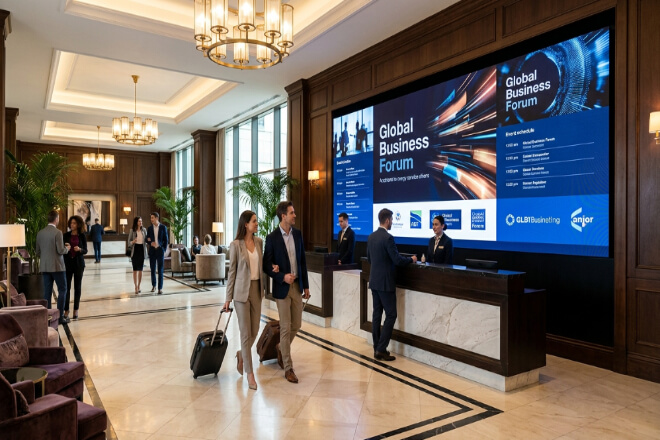
In showrooms and corporate reception settings, one of the greatest values of LED displays is transforming products that require lengthy explanations into visually understandable displays.
First, they showcase product functions and application scenarios. Compared to simply stating parameters, LED screens can directly place the product in a real-world usage environment.
For example, with smart devices, instead of simply stating “30% efficiency improvement,” they can directly demonstrate their actual operation in a factory, 购物中心, or office using animation.
This makes it easier for customers to understand “what it can actually do.”
Second, they can display real-world project case studies. Real-world examples are often more persuasive than descriptions.
LED screens can loop through project implementation processes, from design to on-site implementation and final results.
For example, seeing a large project successfully implemented in different cities allows customers to more intuitively judge “whether this solution is reliable.”
Furthermore, they enhance the expression of product value. Many product values are abstract, such as “cost reduction and efficiency improvement” or “enhanced experience.”
But through the visual presentation of LED screens, they can become more concrete.
For example, using before-and-after comparisons to show the differences allows customers to see the changes at a glance, rather than remaining at the level of conceptual understanding.
Finally, it improves communication efficiency.
Once core information is clearly displayed on the screen, sales or presenters don’t need to start explaining from scratch; instead, they can supplement the existing visuals.
For example, after watching a case study video, a customer can directly ask, “Is this solution suitable for our industry?” Communication becomes more precise and efficient.
In corporate reception or showroom settings, LED displays act like a “visual trust accelerator”—customers form an initial judgment through visuals even before in-depth communication.
First, they showcase successful cases and partners. Compared to verbal introductions, real project visuals are more persuasive.
For example, a scrolling display of collaborative projects between the company and well-known clients, showcasing everything from design to implementation.
Allows customers to intuitively understand that “this company has indeed completed many large projects.”
Second, it presents the company’s strengths and accolades. For example, industry certifications, awards, certificates.
And major engineering achievements, displayed dynamically, are more impactful than a row of certificates on a wall.
For example, displaying a company’s significant awards in a timeline format makes its “strength” more logical and layered, rather than a scattered collection.
Next, it enhances brand credibility. LED screens make information more “verifiable” through real videos, project site footage, and customer feedback.
For instance, showing actual construction site footage, system operation screenshots, or customer feedback builds trust more easily than simple promotional slogans.
When customers see something “that actually happened,” they are naturally more willing to believe in the company’s capabilities.
Finally, it deepens customer willingness to cooperate. When customers see a company’s scale, case studies, and achievements in a short period.
They are more likely to psychologically decide, “We can continue the discussion.”
For example, reviewing a collection of key projects before the tour concludes reinforces the overall impression, facilitating the smoother formation of cooperation intentions.


 English
  Español
  简体中文
简体中文  Français
  日本語
日本語  한국어
한국어  العربية