
소개
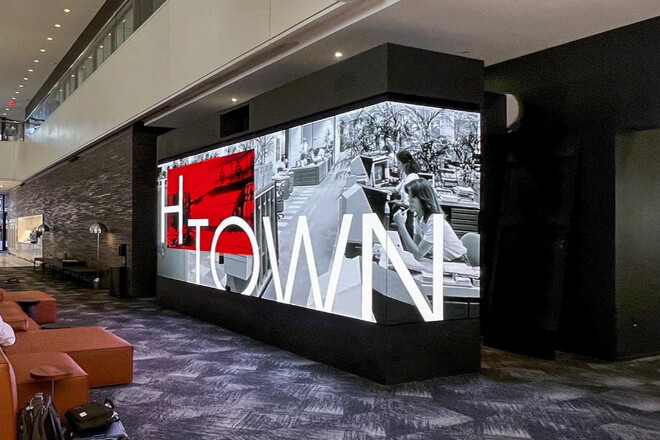
Walking into many corporate lobbies these days, you’ll notice a significant change—screens are no longer just for displaying information; they’re increasingly becoming an integral part of the spatial design.
Some are simple, some are stylish, and some are even integrated into the architecture, creating a memorable impression.
So, the question is, why are so many companies using LED 스크린 for these designs? And what styles are currently popular?
목차
Style 1: Minimalist Brand Image Indoor LED Screen
Many corporate lobbies are now following a clear trend—the simpler, the more sophisticated. In this style, the 발광 다이오드 표시 스크린 is often not just an “embellishment,” but the visual core of the entire space.
A common approach is to create a large LED main background wall on the front of the lobby. The image is clean and complete, without too many complex splicing structures, resulting in a very sleek look.
The content is also not overly flashy, usually featuring the company logo, brand slogan, and some very restrained dynamic effects.
Such as subtle changes in light and shadow, and slowly flowing backgrounds, making the image “a little dynamic, but not noisy.”
This design actually emphasizes a sense of proportion. Too much stillness can feel monotonous, while too much movement can feel restless.
Minimalist LED screens strike a perfect balance—they’re technologically advanced without disrupting the overall ambiance.
Upon entering the lobby, the brand is immediately visible, free from unnecessary distractions, making it easily memorable.
Moreover, these large screens possess an inherent “aura.” Their size and clean display naturally make the space feel more open and layered.
Especially in lobbies with high ceilings, an entire LED wall creates a more cohesive and visually impactful space—not flashy, but stable.
It’s easy to understand why this style is so common in tech companies and internet enterprises.
These companies typically aim to convey a professional, rational, and technologically advanced brand image, which minimalist LED screens amplify—simple yet powerful.
In short, minimalist LED displays are a form of understated yet impactful expression.
Instead of relying on complex designs to attract attention, clean visuals and stable visual output make the brand itself the focus, and it doesn’t feel outdated even after prolonged viewing.
Style 2: Curved or Surface LED Screens
If minimalist large screens emphasize “stability” and “cleanliness,” then curved or surface LED screens offer a more “flowing” and “futuristic” feel.
This design doesn’t just treat the screen as a flat surface hanging on the wall; it integrates directly into the architectural structure, making the screen itself a part of the space.
A common approach is to make the LED screen a curved wall surface, or to create a wraparound design around pillars or corners.
In this way, the image is no longer a “flat display,” but rather has extension. As content flows on the screen, it extends along the curve, looking more natural and layered.
This continuous image effect makes the entire space feel more “alive.” For example, a dynamic background slowly extending from one side to the other.
Or light and shadow flowing on a curved surface, makes the space feel like it’s “breathing,” rather than static.
Compared to traditional flat screens, this visual experience is more immersive and leaves a stronger impression.
This design is particularly common in the lobbies of some technology company headquarters.
It inherently possesses a strong sense of futurism and design, perfectly aligning with the image that technology companies want to project—innovative, cutting-edge, and imaginative in space.
Upon entering, people don’t just see a screen, but enter a more holistic visual environment.
Of course, this curved design also places certain demands on the content. The visuals usually need to be customized to the screen structure.
Such as incorporating extended animations and flowing visual effects, to fully utilize the advantages of the curved screen, rather than simply “pasting” flat content onto it.
In short, curved or curved LED screens are more about “shaping space,” not just displaying content.
They transform the screen from a tool into an integral part of the spatial design, making the entire lobby look more dynamic and memorable.
Style 3: Transparent LED Curtain Wall Screen
Transparent LED curtain wall screens have become increasingly common in corporate lobbies in recent years, especially in office environments with abundant glass and a transparent layout.
Its biggest advantage is that it displays content without obstructing the view or light.
It’s typically installed on glass curtain walls or near large floor-to-ceiling windows, creating a “dynamic facade” with visuals from the outside.
While allowing for continued views of the surrounding landscape and minimal impact on natural light from the inside.
This creates a unique feel; the image appears to “float” on the glass, rather than being a single, heavy screen.
This design is particularly suitable for modern open-plan office buildings. Many companies now desire a more open and natural work environment, and traditional screens can easily “close off” the space, making it feel oppressive.
Transparent LED screens can enhance visual expression without compromising this sense of openness, allowing the space to be both content-rich and light.
It also has its own characteristics in content presentation. Because of its transparent structure, the images are usually not overly dense.
But rather simple and rhythmic, such as brand animations, visual graphics, or lightweight video content.
This ensures clarity without compromising the overall visual experience.
From the outside, this type of curtain wall screen can also showcase brand image, especially at night.
When the screen is illuminated, it easily becomes a visual highlight of the building, making the entire building more recognizable.
Simply put, a transparent LED curtain wall screen is more like a “lightweight display method.”
It doesn’t take up space but increases expression, adding a dynamic visual experience to the lobby while maintaining its openness.
Style 4: Three-Dimensional LED Screens
If traditional flat screens seem a bit “too conventional,” then three-dimensional LED screens offer a more personalized option.
They are no longer limited to square shapes but, through irregular designs or three-dimensional structures, transform the screen itself into a visual installation.
These screens may be folded, multi-angled, or even have a three-dimensional floating structure, looking more like a work of art than just a device for displaying content.
Upon entering the lobby, people are easily attracted by this “non-standard form” design because it breaks everyone’s conventional perception of screens.
Three-dimensional LED screens also offer more room for creative content presentation.
For example, combining images from different angles can create a “spatial displacement” effect.
Or using variations in light and shadow can make the screen appear more layered and deep. This visual effect is often more impactful and easier to remember.
This style is particularly suitable for showcasing a brand’s creative capabilities or technological attributes.
Compared to traditional screens, it’s more about “expressing an attitude,” telling visitors that the brand is thoughtful, design-conscious, and more willing to try new things.
Simply put, three-dimensional LED screens are not just about displaying content, but about spatial expression.
They transform the lobby from a mere functional space into a visually striking and engaging place that leaves a lasting impression.
5. Conclusion
Ultimately, the role of LED displays in corporate lobbies has long since moved beyond being just a “playing tool”; it’s become a means of brand expression.
Whether adopting a minimalist approach or using curved, transparent, or three-dimensional designs, the goal is to make the space more impactful and the brand more memorable.
Choosing the right style is essentially helping a company make a good first impression, and this impression often lingers for a long time.
Finally, if you would like to learn more about LED displays, 우리에게 연락해주세요.
 English
  Español
  简体中文
简体中文  Français
  日本語
日本語  한국어
한국어  العربية