
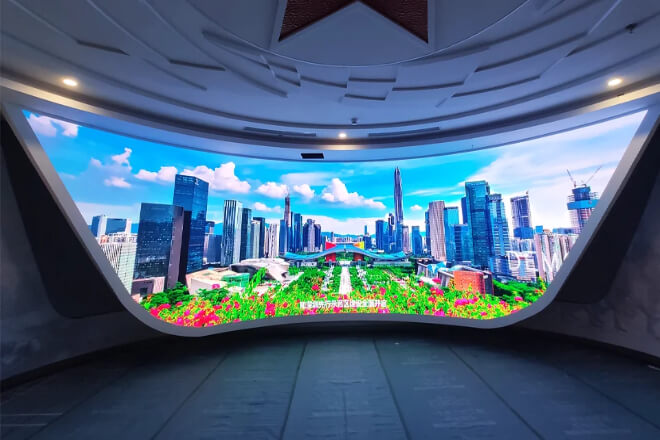
In the past two years, a visit to a sales office has revealed a significant change: LED displays are becoming increasingly common.
Whether it’s a giant screen covering an entire wall at the entrance, a video looping floor plans in the lobby, or even large-screen advertisements on the exterior of commercial complexes, they have almost become standard equipment for real estate promotion.
The reason everyone is using them isn’t just following the trend, but because they are genuinely effective.
First, the visual impact of LED screens is simply too strong. Competition in the real estate market is fierce, and whether a project can grab people’s attention at first glance largely determines whether there’s an opportunity to tell a story later.
고화질 명도, dynamic images, and exquisite animations are all more likely to capture a passerby’s attention than a static poster.
Especially in areas with high traffic and pedestrian flow, the effect of a large screen lighting up is immediate.
Secondly, property information changes too rapidly, and LED screens can keep up perfectly.
Today there’s a discount, tomorrow a different promotion; one day they’re advertising townhouses, the next they might be promoting apartments.
Traditional materials need to be completely remade every time they’re changed, while LED screens can be updated in minutes with just a backend update. Developers save time, and customers always see the “freshest” information.
Another crucial point: LED screens are suitable for various scenarios. They can be straight, curved, pieced together to form walls, hung on pillars, and even used as backdrops.
Whether it’s a sales office, model apartment, commercial plaza, or city center, wherever a display is needed, a suitable way to place the screen can be found. Therefore, it covers far more scenarios than traditional advertising, naturally making it more popular.
At the same time, the technological feel brought by large screens also elevates the overall level of property development. Nowadays, homebuyers not only look at the house itself but also at the project’s “image.”
A modern and visually sophisticated sales office naturally makes people feel that the project is more reliable and of higher quality. LED screens can create this atmosphere, so developers naturally prefer to use them.
Moreover, modern LED screens are no longer just for “playing” content; they can also be “interactive.”
Some people enjoy clicking on floor plans to view 3D animated images on the large screen, others prefer scanning QR codes for more details, and there are even interactive features that allow customers to participate in the presentation.
The more fun and visually appealing the presentation, the longer customers will stay, making it easier to follow up with sales.
Therefore, the large-scale use of LED screens in the real estate industry is a very practical result: they are attractive, easy to modify, and easy to use, while also enhancing the overall image and experience.
For developers, costs are more controllable; for customers, information is clearer—both parties benefit. This is why it has gone from a “novelty” to a “standard feature.”
If technology continues to advance in the future, LED screens will only become more important in real estate advertising.
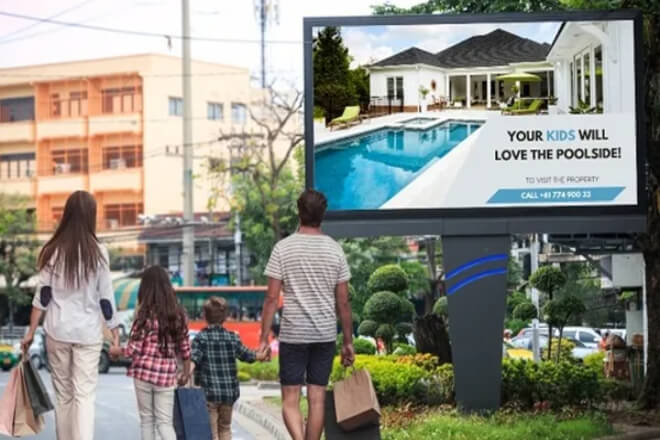
In real estate advertising, LED displays are quietly becoming a “secret weapon” for attracting attention.
Imagine walking to the entrance of a sales office and seeing a huge high-definition screen playing aerial panoramic views of the property.
3D walkthroughs of floor plans, and the surrounding environment and living atmosphere vividly presented before your eyes.
Compared to traditional posters or light boxes, dynamic visuals allow users to instantly grasp the overall layout of a project, leaving a lasting impression even within seconds.
뿐만 아니라, LED screens can bring the advantages of a prime location to life. At the property development, screens display scrolling information about surrounding amenities, transportation routes, schools, and commercial areas.
Allowing customers to intuitively experience the convenience of daily life before even viewing the property.
Compared to simple verbal introductions or brochures, this method is more direct and leaves a clearer impression on customers, as if they are experiencing the entire community’s lifestyle in advance.
LED displays are also flexible in terms of events and promotions.
Opening discounts, limited-time offers, or lucky draws can be updated instantly, providing customers with the latest information as soon as they arrive on-site.
Compared to the printing and posting process of traditional advertising, this real-time updating not only saves time and effort.
But also quickly attracts the attention of target customers, maximizing the dissemination effect of marketing information in the shortest amount of time.
Especially at night, the allure of LED screens becomes even more pronounced.
Bright, vibrant images blend seamlessly with the building facades, becoming the most eye-catching visual focal point in the night sky.
The entire development thus “glosses” at night, increasing its visibility and projecting a sense of modern technology and sophistication, leaving a lasting first impression on potential buyers.
Finally, LED displays can seamlessly integrate with online marketing. QR codes, social media entry points, or event links can be displayed on the screen.
Allowing customers to easily scan and schedule viewings, participate in interactive activities, or obtain more information.
This “screen + social” approach ensures that real estate advertisements are not only seen but also directly converted into potential customers, achieving efficient online-offline integration.
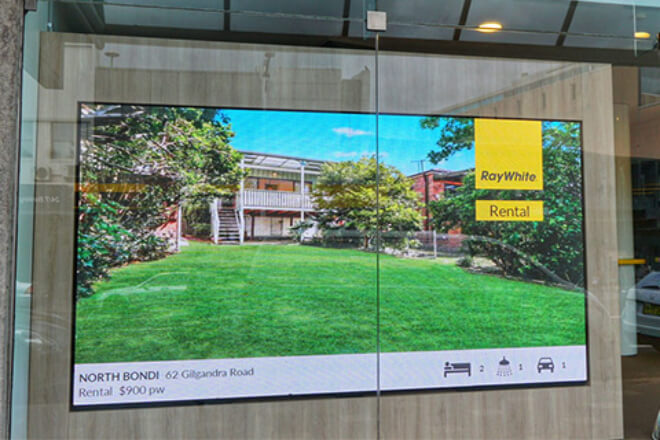
1) Residential Projects
In residential developments, homebuyers are most concerned about the apartment layout and living environment.
For example, when you enter a sales office, an LED screen plays a video of a model apartment, allowing you to almost “walk” into each room and see the balcony lighting and living room layout.
The screen can also display animations showcasing the community’s planning, including greenery, sports facilities, a children’s playground, and parking, allowing customers to mentally visualize the living environment.
Compared to traditional brochures or models, this dynamic display is more intuitive and easier to engage people.
2) Commercial Real Estate
Commercial real estate projects typically involve high foot traffic and diverse information.
예를 들어, 쇼핑몰, LED screens can display advertisements for shops currently seeking tenants, as well as scrolling information about participating brands and promotional activities.
If customers are walking through the mall, they can see which stores are having discounts and where the event entrances are by looking at the screens. This not only benefits customers but also helps merchants quickly attract foot traffic.
Screens can also guide pedestrian flow, for example, by displaying the location of dining areas, cinemas, or children’s areas, making the entire space more organized.
3) Urban Complexes
In urban complexes, large screens often become landmark visual focal points.
For example, at night, when a large LED screen plays dynamic advertisements or artistic videos, the entire building lights up instantly, attracting the attention of passersby.
Such screens not only increase exposure but also make the complex more recognizable in the city, giving it a technological and modern feel, while also conveying a sophisticated commercial and cultural atmosphere.
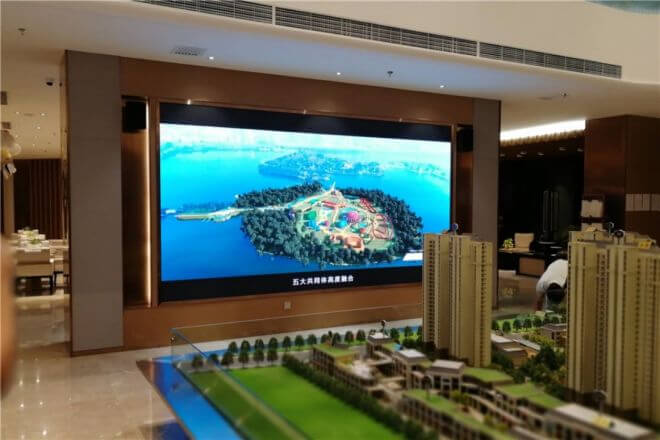
4) Sales Center
Traditional sales centers often use scale models to display apartment layouts, but static models often fail to provide customers with a complete understanding of the community’s layout.
Many sales centers now use large LED screens instead of scale models. Customers can touch-operate to view different apartment types, floors, and viewpoints, and even participate in interactive games or promotional activities.
For example, clicking on the screen allows you to see the view from the rooftop balcony or view the community’s nighttime scenery. This experience is more intuitive and engaging than viewing a scale model.
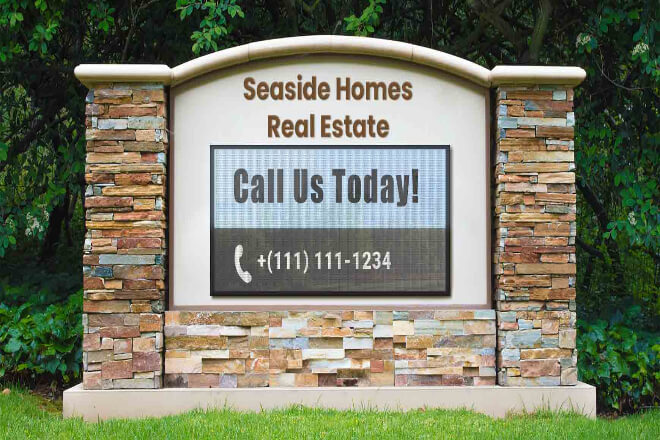
In real estate advertising, the selection and design of LED displays are actually more complex than you might imagine.
First, consider 명도 그리고 해결. If the screen is unclear during the day and glaring at night, the display effect is greatly diminished.
For example, once when I walked into a sales center, the screen was playing aerial videos of the property and apartment layout walkthroughs.
Even in direct sunlight, the living room, balcony, and greenery were clearly visible, giving the feeling of “I’ve already stepped into my future home.” This is the charm of high brightness and high resolution.
Next, consider the installation location and 시야각. LED screens should be placed in visible locations, such as along main roads, at the entrance of sales offices, or along commercial streets.
I recall a project where a screen was installed in the center of a plaza.
Passersby could see the property’s animations and surrounding amenities without stopping, and even customers in nearby coffee shops couldn’t help but glance at it.
This “attracting passersby” effect is something no ordinary poster can achieve.
The screen’s structural design is also crucial. It must blend seamlessly with the building’s facade, ensuring both aesthetics and safety.
For example, a large screen in a residential development not only displays floor plans and landscape videos but also integrates perfectly with the building’s facade.
When the lights are on at night, the entire development resembles a “glowing work of art,” eye-catching and sophisticated, while also being windproof, rainproof, and earthquake-resistant, eliminating safety concerns.
The control system and content management platform are the unsung heroes behind this.
Some screens can be remotely operated, switching between promotional information, opening events, or floor plan videos within minutes, ensuring customers see the latest content.
Imagine having real-time updates on opening day event information; this flexibility significantly improves on-site sales efficiency, far more convenient than traditional models or posters.
Finally, don’t forget to comply with city advertising regulations. Different cities have regulations regarding the size, brightness, and content displayed on outdoor screens.
I recall a project where, without prior approval, it risked fines due to a screen being too bright or its location not meeting requirements.
Therefore, considering regulations during design and selection is crucial for smooth advertising campaigns and avoiding complications.
In summary, choosing the right LED screen, placing it correctly, designing it appropriately, operating it flexibly, and adhering to legal regulations can greatly enhance the effectiveness of real estate advertising.
A good screen not only ensures information is seen but also provides customers with an immersive experience, potentially even stimulating their interest in purchasing.
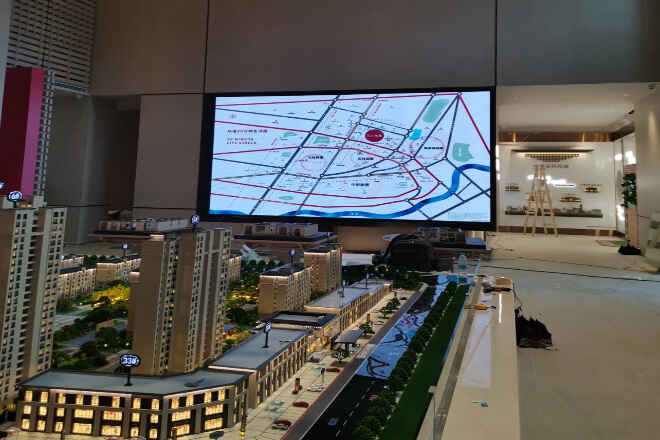
In real estate marketing, LED displays are not just a promotional tool but also a marketing asset that delivers a real return on investment.
Firstly, they can significantly increase brand exposure and customer conversion rates.
For example, large screens at the entrance of sales offices or along commercial streets display high-definition dynamic images, ensuring that passersby and potential homebuyers notice the property information at first glance.
This is more effective at capturing attention than traditional static posters and guiding customers into the sales center for more details.
Secondly, LED screens support dynamic content updates, significantly extending the lifespan of advertising content.
Opening events, special offers, and unit displays can all be updated in real time, eliminating the need for repetitive promotional materials.
Compared to traditional advertising, this method not only saves costs but also keeps marketing information “up-to-date,” maximizing return on investment.
Furthermore, LED displays can support collaborative playback by multiple advertisers, enabling revenue sharing.
Besides promoting their own properties, the screens can be rented out to other brands or businesses during off-peak hours.
Generating additional revenue for the real estate project and transforming the screen into a directly economically valuable asset.
More importantly, LED screens help projects create a differentiated competitive advantage.
In a market saturated with similar properties, a technologically advanced and visually impactful LED screen not only makes the project appear modern.
And high-end but also leaves a unique impression on customers, strengthening their purchasing decisions.
Finally, LED displays, in line with the development trend of digital media, can achieve long-term appreciation of advertising assets.
With the addition of interactive functions, online linkage, and big data analysis, the screen is not only a carrier of information but also a digital entry point in the project marketing system, making every display potentially lead to customer conversion and value returns.
 English
  Español
  简体中文
简体中文  Français
  日本語
日本語  한국어
한국어  العربية