
소개
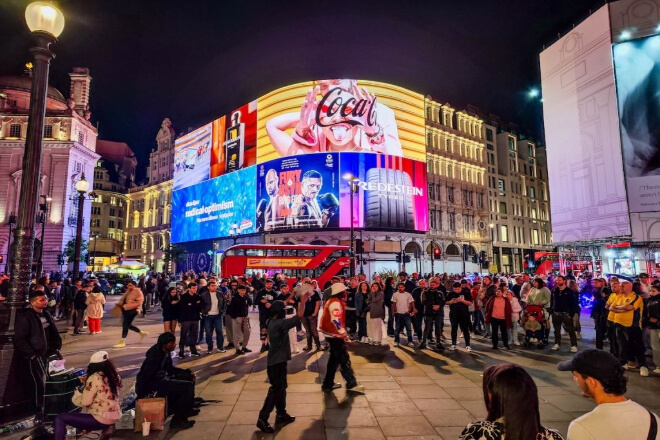
In today’s increasingly sophisticated advertising landscape, the same content presented in a different way can yield drastically different results.
LED 디스플레이, with their high exposure and strong visual impact, are increasingly being used by brands for offline advertising.
However, the true determinant of effectiveness is not simply whether or not an ad is displayed, but rather whether the content, context, and strategy are well-matched.
When these factors are combined appropriately, LED displays can transform from mere “display tools” into a vehicle for amplifying advertising impact.
목차
Method 1: Enhancing Advertising Appeal Through Content Design?
In LED display applications, many focus on “how big or bright the screen is,” but what truly determines advertising effectiveness is often the content displayed on the screen itself.
First, the image must be concise and highlight key information. The viewing environment for LED screens is typically one of “quick scanning,” not “focusing on details.”
If there is too much information or a chaotic hierarchy, users can easily skim through it without remembering anything. Simplicity and focus are far more memorable.
Second, dynamic content is generally more advantageous than static displays.
Compared to a static image, appropriate dynamic effects can more easily grab attention, making the image “stand out” among a multitude of visual information.
Of course, more complexity isn’t always better; the dynamics should serve the message, not overshadow it.
Furthermore, visual impact is key to a good first impression. In the limited time users spend viewing the content, color contrast, rhythmic changes.
And composition all influence whether a user is willing to take a second look. Good content often makes a strong first impression.
Finally, the content needs to match the viewing environment and distance. In scenarios viewed from a distance, fonts, contrast, and visual elements need to be clearer.
In close-up scenarios, information density and detail can be appropriately increased.
Simply put, an LED screen is not a “container of content,” but a “content amplifier.” With correct content design.
The screen truly begins to realize its value; with poor content design, even the best equipment is just a backdrop.
Method 2: Optimizing Ad Exposure Through Playback Strategies?
Having a good LED screen and engaging content isn’t enough—playback strategies are crucial for ensuring ads are truly “seen.”
First, content should be flexibly switched according to time periods.
Morning rush hour, lunch break, and evening rush hour – different time periods have different demographics.
Playing content that matches the scene and the audience’s habits is crucial to maximizing actual message reach.
Secondly, adjust the ad placement rhythm according to peak traffic times. When crowds are high, focus on promoting key products; when fewer people are around, display detailed information or interactive content.
This not only avoids wasting exposure opportunities but also allows ads to reach potential customers more precisely.
Furthermore, rotation or time-slot placement strategies are also powerful tools for improving effectiveness.
Rotating different content covers more information and avoids viewer fatigue, keeping the screen “fresh.”
Finally, avoid information overload. Too much information on one screen will overwhelm viewers and may even cause them to miss key points.
Simplicity, clarity, and ease of understanding are the core principles of a playback strategy.
In summary, a playback strategy not only makes content “bright” but also “memorable.”
Mastering the rhythm and sequence allows your LED screen to act like a shrewd “advertising director,” helping you maximize the value of every exposure.
Method 3: How to use LED displays to enhance ad interaction and conversion?
If an LED screen merely “plays content,” its value is only half realized. The real difference lies in its ability to engage users, get them to stop and participate, and even facilitate conversions.
First, it must have the ability to “get them to take a second look.” Through dynamic rhythms, visual changes, or highlighting key information, guide users to naturally linger for a few seconds.
Often, the starting point for conversion isn’t a click, but that instant of being “attracted.”
Second, make interactions smoother. For example, combine QR codes, limited-time events, or guided paths, minimizing the cognitive load between “seeing” and “participating.”
The simpler and more direct, the higher the probability of participation.
Third, integrating with online channels enhances the overall effect. The content on the screen can be synchronized with mini-programs, social media, or membership systems.
Allowing users to move naturally between online and offline experiences, rather than remaining stuck at a single touchpoint.
Finally, don’t overlook trackable conversion design. Whether it’s scanning a code, clicking, or visiting a store.
If these actions can be recorded and analyzed, content and delivery methods can be continuously optimized, making the value of each screen measurable.
In short, LED screens are not just “display tools,” but more like a conversion portal that guides, interacts, and helps collect feedback.
The difference between a user “glancing at it” and “participating” often lies in this one design step.
Method 4: Amplifying Advertising Effectiveness Through Location and Installation
Often, the effectiveness of advertising doesn’t entirely depend on the content itself, but rather on “where and how it’s placed.”
Location and installation often determine whether users can see it, see it clearly, and even whether they want to look at it.
First, the installation height needs to naturally match eye level. If the screen is too high or too low, viewers may inadvertently “miss” it.
Ideally, users should be able to comfortably view it without consciously looking up or down while walking or standing still.
Second, the screen size must match the 시거리. A large screen at close range can create a feeling of oppression; a small screen at a distance makes effective recognition difficult.
Balancing size and distance essentially solves the problem of “seeing” and “seeing clearly.”
Furthermore, you can fully utilize shop windows or spatial structures to enhance visibility.
For example, utilizing glass facades, corner locations, or open spaces allows the screen to be seen from multiple angles.
Thus expanding its exposure range rather than serving only pedestrian traffic from a single direction.
Finally, the installation method must also consider integration with the overall environment.
If the screen harmonizes with the space design, it will feel more like an integral part of the space than an “extra device.”
Conversely, it may become a visual distraction, weakening the overall experience.
Simply put, location and installation method are not just “placement issues,” but rather amplifiers of exposure efficiency.
Choosing the right location is what truly makes the screen visible; a well-designed layout naturally enhances advertising effectiveness.
5. 결론
The value of LED displays lies not only in being “visible,” but also in “engaging” and “allowing people to linger.”
From content design to playback strategy, from location selection to continuous optimization, every step affects the final advertising performance.
In other words, the LED display itself does not determine the effect, but with the right strategy, it can amplify the effect.
마지막으로 LED 디스플레이에 대한 자세한 내용은 우리에게 연락해주세요.
 English
  Español
  简体中文
简体中文  Français
  日本語
日本語  한국어
한국어  العربية